
Bryde Whale Spotted in Dubai Marina
Last updated: October 14, 2026
4 min read
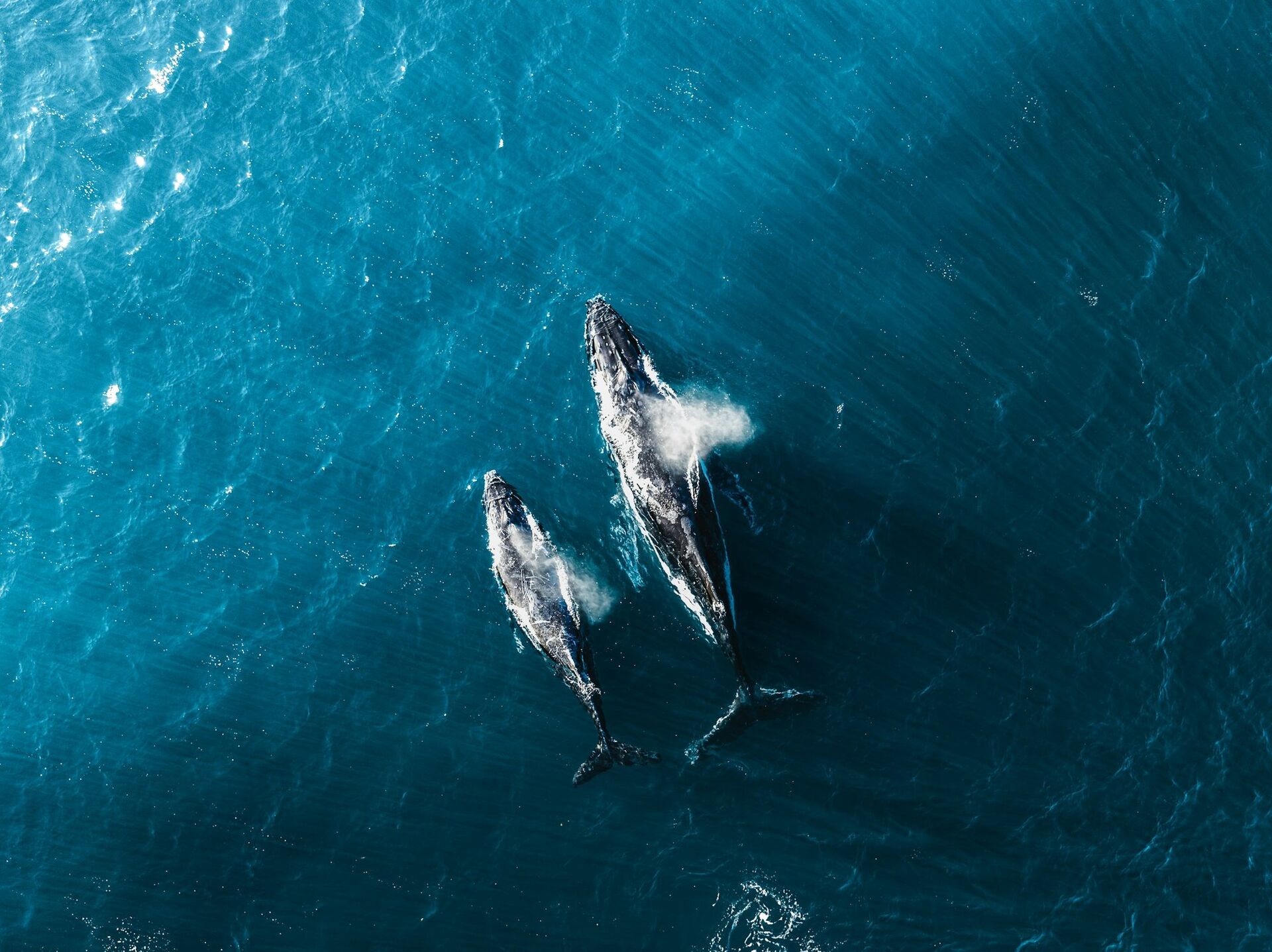
A whale surfacing in the middle of Dubai Marina is the kind of sight most residents never expect to see. In January 2022 video circulated of what looked like a Bryde’s whale gliding past the marina towers, shared by Sheikh Hamdan bin Mohammed, the Crown Prince of Dubai. Whales of any kind are an unusual visitor to these waters, and a Bryde’s whale in a working harbour is rarer still.
Photo: Jonathan Hsu via Unsplash
What happened in the marina
The footage, originally filmed by a Dubai boat crew, showed a large baleen whale rolling at the surface inside the marina basin. Authorities planned a wellness check to confirm the species and make sure the animal was healthy and not distressed by the enclosed, boat-heavy water. There are no whale watching boats operating inside Dubai Marina, so a sighting there is pure chance rather than something a tour can promise. Most documented Bryde’s whale activity in the United Arab Emirates comes from marine surveys further west, including work by the environment agency in Abu Dhabi.
What is a Bryde’s whale?
The Bryde’s whale, pronounced roughly broo-dus, is named after Johan Bryde, the Norwegian consul to South Africa who helped set up the country’s first modern whaling station. It is a baleen whale and a rorqual, the same group that includes the blue whale and the humpback. In that group it is a middleweight: bigger than the minke and Omura’s whales, smaller than the sei, fin and blue. Adults measure roughly 12 to 15.5 metres (about 39 to 51 feet) and weigh somewhere between 12 and 25 tonnes, with females typically larger than males and the inshore form tending to be smaller than the offshore form.
One feature makes a Bryde’s whale easy to identify if you get a clear look at its head: three parallel ridges running from the blowholes to the tip of the snout. The sei whale, which it is most often confused with, has a single median ridge. Scientists treat the Bryde’s whale as a complex of closely related forms rather than a single tidy species, and research is still untangling it. The Gulf of Mexico population, for example, was described as a separate species, Rice’s whale, in 2021.
Why warm water suits them
Unlike whales that migrate thousands of miles between cold feeding grounds and warm breeding grounds, Bryde’s whales stay in warm temperate and tropical water year round. They favour seas of roughly 16 to 22 degrees Celsius and are found between about 40 degrees north and 40 degrees south. The Arabian Gulf sits comfortably inside that band, which is exactly why a Bryde’s whale can turn up off the UAE coast at all.
What they eat, and why a sighting is good news
Bryde’s whales are big eaters, with daily intake estimated in the hundreds of kilograms. Their diet is varied for a baleen whale and includes:
- Krill and other small crustaceans
- Shrimp
- Schooling fish such as anchovies, sardines, herring and mackerel
- Occasionally small squid
A whale lingering near the UAE coast is therefore a quiet signal that the water holds enough fish and krill to make the visit worthwhile. In Abu Dhabi waters, researchers have recorded several Bryde’s whales gathering to feed together, reported as the first documented case of collective feeding by whales in the Arabian Gulf. A healthy prey base supports the whole chain of marine life, not just the whales.
How Bryde’s whales hunt
Bryde’s whales feed using the rorqual lunge, the same explosive technique their blue and humpback relatives use. The whale accelerates into a tight ball of fish or krill with its mouth wide open, the pleated grooves along its throat balloon outward to take in a huge volume of water, and the baleen plates strain the prey as the water is pushed back out. Unlike the more predictable behaviour of some larger whales, Bryde’s whales are known for sudden direction changes and short, erratic dives, which can make them harder to follow during a survey. They typically surface to breathe four to seven times before a longer dive, and they often appear and vanish quickly, exactly the kind of brief, surprising encounter that played out in Dubai Marina.
Conservation status
The International Union for Conservation of Nature lists the Bryde’s whale as Least Concern overall, which reflects a reasonably wide global range. That headline figure hides real local pressure. Bryde’s whales were targeted by commercial and so-called scientific whaling in the twentieth century, and today the main threats are ship strikes, entanglement in fishing gear, ocean noise and plastic ingestion. Because they favour warm coastal water that overlaps with busy ports and shipping lanes, including the approaches to the Gulf, collisions with vessels are a particular concern. Rice’s whale, the Gulf of Mexico species split off from the Bryde’s complex in 2021, has a current estimate of about 50 animals from 2017 and 2018 surveys and is one of the most endangered whales on Earth.
When and where Bryde’s whales appear in the UAE
Sightings in the UAE cluster around the cooler winter months, when fish move and concentrate in ways that draw large predators inshore. They remain genuinely uncommon, which is why each confirmed sighting tends to make local news. The wider region also holds the Arabian Sea humpback whale, a population of only around 80 animals that is the only humpback population in the world known not to undertake a long migration. It is centred on the coast of Oman but has been recorded in the Gulf of Aden, the Persian Gulf, and off Pakistan and India. That makes the Gulf and Arabian Sea an unexpectedly interesting place for whales, even though the waters are warm and busy with shipping.
The takeaway
A Bryde’s whale in Dubai Marina is a one-off treat rather than a sign of a new resident population. The right response is to keep boats at a respectful distance, let marine authorities do their wellness check, and enjoy the reminder that even a heavily developed coastline can still surprise you. For a look at how Bryde’s relatives interact with other ocean predators, see our piece on humpback whales and killer whales.
Updated 14 September 2026: updated the Rice’s whale estimate.



A Bryde’s whale in Dubai Marina is amazing.
Didn’t know the species was named after a person.
Nice to see whale sightings shared in that part of the world.