
Entangled Humpback Whale in Maui is Freed
Last updated: July 28, 2026
4 min read
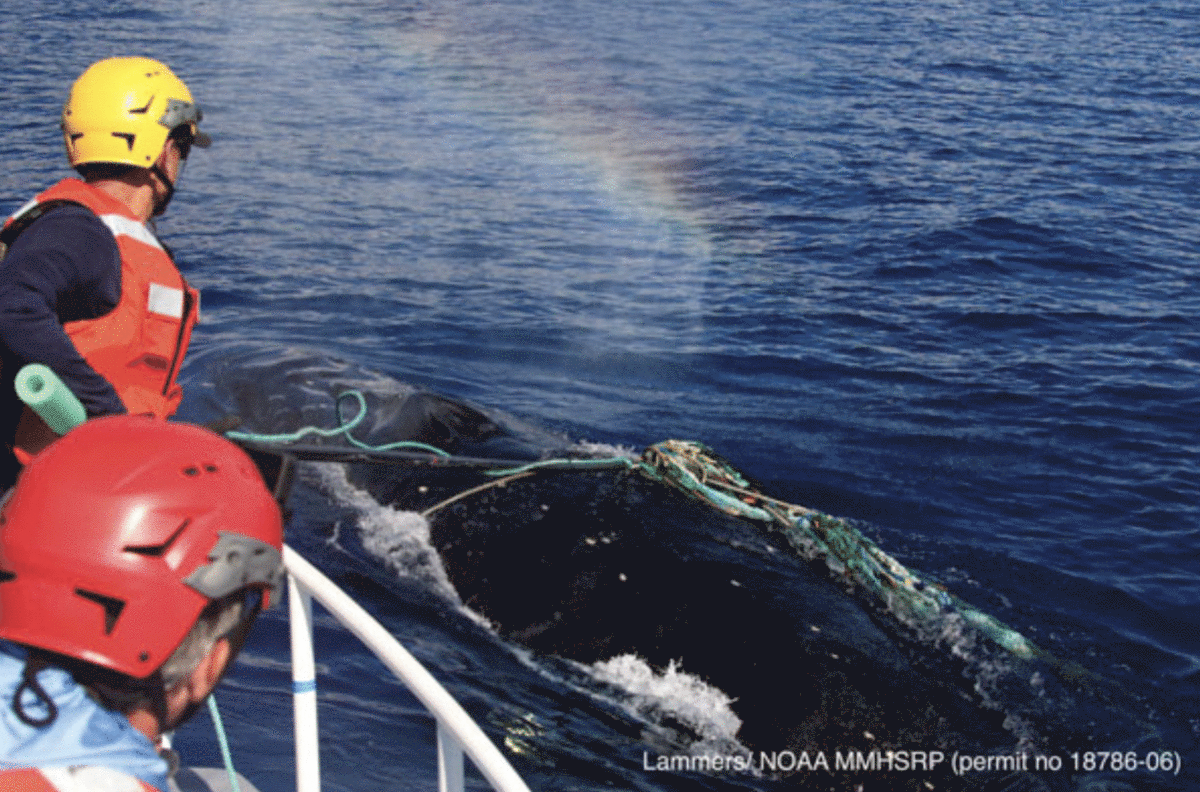
On 14 February 2022, off Lahaina Harbour on Maui, a response team spent six hours working a mother humpback free of more than 550 feet of line and marine debris wrapped tightly around her head. She had been travelling with her calf and a male escort. Once the gear dropped away, mother and calf settled and rested together.
How the rescue unfolded
The whale was first reported on the Saturday by the tour vessel Napali Explorer III. Two days later the crew of another tour boat, Trilogy V, sighted the same mother and called in her position. That brought out the Pacific Islands Large Whale Entanglement Response Team, a NOAA-coordinated, multi-agency group trained for exactly this work. On the water that day were staff from the Hawaiian Islands Humpback Whale National Marine Sanctuary, Ultimate Whale Watch, US Coast Guard Station Maui, the NOAA Office of Law Enforcement, the NOAA Corps, Cardinal Point Captains, and the University of Hawaii Marine Mammal Research Program.
The gear was concentrated around her head and in front of her pectoral flippers, restricting her movement. It turned out to be about a dozen different types of line and netting, including 30 feet of heavy rope more than an inch and a half thick. The team did not get in the water. Disentanglement is done from a small boat with a long pole fitted with a specialised cutting knife. Working alongside a moving whale, the responders cut through the rope until the mass of debris finally sank. Responders normally want the gear recovered so it can be examined and traced back to a fishery, but the heaviest of it sank out of reach, so they documented what they could instead. After six hours, she was loose, with only line scars left near her mouth.
What resting looks like for a humpback pair
Once the mother was free, observers saw the calf tuck up under her chin. That posture is normal resting behaviour for a humpback mother and calf, and it matters here because an entangled, exhausted mother cannot rest or nurse properly. Removing the gear gave both animals a far better chance of finishing the season in good condition.
Why Maui is full of humpbacks in winter
This rescue happened in one of the most important whale nurseries on Earth. The Hawaiian Islands Humpback Whale National Marine Sanctuary covers roughly 1,370 square miles of warm, shallow water in five separate areas, and the channels around Maui are its heart. NOAA estimates that up to 12,000 humpback whales, more than half of the North Pacific population, use Hawaiian waters from about November to May.
They come to breed, give birth and nurse, not to feed. The journey from the cold, krill-rich feeding grounds off Alaska runs to about 3,000 miles, and NOAA reports that some whales cover it in as few as 28 days. While in Hawaii they eat nothing at all, living off the blubber laid down in the north. That is what makes entanglement so dangerous in these waters: a mother dragging gear is burning energy she cannot replace until she gets back to Alaska.
The team behind the rescue
The Pacific Islands Large Whale Entanglement Response Team is part of a wider network NOAA Fisheries coordinates across United States waters. Crews follow strict protocols because the work is genuinely hazardous. A frightened humpback can weigh up to about 40 tonnes and throw a tail fluke wider than a small car.
Their core technique is borrowed from whaling and turned to the opposite purpose. Responders attach buoys or floats to the trailing gear so the whale tires and stays near the surface, then make precise cuts with pole-mounted blades until the animal swims clear of the last loop. Hawaii’s winter sanctuary, with thousands of humpbacks packed into a relatively small set of channels, is one of the busiest places in the Pacific for that work.
The whales that do not get a happy ending
This story ended well and many do not. Plenty of whales are still towing rope, net and other debris that nobody has spotted or reached in time. The North Atlantic right whale known as Snow Cone carried rope embedded in her upper jaw through 2021 and 2022, still gave birth off Georgia in December 2021, and covered more than a thousand miles of migration while entangled. Her calf did not survive the year. You can read more in our report on the North Atlantic right whale entangled in rope.
The lasting harm from entanglement includes:
- Constant drag that drains energy reserves, especially serious for fasting Hawaiian humpbacks
- Rope cutting into skin, flippers and the mouth, leading to infection
- Difficulty feeding when gear is caught around the head or jaw
- Drowning risk when a whale cannot surface to breathe
What to do if you see an entangled whale
The most important thing to know is what not to do. Do not approach an entangled whale and do not try to free it yourself. A frightened, struggling whale can easily collide with a small boat or a swimmer. In Hawaiian waters it is illegal to approach a humpback within 100 yards by any means, including a drone, or within 1,000 feet in an aircraft, and only permitted, trained teams may carry out a disentanglement.
If you spot a whale in trouble, keep your distance, note its location and the direction it is heading, and report it. NOAA runs a statewide marine wildlife hotline for Hawaii on 888-256-9840, and if you have no phone signal you can call the US Coast Guard on VHF Channel 16. A quick, accurate report is the most useful thing an onlooker can do, because it gets a trained crew to the animal while there is still time.


Freeing a mother with a calf alongside must be so tricky.
Good that the sanctuary has a team for this.