
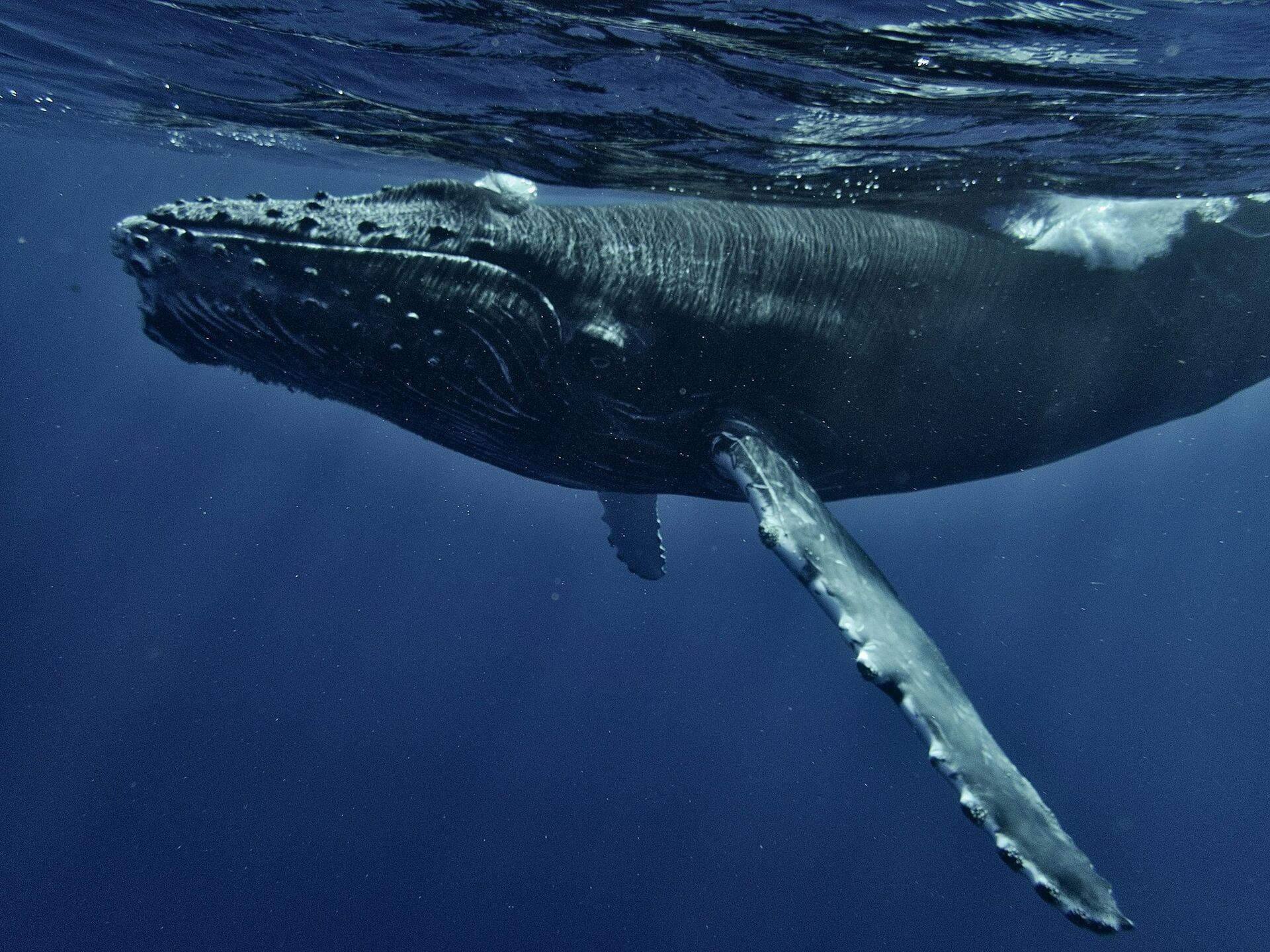
Species Profile: The Common Bryde’s Whale
Last updated: October 14, 2026
4 min read
The common Bryde’s whale is a medium sized rorqual of warm water, and one of the few large whales that never leaves the tropics and subtropics. It is also one of the most frequently misidentified, because at a distance it looks a great deal like a sei whale.
Photo: Zejulio, CC BY-SA 4.0, via Wikimedia Commons. Common Bryde’s whale breaching off Sao Paulo, Brazil.
The name Bryde covers more than one animal. The common Bryde’s whale is the larger form, found worldwide in warm temperate and tropical seas. The smaller Eden’s whale is mostly restricted to Indo-Pacific coastal waters. Taxonomists have argued over whether these are separate species or forms of one, and the names Balaenoptera brydei and Balaenoptera edeni are both still in use for them. Both are smaller than the sei whale and larger than the minke whales.
Bryde’s whales are baleen whales, filter feeders like the humpback and the blue whale. The body is slim and streamlined, dark smoky grey above with a paler underside. The clearest field mark is on the head: three parallel ridges running from the blowholes to the tip of the rostrum, where every other rorqual has only one.
They are known for erratic surfacing. They come up at irregular intervals and change direction suddenly for no reason an observer can see. They are usually alone or in pairs, though loose groups of up to about 20 gather where food is concentrated.
Dives have been recorded to about 292 metres (958 feet), typically lasting 5 to 15 minutes and rarely as long as 20.
1) Scientific name
Balaenoptera brydei, also treated by some authorities as part of Balaenoptera edeni.
2) Scientific classification
- Kingdom: Animalia
- Phylum: Chordata
- Class: Mammalia
- Order: Artiodactyla
- Infraorder: Cetacea
- Parvorder: Mysticeti (baleen whales)
- Family: Balaenopteridae
- Genus: Balaenoptera
3) Average and maximum length
Adults of both sexes off South Africa range from 13.1 metres (43 feet) to 14.4 metres (47 feet). Animals off the Japanese coast are smaller, around 11.9 to 12 metres (39 feet).
The largest individuals measured were a 15.51 metre (50.9 feet) female and a 14.56 metre (47.8 feet) male, both off South Africa. Females are slightly larger than males.
4) Average and maximum weight
Most adults weigh between 12 and 25 tonnes. The largest recorded animals reach around 40 tonnes.
5) Swimming speed
Bryde’s whales normally cruise at 1.6 to 6.4 km/h (1 to 4 mph) but can reach 19 to 24 km/h (12 to 15 mph) in short bursts.
They produce powerful low frequency calls, often described as moaning, in the range where shipping noise is loudest.
6) Interaction with humans
Bryde’s whales were not an early target of commercial whaling. They are smaller than the great rorquals and live in waters the Antarctic fleets ignored. That changed as the blue, fin and sei whale stocks collapsed and fleets moved down the size ladder to whatever was left.
Japan is the only country currently taking Bryde’s whales in numbers. It left the International Whaling Commission in 2019 and now hunts minke, Bryde’s, sei and fin whales commercially inside its own exclusive economic zone, under a quota set by its own fisheries ministry rather than by the IWC. Small artisanal hunts have historically taken Bryde’s whales off Indonesia and the Philippines. Norway does not hunt this species: its whaling is directed at North Atlantic minke whales.
The other pressures on the species are the familiar ones: ship strikes, entanglement in fishing gear, and underwater noise.
7) Reproduction
Breeding happens in any season, with a reported peak in autumn. Females produce one calf every other year after a gestation of about 12 months.
Newborns measure roughly 3.4 to 4.0 metres (11 to 13 feet). Mothers nurse for between 6 and 12 months, and calves of either sex reach sexual maturity between 8 and 13 years old.
8) Diet and hunting
They are filter feeders taking a wide range of schooling fish, planktonic crustaceans and cephalopods. Unlike the strict krill specialists, they will switch prey readily depending on what is available.
Feeding techniques include skimming at the surface, lunging, twisting through bait balls, and blowing bubble nets. Bryde’s whales are also unusually inquisitive and will often approach or swim alongside boats.
9) Alternative names
- Tropical whale
- Sittang whale
- Nitari-kujira, the Japanese name, meaning look-alike whale
10) Population and conservation status
The population is not precisely known but is thought to be in the region of 90,000 to 100,000 animals worldwide, around two thirds of them in the Northern Hemisphere.
The IUCN Red List assessed Bryde’s whale as Least Concern in 2018. That is a change from its earlier Data Deficient listing and reflects better survey coverage rather than a recovery, so the status should be read as “no evidence of decline” rather than “doing well”.
11) Where the name comes from
The whale is named after Johan Bryde, the Norwegian consul to South Africa who helped establish the country’s first modern whaling station, at Durban in 1909.
Bryde’s whales are closely related to sei whales and genuinely hard to tell apart at a distance, which is why Japanese whalers called them nitari-kujira, the look-alike whale. The three head ridges are the reliable way to separate them: a sei whale has one.
12) Distribution and habitat
This is the only baleen whale that spends the entire year in tropical and subtropical water. It does not make the long polar migration that defines the lives of humpbacks, blue whales and grays.
It is regularly recorded in parts of the Atlantic, Pacific and Indian Oceans, including the Gulf of California, and off Peru, Ecuador, Chile, New Zealand, the Philippines and Indonesia.
Updated 14 September 2026: added fin whales to Japan’s current commercial hunt.




Bryde’s whales seem curious about boats from what I’ve read.
The Bryde’s whale names confuse me every time.
Interesting that they stay in warmer water than most big whales.