
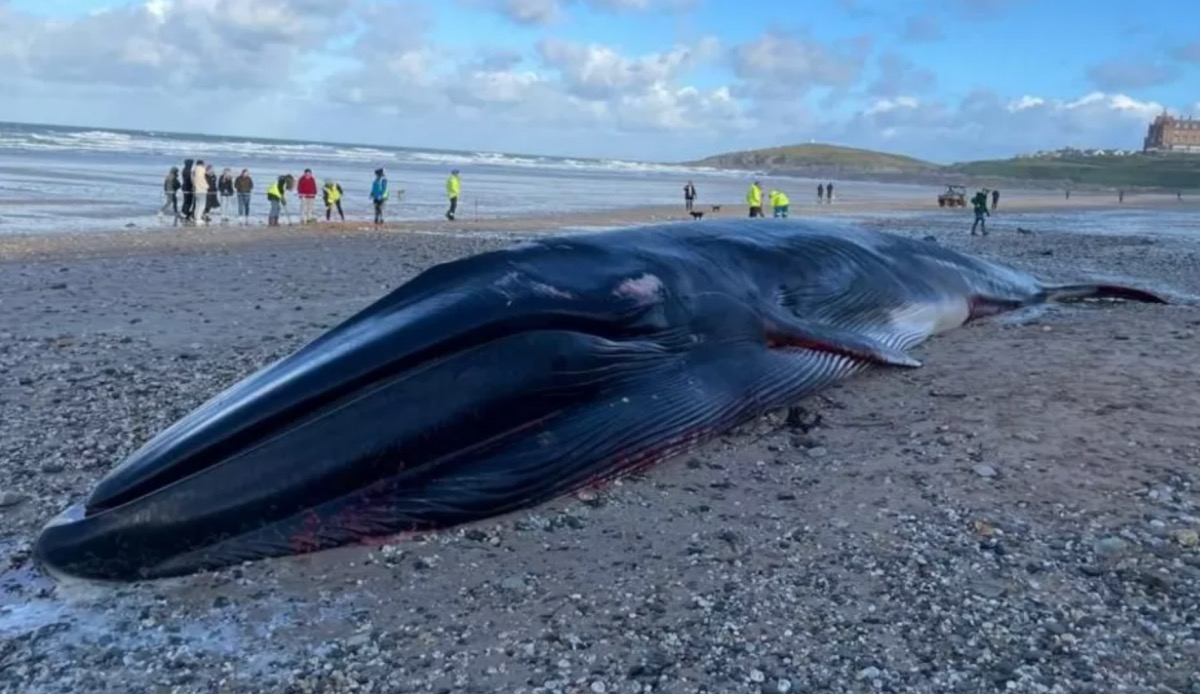
Fin Whale Washed Up on Cornwall Beach
Last updated: October 14, 2026
4 min read
A 16 metre female fin whale washed up dead on Fistral Beach at Newquay, in Cornwall, England, found at dawn on 15 November 2023. She was a juvenile, sick and badly malnourished, and she was the second fin whale to come ashore dead in Cornwall that year. This page keeps the account of that stranding and builds it into a guide to the fin whale: the second largest animal alive today, why one would die on an English beach, and what the examination found.
The Fistral Beach stranding
Rob Barber, director of the Newquay Activity Centre, was among the first there, on the centre’s routine dawn check of the beach. “We noticed what looked like a big, uncovered, gray rock but as the light got brighter, we could see it was a creature of some kind,” he said. “After we investigated, we found a 16-meter-long whale.” His verdict on the morning: “It’s super sad obviously, but it’s also phenomenally interesting.”
Devon and Cornwall Police cordoned off the area to keep people and dogs away from the carcass, alongside RNLI lifeguards, the coastguard and the Cornwall Wildlife Trust’s Marine Strandings Network. The whale had been seen the previous day off Towan Head, swimming in what responders described as an uncomfortable state, so it was already in trouble before it came ashore.
Anthea Hawtrey-Collier, project officer for the Marine Strandings Network, said on the day that the whale was “in a really poor nutritional state so it’s obviously not a well animal”. She added later: “It’s quite a skinny animal and there have been parasites seen on it, which usually indicate poor health.”
What the post-mortem found
A post-mortem was carried out on the beach once the council gave permission. James Barnett, a veterinary pathologist with the Cornwall marine pathology team, found severe inflammation in the whale’s brain. Later PCR testing confirmed cetacean morbillivirus, from the same family of viruses as measles, and pathologists diagnosed severe encephalitis. Pathologists put her age at about two years and recorded a thin blubber layer.
There are two reasons an examination like that cannot wait. The first is scientific: opening the animal up is the only way to separate disease from starvation, ingested plastic, an old entanglement injury or a ship strike. The second is blunter. A large dead whale fills with gas as it decomposes, and the pressure can build until the carcass ruptures. Responders in Cornwall warned publicly about that risk while the whale was still on the sand. A controlled necropsy releases the gas rather than leaving it to the tide and the crowd.
Every examined stranding feeds the UK Cetacean Strandings Investigation Programme, the long running national record of what washes up on British coasts and why.
The fin whale: greyhound of the sea
Fin whales are the second largest animal alive today, beaten only by the blue whale. NOAA Fisheries puts the maximum at 75 to 85 feet and 40 to 80 tons. The Fistral Beach whale, at 16 metres, was a juvenile well short of that.
Despite the bulk, a fin whale is built like a torpedo: slim, streamlined and heavily muscled. It is the fastest of the large rorquals, cruising at 10 to 15 km/h with bursts recorded up to about 46 km/h (29 mph), which earned it the nickname “the greyhound of the sea”. It also carries one of the odder pieces of colouring in nature. Its lower jaw is white on the right side and dark on the left. The leading idea is that the asymmetry helps the whale herd fish as it rolls and lunges through a shoal.
Fin whales are baleen whales, taking up to two tons of krill, small schooling fish and squid a day through the summer. They live 80 to 90 years, range across the deep oceans worldwide, and produce 20 hertz pulses that are among the lowest frequency sounds any animal makes, carrying enormous distances underwater.
A species still recovering
More than 725,000 fin whales were caught in the Southern Hemisphere alone between 1905 and 1976, the year the International Whaling Commission stopped the Southern Hemisphere hunt. The global commercial whaling moratorium followed and took effect in 1986.
The species is still listed as endangered under the United States Endangered Species Act. The IUCN moved it from endangered to vulnerable in 2018 and puts the global population at roughly 100,000 mature animals. Recovery is real but uneven, and fin whales still face ship strikes, entanglement in fishing gear, underwater noise, pollution, and hunting by a small number of countries.
Fin whales around Cornwall
Cornwall sits at the south west tip of England, where the productive waters of the Celtic Sea and the western English Channel meet. Fin whales pass through, along with minke whales, common dolphins and basking sharks, and the Cornwall Wildlife Trust logs roughly one or two fin whale sightings in the county in a typical year. Strandings are rarer still, with none at all recorded in 2022.
The Fistral whale was the second of 2023. The first came ashore on Cornwall’s south coast in January, a female of 12 to 15 metres in similarly poor condition, and it washed back out to sea overnight before a post-mortem could be done.
If you find a stranded whale, alive or dead, keep your distance, keep dogs away, and call your local marine strandings network so trained responders can attend. To learn more about this fast moving ocean traveller, read our full fin whale species profile.
Updated 14 September 2026: added the confirmed morbillivirus test result.




Live near Newquay and walked down that morning. Sad day.
Rosalind, the local stranding teams did a careful job by all accounts.
Didn’t know they had to release the gas before moving a carcass.
Sad that it was already unwell before it stranded.