
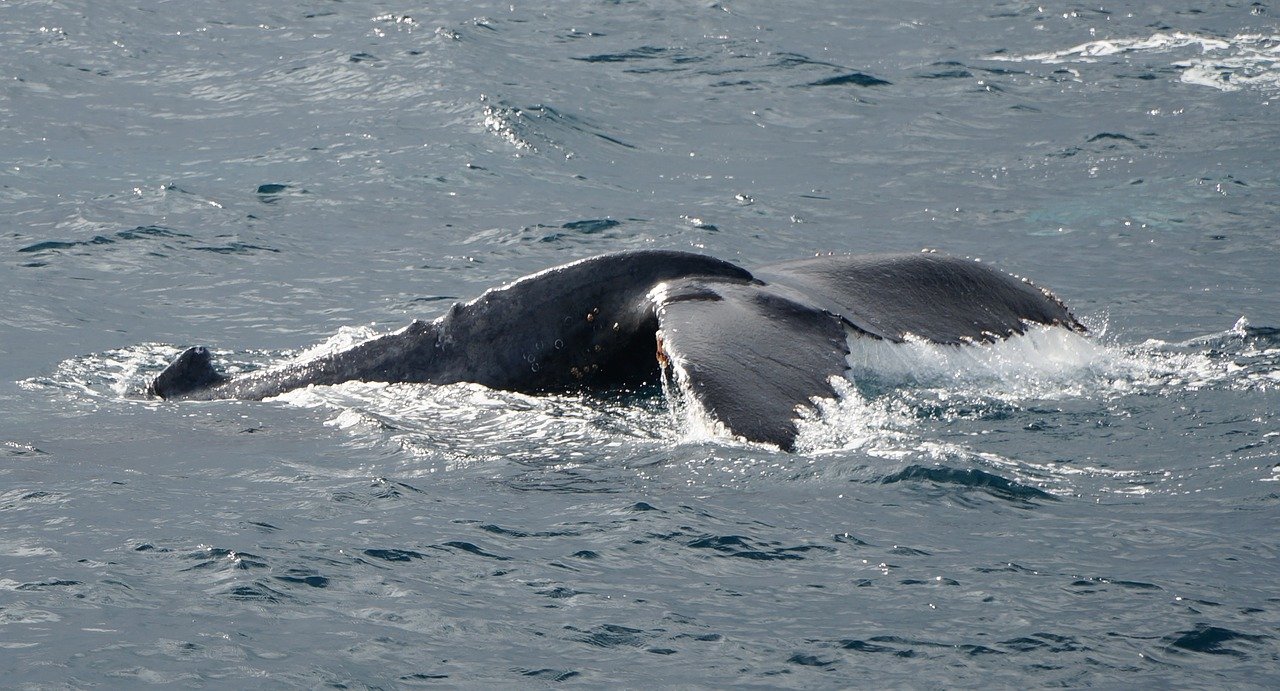
Orca Pod Encounters Tangled Humpback Whale
Last updated: September 14, 2026
4 min read
In January 2022, a tour group off Bremer Bay in Western Australia watched a pod of killer whales approach a humpback that had rope coiled around its tail. Everyone aboard expected a hunt. Instead the rope came loose, the orcas moved on, and the humpback swam away. Whale Watch Western Australia filmed the whole thing by drone, and nobody, including the researchers who have since looked at the footage, can say for certain what the orcas were doing.
What the tour group saw
The humpback was in poor shape: thin, and covered in whale lice. A weak animal trailing fishing rope is normally read as an easy meal. Two male orcas, nicknamed Blade and Hookfin, came in first and circled. Then the pod’s matriarch, nicknamed Queen, arrived in a burst of white water. When it cleared, a large section of the rope binding the whale’s fluke was drifting free, and the killer whales left the humpback alone.
The crew posed the obvious question rather than answering it: did the orcas free the humpback on purpose, or did they decide that an animal in that condition was not worth the energy of a hunt? Erich Hoyt of Whale and Dolphin Conservation made the same point, that behaviour like this is very hard to interpret from one sighting. The orcas may have grabbed the rope deliberately or snagged it while investigating. Whale Watch Western Australia said it was the first interaction they had recorded between orcas and a humpback at Bremer Bay in summer.
Why Bremer Bay is an orca hotspot
This did not happen in a random patch of sea. The Bremer Canyon, about 70 km south-east of Bremer Bay, hosts the largest known seasonal gathering of killer whales in the Southern Hemisphere. Researchers have photo-identified well over 100 individuals there, and the catalogue keeps growing as each season’s images are worked through.
The reason is the canyon itself. It cuts into the continental slope and drops past 4,000 metres at its deepest. Cold, nutrient-rich water from the deep Flinders Current meets the warmer Leeuwin Current, and the steep terrain pushes that water up toward the surface. The upwelling powers an intense food chain. Beaked whales are the prey most often recorded for the Bremer orcas, along with squid and smaller fish. The reliable season runs from about January to mid-April, which is when whale watching boats head out from Bremer Bay to find them.
A humpback in the wrong place
One detail of this story is genuinely odd. The humpback was in Australian waters in January, when most of the western Australian humpback population should be at or near Antarctic feeding grounds. The animal may have lagged behind, weakened by the effort of dragging gear, or been thrown off by it. We do not know.
How orcas usually treat humpbacks
The sighting stands out because orcas and humpbacks normally have a far tenser relationship. Mammal-eating killer whales hunt humpback calves, singling out a young animal and working to separate it from its mother. Humpbacks do not simply flee. A 2017 review by Robert Pitman and colleagues in Marine Mammal Science pulled together 115 recorded interactions between the two species from 1951 to 2012. In the cases where humpbacks interfered with a hunt, 89 percent of the animals under attack were not humpbacks at all but other species, including seals, sea lions and other cetaceans.
Set against that, a pod of orcas leaving a weakened humpback unharmed is the opposite of the expected script. It fits a picture of orca decision-making shaped by context, prey quality and learned culture rather than a fixed predatory reflex.
The bigger problem: whale entanglement
Strip away the surprise of the orca encounter and what remains is a whale in trouble because of fishing gear. Entanglement in ropes, nets and lines is one of the most serious threats humpback whales face. Whales migrate along busy coastlines where set fishing gear is common, and a humpback that swims into a line can carry it for weeks or months.
Scar analysis shows how routine this is. In the Gulf of Maine, where researchers have photographed the tail stock of catalogued humpbacks since 1997, more than half of the whales carry scarring consistent with a previous entanglement, and the scar record puts the annual entanglement rate at roughly 12 percent of the population. In New South Wales, Australia, 242 entanglement records were assessed as highly likely to involve NSW set fishing gear between 1994 and February 2022, and reports have risen over those three decades.
The danger of dragged gear includes:
- Exhaustion and starvation from the constant drag of heavy rope
- Deep wounds and infection where line cuts into skin and flippers
- Restricted feeding when gear is caught in the mouth or around the head
- Drowning if the whale cannot reach the surface to breathe
This is why trained disentanglement teams exist along major whale coastlines. If you ever see an entangled whale, the advice is consistent: do not try to free it yourself, keep your distance, and report it to local marine authorities so a trained crew can respond safely.
What the sighting is worth
One drone clip cannot show intent. What it does show is that orca behaviour toward humpbacks is more variable than a simple predator-prey model allows, and that a whale was dragging rope in the first place because of something people put in the water. Both halves of that are worth more attention than the feel-good headline. To read more about the species involved, see our humpback whale species profile and our piece on humpbacks intervening in killer whale hunts.
Updated 14 September 2026: changed the title to avoid claiming that the orcas intended to help.


Bremer Bay orcas are some of the best studied in Australia.
Constance, there is a lot still to learn about why they did.
Shocking how many humpbacks get tangled at some point.
Strange that the orcas left it alone.
Sorry for my English. I enjoy this and will share with friends in Galicia, our coast has many whales.
My grandfather kept logs from his years at sea. He would have loved this.
Such an unusual encounter.
Old gardener here. The patience it takes to study whales over decades makes sense to me.
Found a source in here I hadn’t read before.