
Euthanized Pygmy Sperm Whale in California
Last updated: October 14, 2026
3 min read
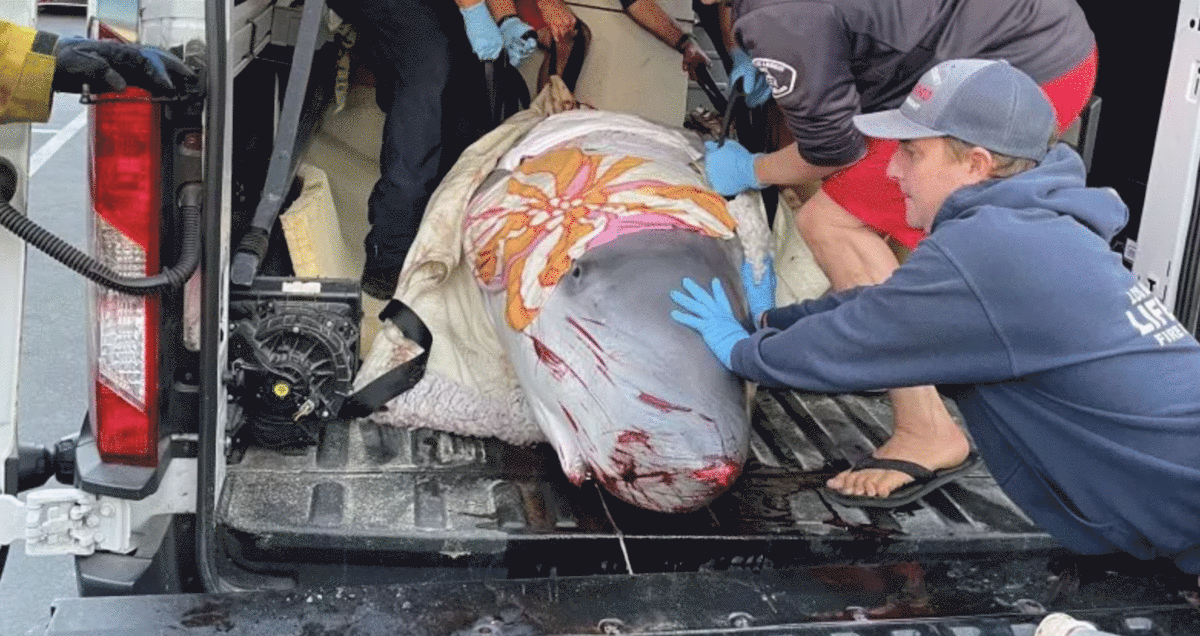
A pygmy sperm whale that washed ashore at Malibu Surfrider Beach in California was euthanized after rescuers concluded there was no realistic way to save her. This page keeps the record of that day and turns it into a proper introduction to one of the least understood whales in the sea.
What happened at Malibu
At about 4.40pm on Sunday 6 March 2022, Los Angeles County lifeguards were called to a whale stranded at Surfrider Beach. County firefighters helped move the adult female clear of the shoreline, and she was taken to the California Wildlife Center.
The examination found several superficial wounds and abrasions, probably from being thrown against the low tide rocks in rough surf, an abscess just in front of her fluke, and severe conjunctivitis in both eyes with corneal lesions. Working with NOAA, the centre made the call to euthanize her. Her injuries and condition, combined with the distance to the nearest facility able to rehabilitate a marine mammal that size, left no other humane option. It is a grim outcome, but for a wild animal in that state it is sometimes the only act of mercy available.
What made the case notable is how rarely this species turns up at all. Of more than 600 stranded whales, dolphins and porpoises recorded on that coast across 45 years, NOAA figures reported at the time counted only three pygmy sperm whales. The one before this was found dead in the San Francisco Bay area in February 2021, and its cause of death was never established.
Meet the pygmy sperm whale
The pygmy sperm whale, scientific name Kogia breviceps, is a small relative of the famous giant sperm whale, but the two are wildly different in scale. A great sperm whale can exceed 16 metres. A pygmy sperm whale grows to around 3.5 metres, 3.8 at the very largest, and weighs up to about 450 kilograms. Calves are around 1.2 metres at birth. In other words, a full grown pygmy sperm whale is barely larger than a big bottlenose dolphin, and at a glance many people would not even recognise it as a whale.
Its body is stocky with a blunt, almost shark like head. The head is large in proportion to the body and looks swollen from the side. Behind the eye there is a pale crescent shaped marking often called a “false gill”, because it looks like a fish’s gill slit, which adds to the shark resemblance. The dorsal fin is small and set well back. It carries a spermaceti organ in the head, like its giant cousin, which is part of what links the two species.
A whale that releases ink
When a pygmy sperm whale is alarmed, it can release more than three gallons of dark reddish brown fluid from a sac in its lower intestine, then dart away behind the screen. It is the same trick a squid or an octopus uses, and among whales and dolphins only the two Kogia species do it. The cloud is thought to confuse predators such as large sharks and killer whales long enough for the whale to escape, which tells you something about how vulnerable this small, slow animal is.
Where they live and what they eat
Pygmy sperm whales are deep water animals of tropical, subtropical and temperate seas worldwide, most common off continental coasts and shelves, including waters around Hawaii and the northern Gulf of Mexico. They dive at least 1,000 feet to feed, mainly on squid and octopus, along with some fish, crabs and shrimp.
Nobody knows how many there are. They surface briefly, sit low in the water, and are almost never seen at sea, so there is no reliable population estimate for the species. That is frustrating news for science. Almost everything researchers know comes from animals that strand or wash ashore, exactly like the Malibu whale.
Why strandings still teach us so much
It is painful to lose an animal that could not be saved, especially one this rare. But a stranded whale is not a wasted loss. Every recovered pygmy sperm whale is examined, and those examinations have built almost the entire knowledge base for the species: its diet, its diseases, its body structure, and increasingly the threat from ingested plastic, which deep water squid hunters are prone to swallowing.
- If you find a stranded whale, do not push it back to sea and do not crowd it.
- Call your local marine mammal stranding network or coast guard straight away.
- Note the time, the exact location, and whether the animal is alive.
- Keep dogs and onlookers well back so responders can work.
The Malibu pygmy sperm whale could not be saved, but the data from her adds another small piece to the picture of an elusive species. To read a fuller account of this animal, see our species profile of the pygmy sperm whale.



Sad, but probably the kindest choice.
Good that the team had clear rules for making that call.