
Whale Watchers Get to Kiss a Gray Whale
Last updated: October 14, 2026
4 min read
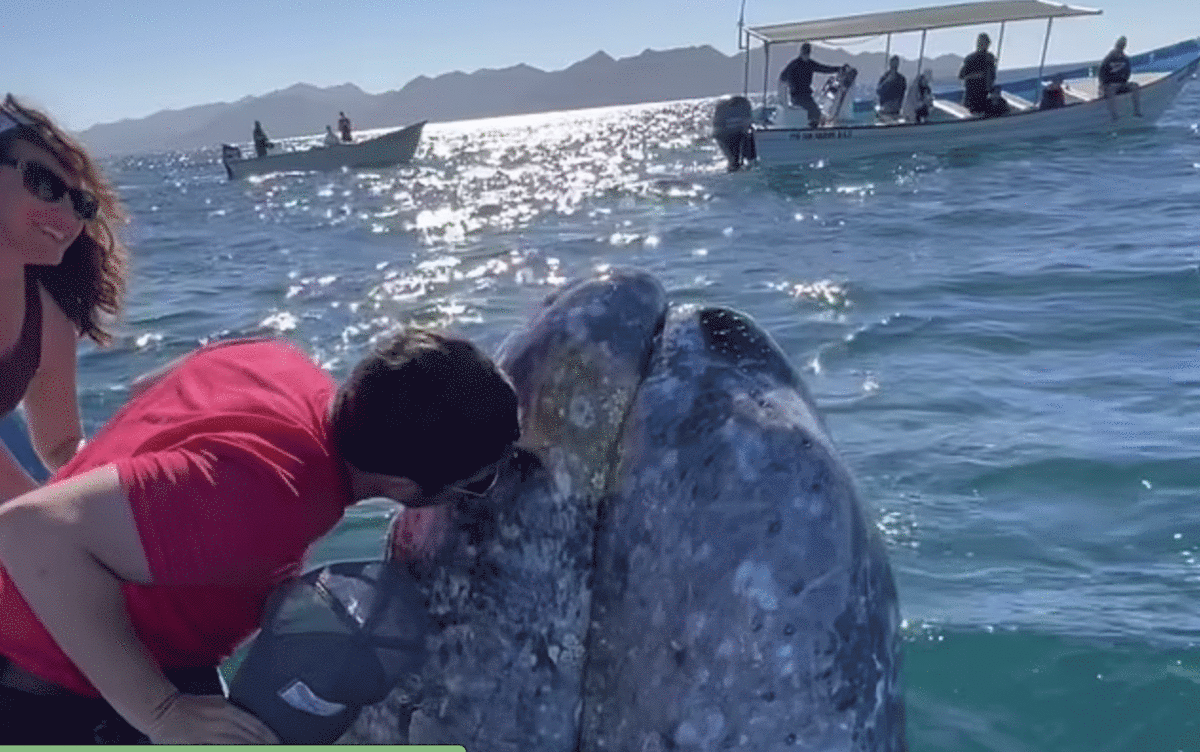
Petting and kissing a wild whale sounds like a stunt, but in one specific corner of the world it is something the whales themselves seem to invite. A widely shared video showed whale watchers in Magdalena Bay, Mexico, reaching out from small boats to stroke a gray whale that had surfaced beside them. One passenger took off his hat, pressed his bald head against the whale, and gave it a kiss before it slipped back under, blowing a fine spray over everyone aboard.
The footage shows a gray whale approaching a small boat and accepting contact. The more interesting story is why this happens at all, and why it happens almost nowhere else.
Magdalena Bay and the “friendly whale” phenomenon
The boats in the clip were drifting in Magdalena Bay, on the Pacific side of Baja California Sur. It is one of three sheltered lagoon systems on that coast, alongside Ojo de Liebre and San Ignacio, where eastern North Pacific gray whales gather every winter. What makes these lagoons famous is not the number of whales but their behaviour. Here, and essentially only here, gray whales approach boats, hold themselves at the surface, and accept rubs and pats from delighted visitors.
The behaviour is usually traced to San Ignacio in the 1970s, where a local fisherman had a series of encounters with one persistent whale. Guides and researchers who have watched the lagoons since describe mothers nudging their calves toward the boats when the calves are only weeks old, and many of those mothers were themselves brought to boats as calves. That points to a local tradition passed down through generations of whales, though nobody has a firm explanation for why gray whales here behave in a way they show nowhere else in their range.
It was not always this way
Nineteenth century whalers nicknamed the gray whale the “devil fish”, because mothers fought ferociously when their calves were harpooned in these same lagoons. The shift from devil fish to friendly whale, in roughly a century, is one of the more striking turnarounds in our relationship with a wild animal.
The gray whale: a quick profile
The gray whale (Eschrichtius robustus) is a baleen whale and the only living member of its family. Key facts worth knowing before you meet one:
- Size: NOAA gives adults at 42 to 49 feet long and about 90,000 pounds, roughly 41 tonnes.
- Calves: newborns are around 14 to 16 feet long and weigh about 2,000 pounds.
- Lifespan: not well established. One female was estimated at 75 to 80 years old after death.
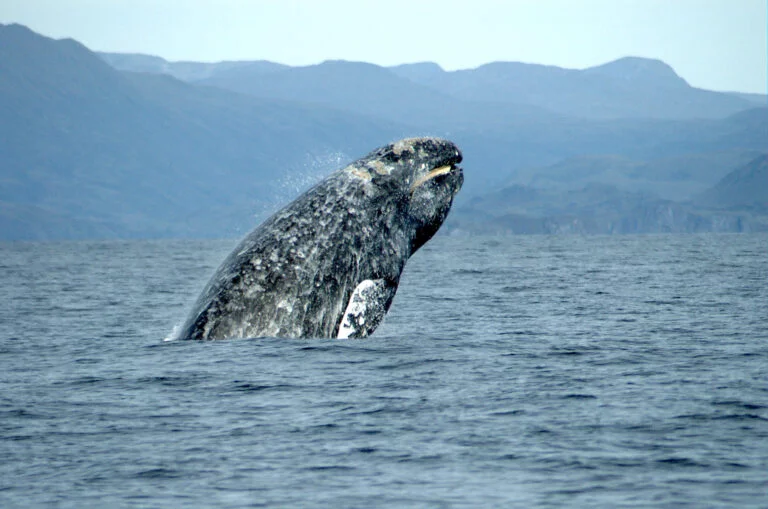
- Appearance: mottled gray skin crusted with barnacles and pale whale lice, which give each whale a unique pattern.
Gray whales are also known for spyhopping, where the whale pokes its head vertically out of the water to look around above the surface. If a gray whale rises slowly beside your boat and seems to be studying you, that is exactly what is happening. For a fuller breakdown, see our gray whale species profile.
The longest commute of any mammal
The whales in that Magdalena Bay video had earned their rest. The eastern North Pacific gray whale makes one of the longest migrations of any mammal, about 10,000 miles round trip and in some cases upwards of 14,000. Each year they travel between summer feeding grounds in the cold, shallow seas of the Arctic and Bering Sea, and the warm, protected lagoons of Baja California where they breed and raise their calves.
They begin arriving in Baja in late December, with numbers peaking through January and February. The lagoons offer warm, calm, shallow water, which suits newborn calves that have little blubber and cannot yet handle the cold open ocean. By spring the whales turn north again, calves in tow.
Touching a wild whale: is it allowed?
People often ask whether petting a gray whale is even legal, given how strict the rules are elsewhere. In most United States waters, approaching a whale closely is prohibited, and in Hawaii federal law bars anyone from coming within 100 yards of a humpback by any means. Mexico takes a different approach in the Baja lagoons. Whale watching there is regulated and licensed, boat numbers and time on the water are limited, and tour pangas are not allowed to chase whales or force contact. The rule is simple: the whale decides. If a gray whale swims up and rests beside the boat, passengers may touch it gently. If it does not, the boat keeps its distance.
That distinction matters. The footage works precisely because nobody is pursuing the animal. A 40-tonne whale that wants to be left alone simply leaves. Responsible operators brief passengers to keep hands away from the blowhole and eyes, to avoid sudden movements, and never to try to climb onto or restrain a whale.
A conservation comeback that has gone into reverse
This population was hunted to the edge of extinction twice, and its recovery was for years treated as one of the great conservation successes. It was taken off the US endangered species list in 1994, and by the winter of 2015 to 2016 NOAA counted around 27,000 animals, close to an all-time high.
Since then it has fallen sharply. Strandings rose from December 2018 and NOAA declared an Unusual Mortality Event that ran until November 2023, linked to changes in the Arctic and sub-Arctic feeding areas that cut the whales’ food supply. NOAA estimated 11,700 to 14,200 whales in 2024/25, followed by an apparent rise to 15,930 to 20,530 in 2025/26. The agency warns that changes in migration timing and survey availability may explain part of that rise. About 85 calves were counted in 2025.
Gray whales feed by sieving tiny creatures out of Arctic seafloor mud, and that is the ecosystem now changing fastest. So the friendly whales of Magdalena Bay are worth seeing, and the numbers behind them are worth watching. If you go, book with a licensed operator working under the Mexican lagoon rules, and let the whale make the first move.
Updated 14 September 2026: removed a personal statement and updated gray whale estimates.



From what I’ve read, the gray whales in the lagoons choose to come to the boats.
Britta, yes, that is what makes those lagoons unusual.
The faces of the people on the boat say it all.