
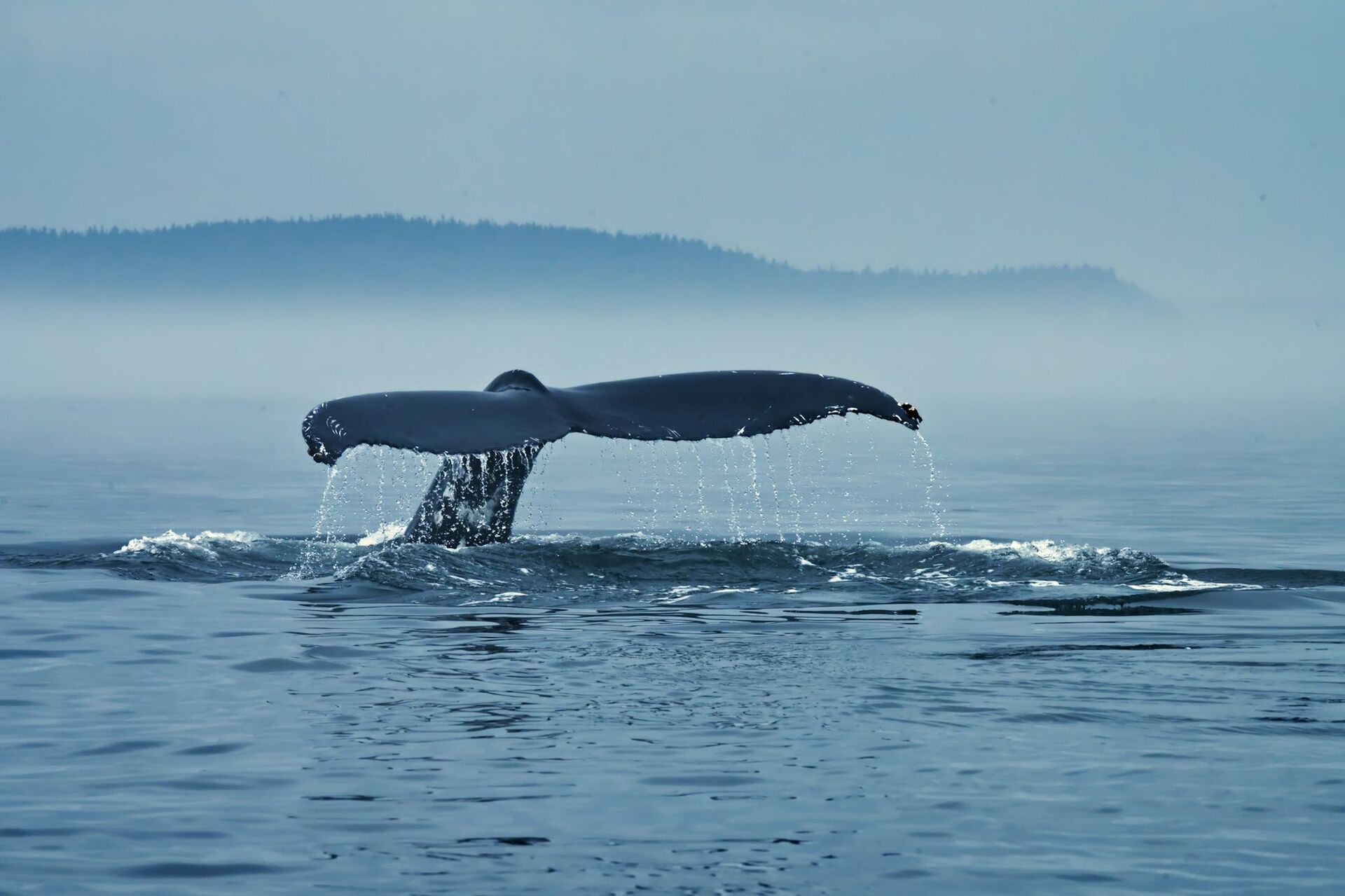
Species Profile: The Cuvier’s Beaked Whale
Last updated: October 14, 2026
3 min read
The Cuvier’s beaked whale is the most widely distributed beaked whale on Earth, the deepest and longest diving mammal ever recorded, and the species that strands more often than any of its relatives. It is also one of the least seen. Almost everything we know about it comes from stranded animals and from a handful of satellite tagging programmes.
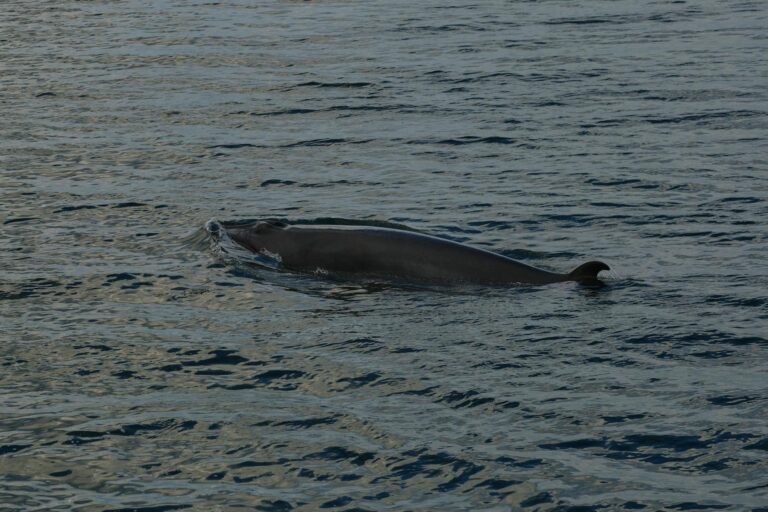
Cuvier’s Beaked Whale. (Courtesy: R.W. Baird/Cascadia Research Collective)
How to identify one
Like other beaked whales it has a cigar-shaped body and is easily confused at sea with the mesoplodont whales, a genus of smaller toothed whales. Look for a short beak (noticeably shorter than most of the family), a small curved dorsal fin set well back, and narrow flippers that tuck into shallow pockets in the body wall. Colour runs from dark grey to reddish brown, and older males in particular pale considerably around the head.
Adults are usually covered in scarring. Oval bite marks come from cookiecutter sharks; long parallel scratches on males are tooth rakes from fighting other males with the single pair of teeth that erupt from the lower jaw.
Scientific name and classification
Ziphius cavirostris
- Kingdom: Animalia
- Phylum: Chordata
- Class: Mammalia
- Order: Artiodactyla
- Infraorder: Cetacea
- Parvorder: Odontoceti (toothed whales)
- Family: Ziphiidae
- Genus: Ziphius
- Species: Z. cavirostris
Ziphius is a genus of one. There is no second living species, and its nearest relatives are the other beaked whale genera, chiefly Mesoplodon and Hyperoodon.
Size and lifespan
An adult grows to between 5 and 7 metres (16 to 23 feet), with no significant size difference between the sexes. Weight is around 2,500 kg (5,500 lbs), with the largest recorded specimens near 3,000 kg (6,600 lbs). Cuvier’s beaked whales are thought to live up to about 60 years.
Diet and the diving record
The diet is deep-sea squid, deep-water fish, and some crustaceans, and the whale will go to remarkable lengths to reach it. In 2014 a satellite-tagged Cuvier’s beaked whale off California recorded a dive to 2,992 metres (9,816 feet), the deepest dive ever measured for any mammal. The same tagging programme logged a dive lasting 2 hours and 17 minutes. That duration record was later broken by an animal tracked for 222 minutes, or 3.7 hours, published in 2020.
Reproduction
Females reach sexual maturity at about 5.8 metres (19 feet), males at about 5.5 metres (18 feet). Newborn calves measure roughly 2 to 3 metres (6.5 to 10 feet) and weigh in the region of 272 kg (600 lbs).
Alternative names
Goose-beaked whale.
Population and conservation status
The IUCN lists Cuvier’s beaked whale as Least Concern, largely because its range is so wide. There is no reliable global population figure. Regional surveys give the best picture available: roughly 80,000 animals in the eastern tropical Pacific and more than 15,000 around Hawaii.
Japanese whalers took small numbers, reported at between 3 and 35 animals a year, before 1955. From 1955 through the 1990s the reported catch was much larger, at more than 4,000 animals in total. The species has also turned up as bycatch in Italian, Colombian and American fisheries.
It is now covered by several international agreements, including ASCOBANS and the Western African Aquatic Mammals Memorandum of Understanding.
Strandings and naval sonar
This species strands more often than any other beaked whale, and mass strandings cluster around military sonar activity. The clearest case is the Canary Islands, where mass strandings followed naval exercises and then stopped once sonar exercises were banned in those waters. Mediterranean mass strandings have continued where sonar use has not been restricted in the same way.
The species is not hunted commercially today and there is no record of one harming a human. The threat that shows up in necropsies instead is plastic: animals have been found dead with large volumes of ingested plastic in their stomachs.
Where the name comes from
The common name honours the French anatomist Georges Cuvier, who was the first to describe the animal. Working from a skull alone, and with no living specimen to compare it to, Cuvier assumed the species was extinct. A later stranding of a living animal proved otherwise.
The scientific name mixes Greek and Latin: Ziphius from the Greek for swordfish, cavus for hollow and rostrum for beak. The hollow is the deep prenarial basin in the skull, one of the features that made the specimen so hard to place.
Distribution and habitat
Cuvier’s beaked whale has the widest distribution of any beaked whale, occurring in deep water in every ocean except the high Arctic. It is recorded off Canada, much of the United States, South Africa, Australia, New Zealand, the Caribbean, the Mediterranean, and the Gulf of Mexico, among many others. What links all of those places is depth: this is an animal of the continental slope and the open abyss, not of the shelf.


Strange that we know them mostly from strandings.
The sonar link is the part that worries me most.
Are there new beaked whale species still being described? I thought I read about one.
Pia, yes. A smaller Berardius beaked whale was named in 2019.