
Surprising Facts About Whale Ancestors
Last updated: October 14, 2026
2 min read
Whale ancestors were nothing like the gentle giants we know today. Millions of years ago they were small, they walked, and they had sharp teeth.
Here are five things about them that tend to surprise people.
1) Whale Ancestors Were Small
Blue whales reach around 30 metres (98 feet) and nothing alive is bigger. The earliest members of the whale line were nothing of the sort.
Pakicetus, one of the first, measured between one and two metres and weighed something like 45 kg, roughly the build of a wolf. Indohyus, a close relative from the same corner of the family tree, was about the size of a raccoon. Its bones were unusually thick, which read as ballast: it waded in shallow water rather than swimming through it.
2) They Had Teeth, And They Were Sharp
Adult baleen whales have no teeth at all. They strain small prey out of huge mouthfuls of seawater using baleen, comb-like keratin plates that hang from the roof of the mouth.
Their ancestors were another animal entirely. In 2017, David Hocking and colleagues at Monash University and Museums Victoria built high-resolution 3D models of teeth from eight extinct whale species and measured their sharpness against lions, dingoes, coyotes, cougars and seals. The archaic whale teeth came out as sharp as those of the land carnivores. They were shaped to catch, pierce and cut prey, not to sieve it. The paper ran in Biology Letters under a title that leaves little room for doubt: “Ancient whales did not filter feed with their teeth”.
3) Whale Ancestors Walked On Land
Pakicetus lived on land beside water, in what is now Pakistan. Long skull, big carnivorous teeth, four working legs. Nothing about it looks like a whale.
The giveaway is in the ear. Pakicetids carry a thickened inner lip on the ear bone called the involucrum, a feature found in cetaceans and in no other group of mammals. Worth being clear about what that does and does not mean: the hearing itself was still set up for listening in air, not underwater. The family resemblance was in the bone long before it was in the biology.
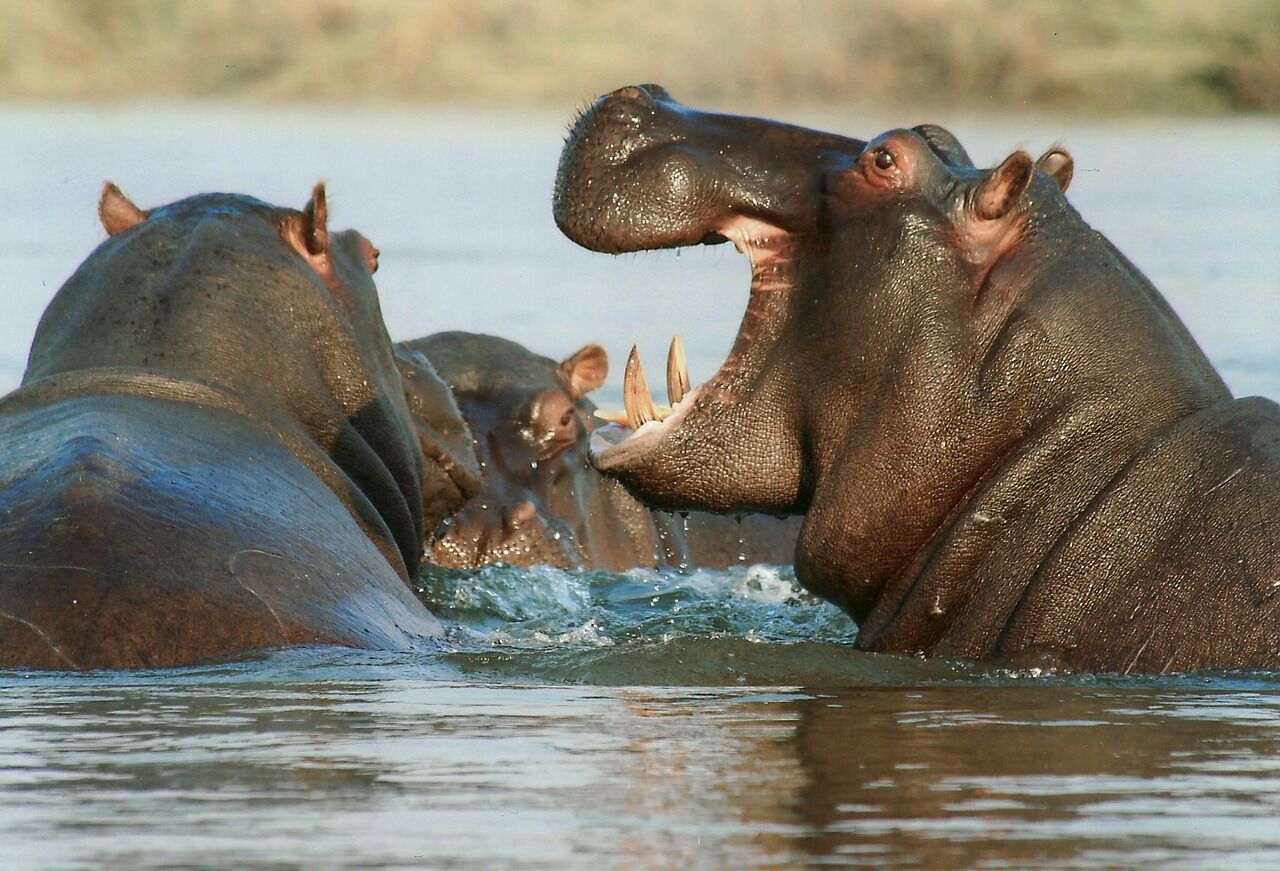
4) Hippos Are The Closest Living Relatives Of Whales
Hippos are the nearest living relatives of whales, which is not the same as being their ancestors. The two lines split from a shared ancestor more than 50 million years ago and each took to the water separately. Whales sit inside the even-toed ungulates, the group that also contains deer, camels, pigs and cattle.
5) How Teeth Gave Way To Baleen Is Still Argued
Somewhere between the sharp-toothed early whales and today’s filter feeders, the teeth went and the baleen arrived. The order is not settled.
One case rests on Coronodon, a toothed early baleen whale from the Oligocene of South Carolina, described in 2017. Its broad, multi-cusped lower molars overlap to frame narrow slots, which the describing team read as a strainer: filtering with the teeth before baleen existed. A 2024 restudy of the tooth wear argued the pattern does not fit that idea.
The rival case is Hocking’s. If archaic whale teeth were too sharp to work as a sieve, baleen probably turned up after the teeth had already been lost, and suction feeding may have covered the gap. Mammalodon colliveri, a three-metre archaic baleen whale from Oligocene Australia, had a short blunt snout that suggests it sucked small prey out of seafloor mud.
Either way, the largest animals that have ever lived came from small, sharp-toothed predators that took prey one animal at a time.



A wolf-sized land animal turning into the blue whale family is my favourite evolution story.
So hippos are the closest living relatives? I’d never have guessed.
How did whales go from hunting to filter feeding? Would read a whole post on that.