Species Profile: Sowerby’s Beaked Whale
Last updated: September 14, 2026
5 min read
Sowerby’s beaked whale is the textbook deep water enigma: a medium sized cetacean that spends most of its life hunting squid in the dark, surfaces briefly and inconspicuously, and is known largely from stranded carcasses rather than live encounters. This profile pulls together what is on the record: anatomy, range, diet, and the strandings literature that links beaked whales to military sonar. See also our Cuvier’s beaked whale profile for the better known cousin.
Key facts at a glance
- Scientific name: Mesoplodon bidens
- Family: Ziphiidae (beaked whales)
- Length: Males to about 5.5 metres, females to about 5 metres
- Mass: Around 1,000 to 1,300 kg
- Range: Cold temperate North Atlantic, in deep water
- Diving: Documented dives past 1,000 metres, typically 30 to 40 minutes
- IUCN status: Least Concern, on sparse data
Discovery and taxonomic place
Sowerby’s beaked whale was the first Mesoplodon to be described. James Sowerby named it in 1804 from a male that stranded in the Moray Firth in Scotland in 1800. The species name bidens means two toothed, after the single pair of teeth that erupt in adult males. Despite that early start it stayed obscure for nearly two centuries, because live sightings were so rare and almost every specimen came from a beach. It is now one of around fifteen recognised Mesoplodon species, the most diverse beaked whale genus.
Appearance
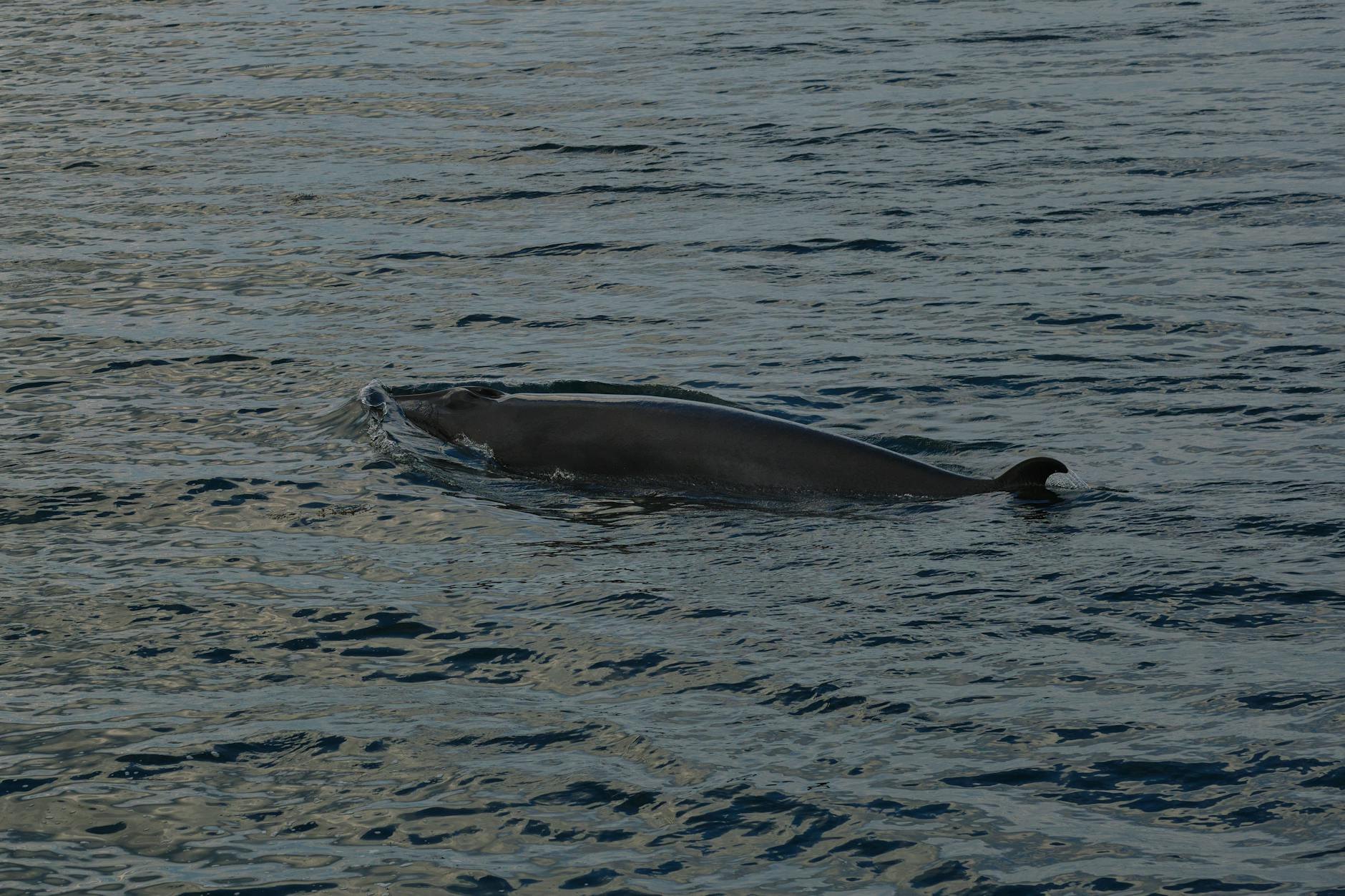
Sowerby’s beaked whales are slender, with a long pointed beak, a small triangular dorsal fin set far back on the body, and an adult length of around 5 to 5.5 metres. Colouring is dark grey to charcoal above and paler underneath, with scattered linear scars in males from tooth rake fights. Females and juveniles are more uniformly coloured.
The most distinctive feature is the pair of erupted teeth in adult males, which protrude from the lower jaw roughly two thirds of the way along the beak. They are used in male to male combat, not for feeding. Females do not erupt these teeth at any age, which is the clearest field mark separating the sexes.
Range and habitat
The species is restricted to the cold temperate North Atlantic. In the west it runs roughly from Nantucket north to Labrador. In the east it runs from Madeira up to the Norwegian Sea. Rare verified sightings have occurred in the Mediterranean, including the Tyrrhenian Sea. Sowerby’s favour water between about 200 and 1,500 metres deep and are rarely seen over the shallow continental shelf, except in the strandings that supply most of what we know.
Deep diving and foraging
Like other beaked whales, Sowerby’s are serious deep divers. Foraging dives regularly pass 500 metres, documented dives exceed 1,000 metres, and a typical dive lasts 30 to 40 minutes. They hunt mainly deep water fish and also take cephalopods, using echolocation clicks tuned for prey detection at depth. After a long foraging dive they usually make several shorter recovery dives before going deep again.
The physiology behind that vertical commute is still being studied: high myoglobin concentrations in the muscle for oxygen storage, lungs that collapse under pressure so gas exchange stops, a sharply reduced heart rate, and blood shunted away from non essential organs.
Sowerby in the historical record
After 1804, knowledge of the species accumulated mostly through stranded specimens collected by museums in the UK, Ireland, France, the Netherlands, Norway, Canada, and the US. The species was assumed to be rare partly because so few people went looking for it at sea. Dedicated cetacean surveys since the late twentieth century have produced enough sightings to suggest it is more widespread than the strandings record alone implied, though still genuinely uncommon.
Vocalisations
Sowerby’s produce echolocation clicks during foraging dives. The clicks have a species specific frequency and timing signature, which lets acoustic monitoring separate Sowerby’s from other beaked whales in the same dataset. Outside foraging the species seems largely silent at the surface, which is part of why live encounters are so brief.
Identification challenges
Telling Sowerby’s from other beaked whales at sea is one of the harder identification problems in cetacean fieldwork. Without a clear view of the male’s tooth position, you are working from beak shape and back colouring, and both are ambiguous from a moving boat. Photo identification from dorsal fin scarring supports catalogue work once a clean image exists. For most encounters, acoustic identification is now more reliable than visual.
Strandings and sonar
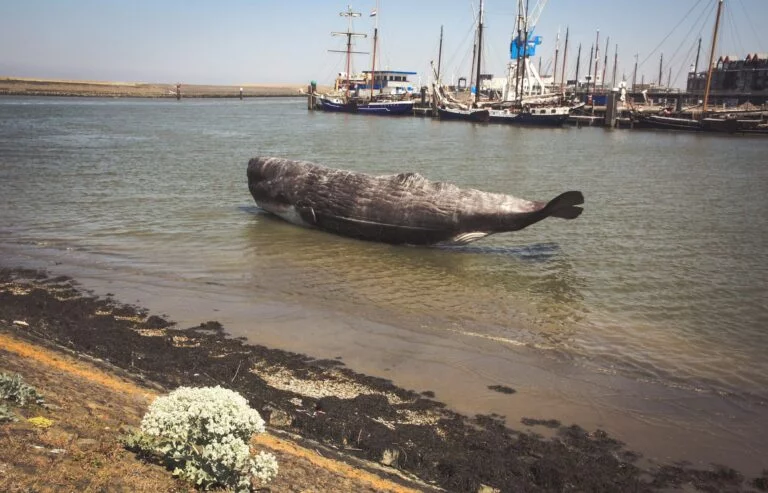
Sowerby’s appears in the literature linking beaked whales to naval sonar, though the best documented mass events involve Cuvier’s and Blainville’s. The clearest Sowerby’s case is recent: two animals stranded in East Lothian in Scotland in October 2020. Investigators found gas emboli but treated decompression sickness and sonar exposure as possible explanations, not confirmed causes. Live stranding was the immediate cause of death.
Mid frequency active sonar can alter beaked whale diving and may contribute to decompression injuries. The precise sequence that causes strandings remains uncertain. Beaked whale physiology is finely tuned for a controlled descent and a stepwise ascent, and that is exactly what makes it fragile when something interrupts the pattern. See our pieces on ocean noise pollution and whether sonar harms whales for the wider context.
Reproduction and life history
Direct observations of Sowerby’s reproduction barely exist. Sexual maturity is estimated at around 7 to 11 years from growth layer counts in teeth. Gestation runs about a year and produces a single calf of roughly 2.1 to 2.7 metres and 185 kg. Adult males carry extensive linear scarring from combat, which suggests tooth rake fights are a regular feature of mate competition.
Sociality
Groups at sea usually number between one and ten animals, most often three to six. Pods seem small and possibly fluid, though the absence of long term photo identification datasets makes that hard to confirm. Synchronised diving and surfacing has been observed during the few prolonged encounters on record.
Threats and protection
Beyond sonar, Sowerby’s face fisheries bycatch, especially in deep water pelagic gill nets, ship strike, plastic ingestion, and chemical pollution. Beaked whale stomachs frequently contain plastic debris mistaken for prey. Noise from oil and gas seismic survey is a particular concern where energy development overlaps the species range on the northeast Atlantic and US east coast continental margins.
The species is listed on CITES Appendix II and covered by the regional agreements ASCOBANS and ACCOBAMS. The Gully marine protected area off Nova Scotia, best known for its northern bottlenose whales, also restricts seismic survey, oil and gas activity, and some fishing across deep water habitat that Sowerby’s use. Long term acoustic monitoring is one of the few tools capable of detecting population level effects on a species this hard to see, and it is becoming the most productive way to study it.
Frequently asked questions
How big is a Sowerby’s beaked whale?
Males reach about 5.5 metres and females about 5 metres, at roughly 1,000 to 1,300 kg. Small to medium by cetacean standards.
Where do Sowerby’s beaked whales live?
The cold temperate North Atlantic: Nantucket to Labrador in the west, Madeira to the Norwegian Sea in the east. They prefer deep water and are rare over the shelf.
How deep do they dive?
Foraging dives regularly pass 500 metres and documented dives exceed 1,000 metres, usually lasting 30 to 40 minutes.
What do Sowerby’s beaked whales eat?
Mainly deep water squid, plus some deep water fish, caught by echolocation at depth.
Are Sowerby’s beaked whales endangered?
The IUCN lists the species as Least Concern, but the population data are sparse and the trend is hard to assess given how few animals are ever observed.
Why do beaked whales strand near sonar exercises?
Mid frequency active sonar can alter beaked whale diving and may contribute to decompression injuries, but the mechanism remains uncertain.
Updated 14 September 2026: corrected range, diet, and sonar evidence.