
Species Profile: The Bowhead Whale
Last updated: October 14, 2026
10 min read
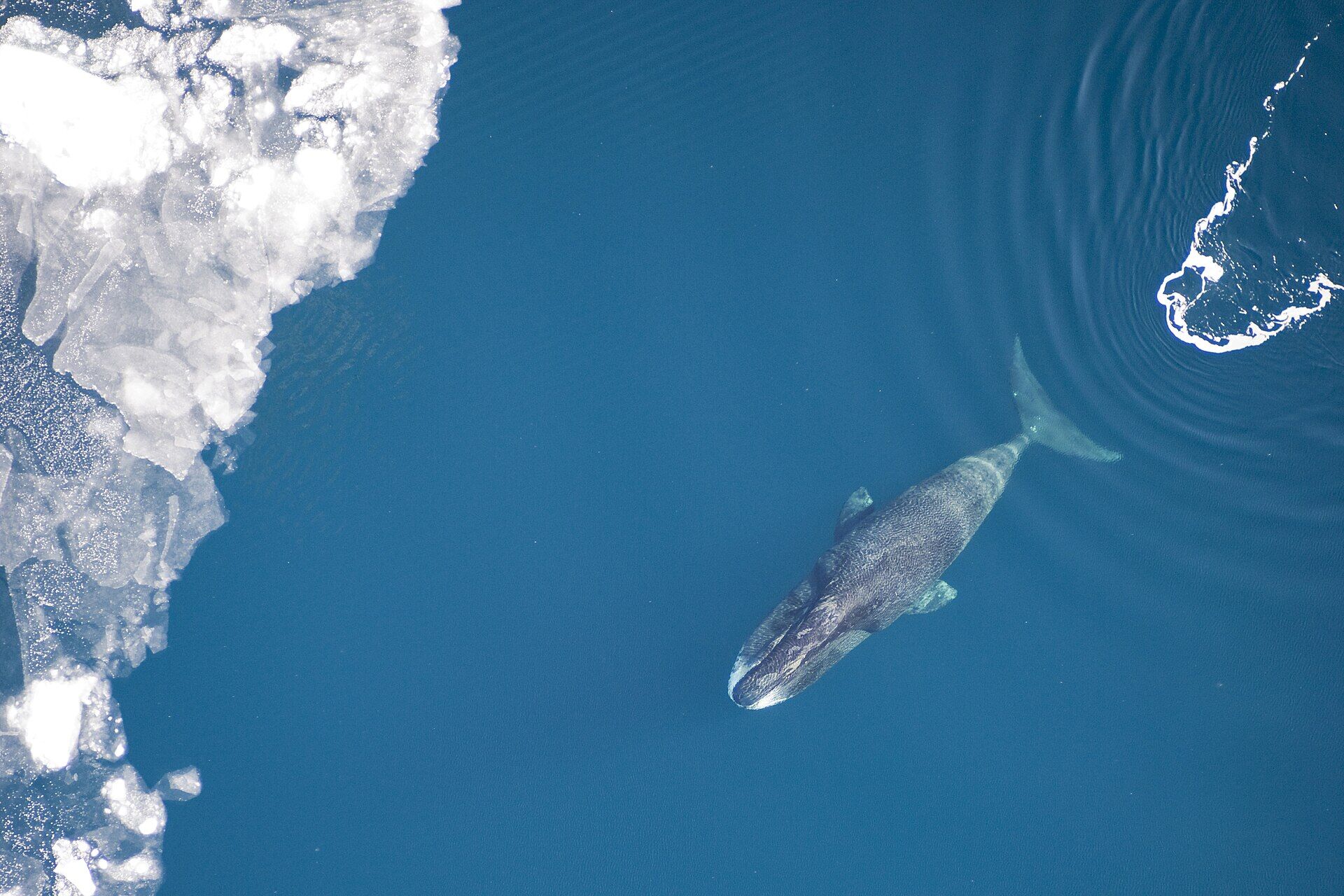
The bowhead whale (Balaena mysticetus) is one of the most extraordinary animals on the planet. It is the only large baleen whale that lives in Arctic waters year round, it can break through sea ice with its huge bow shaped skull, and it routinely lives longer than any other mammal on Earth. Old harpoon tips show that some bowheads survive for well over 100 years, while separate ageing studies suggest that some may pass 200 years, making the bowhead a living archive of Arctic history.
In this profile we look at where bowheads live, how they survive in freezing seas, what they eat, how they breed, and where they stand on the conservation ladder today. If you are new to whales in general, our overview of the conservation status of whale species is a useful companion read.
Key facts at a glance
- Scientific name: Balaena mysticetus
- Family: Balaenidae (right whales)
- Length: up to about 20 metres (66 ft), with most adults 14 to 18 metres
- Weight: 75 to 100 tonnes
- Diet: copepods, krill, and small schooling fish, filtered through baleen
- Habitat: Arctic and sub Arctic seas, often along the ice edge
- Lifespan: 100 to 200 plus years, the longest of any mammal
- IUCN status: Least Concern overall, with the Svalbard stock listed as Critically Endangered and others as Endangered or Vulnerable
What is a bowhead whale?
The bowhead is a member of the right whale family, Balaenidae. It shares that family with the three surviving right whale species: the North Atlantic, North Pacific, and Southern right whales. All four are heavy-bodied, slow swimming, surface feeding baleen whales with thick blubber, no dorsal fin, and very long curved baleen plates. The bowhead is closely related but takes the family blueprint to an extreme. Its head can make up nearly a third of its total body length, its blubber can be more than 40 centimetres thick, and its baleen plates are the longest of any whale, with the longest measured plates running past 5 metres.
Bowheads were once known as Greenland right whales, or simply polar whales. Today the species sits in five recognised stocks: the Bering Chukchi Beaufort stock in the western Arctic, the Eastern Canada West Greenland stock (also written as Baffin Bay Davis Strait), the Hudson Bay Foxe Basin stock, the East Greenland Svalbard Barents Sea stock (sometimes called Spitsbergen), and the Sea of Okhotsk stock. These stocks vary enormously in size, from tens of thousands of animals down to a few hundred, which is why the IUCN can list the species as a whole as Least Concern while flagging individual sub populations at much higher risk.
What does a bowhead whale look like?
If you have ever wondered how a whale can survive in waters that hover around freezing for most of the year, the bowhead body offers a masterclass in cold adaptation. Almost everything about it is built for insulation, ice navigation, and slow, fuel efficient feeding.
- Bow shaped head: the upper jaw is steeply arched, which is where the name comes from. The skull is dense and strong enough to break breathing holes through sea ice, comfortably through ice around 20 centimetres thick.
- No dorsal fin: like the other right whales, bowheads are smooth backed. A dorsal fin would catch on ice as the animal surfaces, so evolution dispensed with it.
- Huge baleen: the dark, fringed plates inside the mouth run from about 3 metres to over 5 metres in the largest animals, the longest of any whale. They form a fine mesh for filtering tiny prey from cold, productive Arctic water.
- Extreme blubber: a layer of fat 40 centimetres deep or more across much of the body traps heat and stores energy through long Arctic winters.
- Colour pattern: mostly black with a distinctive white chin patch and pale spots near the tail stock. Each individual pattern is unique, which researchers use for photo identification.
Adult bowheads typically measure 14 to 18 metres long, with the largest recorded animals reaching about 20 metres. Females are slightly larger than males, a pattern shared with many baleen whales. A full grown bowhead weighs 75 to 100 tonnes, putting it among the heaviest animals on Earth after the blue whale and the fin whale. They look stockier than blues and fins because so much of that weight is blubber rather than muscle and length.
Range and habitat
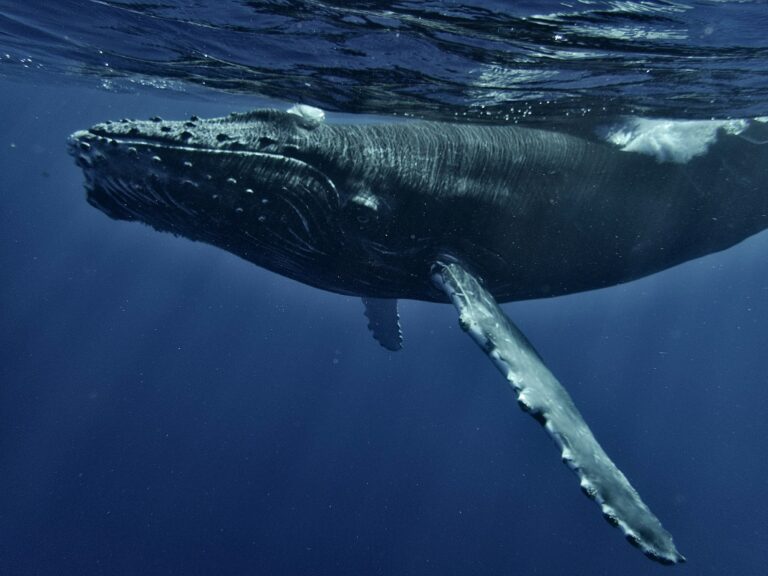
Bowhead whales are true Arctic residents. Unlike the humpback whale, which makes some of the longest migrations on the planet, bowheads stay within Arctic and sub Arctic waters year round. They shift north and south with the seasons as the ice retreats and advances, but they never leave cold water.
The largest population, the Bering Chukchi Beaufort stock, winters in the Bering Sea south of the pack ice and moves north through the Bering Strait into the Chukchi and Beaufort Seas as ice breaks up in spring. In autumn the animals reverse course, threading along leads in the ice as the cold returns. The Eastern Canada West Greenland stock occupies a similar role in the Canadian high Arctic and Baffin Bay. The Spitsbergen stock, hunted nearly to extinction in the 17th and 18th centuries, has only recently shown signs of recovery in the seas around Svalbard.
Bowheads are often found at the boundary between open water and pack ice. That edge is one of the most productive habitats in the polar ocean. Light, nutrients, and seasonal blooms of plankton concentrate along ice margins, and the whales feed where the food is densest.
What do bowhead whales eat?
Despite their enormous size, bowheads target some of the smallest animals in the sea. Their diet is built around copepods, especially Calanus species, plus krill (euphausiids) and the occasional swarm of other small zooplankton. In some areas they will also take small schooling fish and benthic invertebrates if the opportunity is there. The bulk of the food, though, is the slow drifting plankton soup that the Arctic produces in vast quantities every summer.
Bowheads are skim feeders. Rather than lunging at a bait ball the way a humpback or a blue whale does, they swim slowly forward with their mouths open, letting water flow in at the front and out through the sides of the baleen. The plates trap copepods and krill while letting water pass through. Periodically the whale closes its mouth and swallows the catch. A bowhead can keep up this gentle, continuous feeding for hours at a time.
They feed mainly in spring and summer, when daylight is endless and zooplankton biomass is at its annual peak. In winter, when the sea is darker and prey is sparser, they live largely off the energy reserves stored in their thick blubber. That makes a healthy summer feeding season essential. If climate change disrupts the timing or location of zooplankton blooms, bowheads can be left short of food during their critical fattening months.
Behaviour, social life, and vocalisations
Bowheads are usually seen alone or in small groups of two to ten. They sometimes gather in larger feeding aggregations where food is concentrated, but they do not form the tight, stable pods seen in killer whales or some dolphins. They are strong, agile swimmers in spite of their bulk. They can dive for 20 minutes or more, reach depths of around 200 metres, and break through surface ice from below when they need to breathe.
One of the bowhead’s most striking traits is its voice. Bowheads are among the most vocally complex of all baleen whales. Each population has a shared repertoire of songs that includes long, layered phrases, moans, knocks, and almost mechanical sounding pulses. Researchers using under ice hydrophones in the Spitsbergen population have recorded dozens of distinct song types in a single winter, with new songs appearing year on year. The function is not fully understood, but it is likely tied to mating and social bonding under the long polar night.
Reproduction and lifespan
Bowheads grow up slowly, in line with their long life. Females reach sexual maturity at around 25 years old. Gestation lasts about 13 to 14 months and a calf is typically born every three to four years. Newborns are already around 4 metres long and roughly 1,000 kg, and they nurse on their mother’s extremely rich milk for about a year. Calves grow quickly in their first year so that they can build up a survival layer of blubber before their first proper winter.
The bowhead lifespan is the headline. Subsistence hunters in Alaska have recovered stone and ivory harpoon points from inside bowhead bodies that were almost certainly fired in the 19th century, before steel and explosive harpoons replaced traditional gear. Scientists then cross checked those finds with aspartic acid racemisation, a technique that estimates age from changes in eye lens proteins. The combined evidence suggests that some bowheads alive today are more than 200 years old, with one male specimen estimated at around 211 years. No other mammal is known to reach those ages.
The biology behind that longevity is now an active research field. Bowheads carry unique versions of genes involved in DNA repair, cell cycle control, and cancer resistance. Their cells appear to manage damage more efficiently than those of shorter lived mammals, which may help explain how an animal weighing 100 tonnes avoids dying of cancer for more than two centuries. For more on the comparative ecology of whales and how species like the bowhead fit into the wider picture, see our profiles of the gray whale and the narwhal, two other charismatic northern species.
Conservation status and threats
Commercial whaling almost erased the bowhead. From the 1600s onwards, European and American fleets targeted the species for its baleen and its enormous yield of oil. The Spitsbergen stock collapsed first, in the 17th and 18th centuries. The eastern Canadian, Hudson Bay, and western Arctic stocks were hit hard in the 19th century. Commercial bowhead whaling ended in 1921, when global abundance had fallen below 3,000. Regulated Indigenous subsistence hunts continue under IWC limits.
The picture today is genuinely encouraging by whale standards. The Bering Chukchi Beaufort stock has grown back over decades at around 3.7 percent a year. NOAA’s current figure is 15,229 Western Arctic bowheads, averaging spring and summer estimates from 2019. Either way, this is a population many times larger than the one that came out of the whaling era. The Eastern Canada West Greenland stock has also rebounded into the thousands. As a result, the IUCN lists the bowhead overall as Least Concern. That is one of the few unambiguous good news stories in great whale conservation. The regional picture is harsher: the Svalbard stock is Critically Endangered, the Sea of Okhotsk and Baffin Bay Davis Strait stocks are Endangered, and the Hudson Bay Foxe Basin stock is Vulnerable. For the global context on how different whale species are faring, see our broader piece on the conservation status of different whale species.
The pressures bowheads face now are different from those of the 19th century, but they are real:
- Climate change: retreating sea ice changes where copepods bloom, when ice algae are available, and which predators can reach Arctic seas. Killer whales, in particular, are pushing further north as ice retreats.
- Ship strikes and noise: as the Northwest Passage and Northern Sea Route open up to commercial shipping, bowheads face more traffic in waters that were quiet for centuries.
- Oil and gas exploration: seismic surveys and drilling in the Chukchi and Beaufort Seas raise the risk of acoustic disturbance, habitat loss, and spills.
- Entanglement: bowheads can become tangled in crab pot lines and other fishing gear, especially where fisheries expand into former ice covered areas.
- Subsistence hunting: Indigenous communities in Alaska, Canada, Chukotka, and Greenland still take a small, regulated number of bowheads each year under IWC quotas. Current science suggests this take is sustainable for the larger stocks but needs careful management.
For deeper reading, NOAA Fisheries maintains a detailed bowhead whale species page, and the IUCN keeps an up to date assessment under Balaena mysticetus on the Red List. For a broad natural history overview, the Wikipedia bowhead whale article is well referenced and updated.
How you can help bowhead whales
You do not have to live in the Arctic to make a difference for bowheads. Climate, shipping, and pollution decisions made far to the south shape their world. A few things help.
- Support organisations that fund Arctic whale research, photo identification programmes, and acoustic monitoring.
- Push for strong noise and shipping rules in Arctic seas, including slow speed zones in bowhead habitat.
- Cut your own carbon footprint where you can. Slower warming in the Arctic is the single biggest gift the rest of the world can give to bowhead whales.
- Share good information. The more people know about Arctic whales, the harder it becomes to ignore decisions that put them at risk. Our species profile library is a good place to start.
Read next
- Whale Species: A Complete Guide to the Cetaceans of the World
- Species Profile: The Antarctic Minke Whale
- Species Profile: The Long-Finned Pilot Whale
Frequently asked questions
How long can a bowhead whale live?
Bowhead whales are the longest lived mammals on Earth. Eye lens dating and recovered 19th century harpoon fragments suggest that some individuals alive today are more than 200 years old, with one male specimen estimated at around 211 years.
Where do bowhead whales live?
Bowheads are Arctic specialists. They occur in five main stocks across the Bering, Chukchi, and Beaufort Seas, the Canadian high Arctic and West Greenland, Hudson Bay and Foxe Basin, the seas around Svalbard, and the Sea of Okhotsk. Unlike most large whales, they do not migrate out of cold water.
What do bowhead whales eat?
Their diet is dominated by tiny crustaceans, especially copepods of the genus Calanus and krill, plus small schooling fish and other zooplankton. They are skim feeders, swimming slowly with the mouth open and filtering food through long baleen plates.
How big do bowhead whales get?
Most adult bowheads reach 14 to 18 metres in length, with the largest around 20 metres, and weigh 75 to 100 tonnes. Females are slightly larger than males. Their bow shaped heads can account for almost a third of their total body length.
Are bowhead whales endangered?
The IUCN lists the species overall as Least Concern, thanks to a strong recovery of the Bering Chukchi Beaufort stock since the end of commercial whaling. Individual stocks are in worse shape: Svalbard is Critically Endangered, the Sea of Okhotsk and Baffin Bay Davis Strait stocks are Endangered, and Hudson Bay Foxe Basin is Vulnerable.
How do bowhead whales survive in the Arctic?
They combine blubber 40 centimetres deep or more, a powerful bow shaped skull that can break through sea ice, no dorsal fin, and a low energy lifestyle. Slow swimming, skim feeding, and long winter fasts let them get through months of darkness on stored fat.
What is the difference between a bowhead and a right whale?
Bowheads and right whales share a family (Balaenidae) and many features, including no dorsal fin and long baleen. The bowhead has an even more arched head, the longest baleen plates of any whale, no callosities on the head, and an Arctic only range. Right whales live in warmer temperate seas.
How many bowhead whales are left?
NOAA currently reports 15,229 Western Arctic bowheads, based on the average of spring and summer estimates from 2019. The Eastern Canada West Greenland stock numbers several thousand more. The Svalbard and Okhotsk stocks are far smaller, in the hundreds, which is why those sub populations remain a conservation priority.
Updated 14 September 2026: separated harpoon evidence from estimates above 200 years.


Old harpoon tips found in living bowheads is incredible.
Interesting how closely the Alaska hunt is monitored.
Is it true scientists study bowheads for cancer research?
Inka, yes. Their genome is studied for clues about long life and low cancer rates.
Breaking ice with their heads. Amazing.