

Species Profile: The Common Minke Whale
Last updated: September 14, 2026
8 min read
The common minke whale (Balaenoptera acutorostrata) is the smallest and most numerous of the rorquals, the family of streamlined baleen whales that also includes the blue, fin, sei, and Bryde whales. What it gives up in length it makes up for in versatility. Minkes show up in almost every ocean, from tropical coasts to the edge of the Arctic pack ice, and they have become one of the most familiar large whales to coastal watchers in Europe, North America, and the North Pacific.
This profile covers what a common minke whale actually is, how to recognise one, where they live, what they eat, how they breed, and where they stand in modern whale conservation. There is also a section on the surprisingly noisy underwater world of the minke and the role this species still plays in commercial whaling.
Key facts at a glance
- Scientific name: Balaenoptera acutorostrata
- Family: Balaenopteridae (rorquals)
- Length: up to about 10 metres (33 ft)
- Weight: up to roughly 9,000 kg, occasionally a little more
- Diet: krill, copepods, sand eels, herring, capelin, and other small schooling fish
- Habitat: cosmopolitan, North Atlantic and North Pacific, both coastal and offshore
- Lifespan: 30 to 50 years
- IUCN status: Least Concern
What is a common minke whale?
Minkes are rorquals: small to mid sized baleen whales with long pleated throats and a single dorsal fin set well back on the body. The rorqual family includes the largest animals ever to live, but minkes sit at the bottom of the size scale. Despite that, the basic body plan is the same as the fin whale or the sei whale, just shrunk down.
There are two recognised minke species. The common (or northern) minke whale, Balaenoptera acutorostrata, lives in the Northern Hemisphere. The Antarctic minke whale, Balaenoptera bonaerensis, lives in the Southern Ocean. The dwarf minke, sometimes seen on the Great Barrier Reef, is currently treated as an unnamed sub species of B. acutorostrata pending formal description. This profile is about the common northern minke, which is the species most readers will actually see from a coastal viewpoint or a whale watching boat in the Atlantic or Pacific.
How to recognise a common minke whale
Minkes are easier to identify than many small cetaceans because of a few unmistakable features. Once you have seen a few, the species becomes obvious from far off.
- Sharply pointed snout: the rostrum is narrow and triangular, sometimes described as razor sharp from above. This is what the species name acutorostrata refers to.
- White flipper band: on the common minke, the pectoral fin carries a distinctive bright white band. This is the single most reliable field mark when the animal rolls at the surface. Antarctic minkes lack this band, so it is also a useful species check in places where ranges might overlap.
- Falcate dorsal fin: the curved dorsal sits about two thirds of the way along the back, and it usually appears almost at the same time as the blow when the whale surfaces.
- Small blow: minke blows are short, low, and often invisible. In a stiff breeze you may only see the back and dorsal.
- Size: adults reach about 8 to 9 metres, sometimes up to 10 metres. Calves are around 2.5 metres at birth.
Where do common minke whales live?
Common minkes are found throughout the North Atlantic and North Pacific. In the Atlantic they range from the polar front off Svalbard and the Barents Sea south to West Africa and the Caribbean. In the Pacific they extend from the Bering and Chukchi Seas south to California, Korea, and Japan. They are one of the most reliable species on European whale watching trips, from the west coast of Ireland and the Hebrides through Iceland, Norway, and on to the Faroes.
Unlike the humpback whale, which makes long, predictable migrations between feeding and breeding grounds, minke movements are less rigid. Many animals shift north into productive summer feeding waters and back south in winter, but a sizeable share of the population stays in mid latitudes year round. They use coastal areas, fjords, banks, and the open ocean more or less equally, which is part of why people see them so often.
Population numbers are healthy. The IWC modelled 157,057 common minke whales in the North Atlantic for 2022, with a 95 percent interval of 144,395 to 169,081. Global estimates combine surveys from different years and regions.
What do common minke whales eat?
Common minkes are flexible predators. Their diet depends heavily on where they are and what is around. Krill and copepods dominate in high latitude feeding grounds, but in cooler temperate seas they switch to small schooling fish: sand eels, herring, capelin, mackerel, sprat, and pollock.
They feed by lunging, just like their larger rorqual cousins. A minke accelerates into a dense ball of prey with its mouth wide open, lets the throat pleats expand to engulf hundreds of litres of seawater and food, then forces the water out through its baleen plates. Compared to a blue or fin whale lunge, a minke lunge is fast and tight, suited to small, agile fish. They will also use bubble curtains and coordinated surface charges to corral prey.
Because they take such a wide range of prey, minkes are relatively buffered against the kind of food shortages that hit specialist species. The Antarctic minke, for example, is much more krill dependent than the northern common minke and is more sensitive to changes in sea ice.
Behaviour, sounds, and social life
Minkes are usually solitary or seen in twos and threes, although loose feeding aggregations of a dozen or more can form where prey is concentrated. They are curious, often approaching slow moving boats and divers, especially in places like the northern Great Barrier Reef where the dwarf minke sub species is famous for close encounters.
Acoustically, common minkes are best known for the so called “boing” call recorded in the North Pacific and a series of low frequency pulse trains in the North Atlantic. For decades the boing was a mysterious ocean sound that no one could attribute to a species. It is now firmly identified as a minke call, probably used by males in winter for mating display. North Atlantic minkes produce a different set of low frequency clicks, downsweeps, and pulse trains that are still being mapped to populations and seasons. Anyone curious about how whales communicate will find the minke acoustic story one of the most actively researched in current cetology.
Reproduction and lifespan
Common minkes reach sexual maturity at around 6 to 8 years, much earlier than the longer lived right whales or bowheads. Females usually calve every one or two years, which is a remarkably high reproductive rate for a baleen whale and helps explain why the species is still numerous. Gestation lasts about 10 months. Newborns are around 2.5 metres long at birth and nurse for around 6 months before becoming independent.
Common minkes live for around 30 to 50 years. They are smaller, faster to mature, and shorter lived than the great baleen whales, but they do not have the very high natural mortality of small cetaceans like porpoises and many dolphins. Their life history strategy, mature early, breed often, and live a few decades, is a big part of why minke populations bounced back faster from whaling than most large whale species.
Conservation status and whaling
The IUCN currently lists the common minke whale as Least Concern. Numbers are large, the range is wide, and unlike some great whales, minkes have not shown signs of long term decline. That position is not the whole story, though.
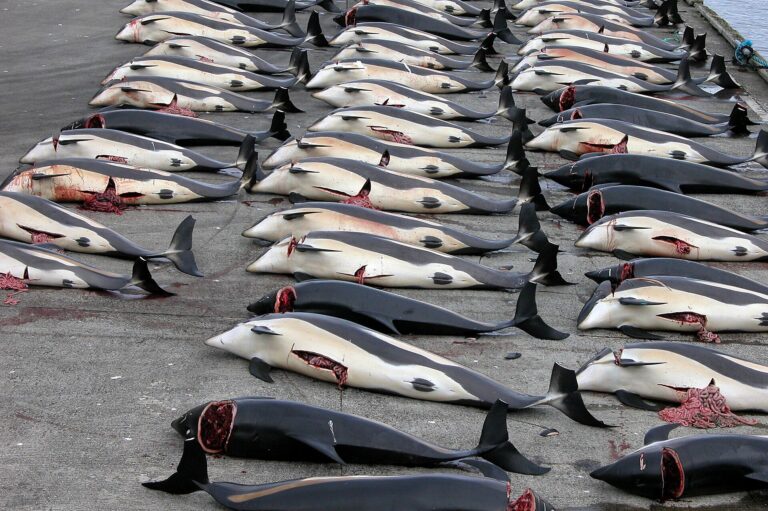
Minkes are the most heavily hunted whale on Earth today. While most great whales have been off limits to commercial whaling under the IWC moratorium since 1986, three nations still hunt minkes in significant numbers. Norway sets unilateral commercial quotas in the North East Atlantic. Iceland has continued commercial minke hunts on and off, although its main remaining whaling operation, Hvalur, targets fin whales and has paused repeatedly. Japan resumed commercial whaling inside its own waters in 2019 after leaving the IWC, with minkes as one of the main target species. There is more on this in our pieces on why we hunt whales and the more recent news on Iceland resuming whale hunting.
Whether the take is sustainable is contested. Pro hunting governments argue that current quotas are well within scientifically calculated yield. Critics, including most major conservation NGOs, argue that the welfare impact of harpoon killing on individual whales is unacceptable and that broader ecosystem and climate pressures should rule out any commercial take. For a wider picture of how different whale species are doing globally, see our overview of the conservation status of different whale species.
Other modern pressures on minkes include:
- Ship strikes: minkes feed in coastal waters and shipping lanes, and strikes are likely under reported.
- Entanglement: fishing gear is the most common cause of injury and death in many coastal populations.
- Pollution: as long lived top predators, minkes accumulate organochlorines, PCBs, and heavy metals.
- Climate change: shifting prey distributions, especially capelin and sand eels, affect feeding success at high latitudes.
For deeper reading, see the NOAA Fisheries minke whale page, the IUCN Red List entry for Balaenoptera acutorostrata, and the well referenced Wikipedia article on the common minke whale.
How you can help minke whales
- Support boycotts and consumer pressure on whale meat imports in Iceland, Norway, and Japan. The market for whale meat is small and shrinking. Demand pressure works.
- Support sustainable, well managed fisheries that reduce bycatch and entanglement, and back fishery rope and trap innovations that minimise risk to whales.
- Pick whale watching operators that respect distance and approach rules. Responsible operators are direct economic competition to whaling.
- Stay informed and share. Our species profile library is built so you can learn about a species in a single sitting.
Take whales home
Bring this species home with a curated collection of whale plush, books, jewelry, and apparel. Every order supports more long form whale writing on lovewhales.org.
Frequently asked questions
How big is a common minke whale?
Adult common minkes typically grow to somewhere between 8 and 10 metres long and weigh up to around 9 tonnes. They are the smallest of the rorquals and one of the smallest baleen whales overall.
Where can I see common minke whales?
They are common across the North Atlantic and North Pacific. Reliable hot spots include the west coast of Ireland and Scotland, Iceland, Norway, the Faroes, the Gulf of Maine and St Lawrence in North America, and the seas around Japan and Korea.
What is the difference between a common minke and an Antarctic minke?
They are separate species. Common (northern) minkes have a bright white band on the pectoral flipper. Antarctic minkes lack that band and tend to be slightly larger. They also live in different hemispheres and rarely overlap.
What do common minke whales eat?
Diet varies by region. In high latitudes they mostly eat krill and copepods. In temperate seas they target small schooling fish such as herring, sand eels, capelin, sprat, and mackerel. They lunge feed in the same way as their larger rorqual relatives.
Are common minke whales endangered?
No. The IUCN classes the species as Least Concern. The IWC modelled 157,057 common minke whales in the North Atlantic for 2022, with a 95 percent interval of 144,395 to 169,081.
Are minke whales still hunted?
Norway and Japan continue catching common minke whales. Iceland remains licensed but reported no minke catches from 2022 through 2025. Norway sets the largest quotas, followed by Japan since it left the IWC in 2019. The overall global take is in the hundreds per year, far smaller than 20th century whaling but still controversial.
How long do minke whales live?
Most common minkes live 30 to 50 years. They mature young, around 6 to 8 years, and breed about every one to two years, which gives the species a strong demographic base.
Do minke whales sing?
They produce a wide range of low frequency sounds. North Pacific common minkes make a distinctive “boing” call linked to males during winter. North Atlantic populations produce pulse trains, clicks, and downsweeps. Their full acoustic repertoire is still being studied.
Updated 14 September 2026: updated the North Atlantic common minke estimate.


Minkes were the whales we saw most in Iceland. Small but lovely.
Is there still much demand for whale meat in Norway?
Wenzel, from what I have read, demand at home has been falling for years.
Didn’t know the Antarctic minke was a separate species.