

Whale Migration Patterns Explained
Last updated: September 14, 2026
7 min read
Whale migration is one of the longest commutes in the animal world. Eastern North Pacific gray whales cover 16,000 to 22,000 kilometres a year between Arctic feeding grounds and the lagoons of Baja California. Humpbacks loop between high latitude feeding grounds and tropical breeding bays. Bowheads never leave polar water. And some whales do not migrate at all, which turns out to be just as interesting. This guide covers what is known about cetacean migration, why species pick the routes they pick, and how a warming ocean is redrawing the map.
Key facts at a glance
- Longest migration: gray whale, 16,000 to 22,000 km a year between the Bering and Chukchi seas and Baja California
- Typical pattern: migratory baleen whales feed in cold water and breed in warm water
- Non migrators: bowheads, resident orca populations, and the blue whales of the South Taranaki Bight in New Zealand
- Navigation: probably a mix of magnetic sensing, sea floor topography, currents, and learned routes
- Climate shift: several feeding grounds are moving north as prey moves, and some routes are getting longer
The basic logic
Most large baleen whales follow the same annual pattern: feed hard in cold, productive water for part of the year, fast through a months long migration, then breed and calve in warm, sheltered, low predator water where a calf can grow without losing heat to a cold sea. The energy maths only works if the feeding grounds are rich enough that a few months of intensive feeding pays for the round trip and the breeding season on top.
Humpback whales
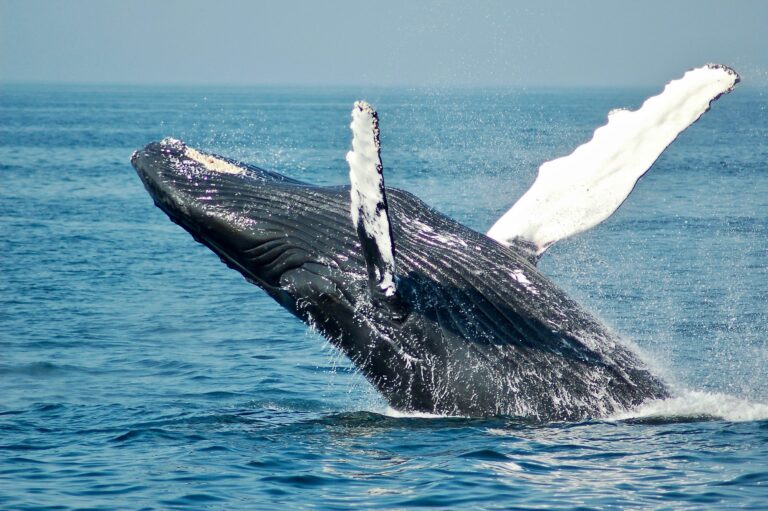
Humpbacks are the textbook migrators. They feed in summer at high latitudes in both hemispheres: the Gulf of Maine, Alaska, Iceland, Norway, the Antarctic Peninsula, southern Australia. Then they swim to warm, shallow breeding grounds off Hawaii, Mexico, the Caribbean, Tonga, Brazil, Madagascar, and the Great Barrier Reef. Round trip distance varies by population but is often 8,000 to 10,000 km. Our account of Moon, the humpback who swam from British Columbia to Hawaii with a broken spine, shows how strongly individual whales hold to the route.
Gray whales
NOAA describes the gray whale as making one of the longest annual migrations of any mammal: about 10,000 miles round trip, and in some cases upwards of 14,000, which is 16,000 to 22,000 km. Eastern North Pacific grays feed in the shallow Bering and Chukchi seas in summer, then swim south along the North American coast to calve in the lagoons of Baja California Sur: San Ignacio, Ojo de Liebre, Magdalena. The route hugs the shore closely enough that whale watchers can pick them up from headlands in Oregon, Washington and California. Calves are born in the lagoons and head north with their mothers in spring. See our gray whale species profile for the full picture.
Blue whales
Blue whales migrate, but the patterns vary by population and are not fully mapped. Eastern Pacific blues feed off California and Mexico and breed in lower latitude areas that are still poorly described. North Atlantic blues feed off Iceland and the eastern Canadian shelf. Antarctic blues feed in the Southern Ocean and move north in winter. New Zealand is the clear exception: work led by Leigh Torres at Oregon State University from 2014 onwards showed that the blue whales of the South Taranaki Bight, between the North and South Islands, are a genetically distinct population that is present in every month of the year and does not migrate out. Tag and acoustic data keep filling in the rest.
Bowhead and right whales
Bowheads never leave polar and sub polar water, but that does not make them sedentary. The Bering Chukchi Beaufort stock winters in the Bering Sea south of the pack ice and moves north through the Bering Strait into the Chukchi and Beaufort seas as the ice breaks up in spring. The journey is real, it just stays inside the Arctic instead of running out of it.
North Atlantic right whales migrate along the United States east coast between summer feeding grounds in the Gulf of Maine and Bay of Fundy and calving grounds off Georgia and Florida. The route is short by gray whale standards, but it runs through some of the busiest shipping lanes in the world, which is why ship strike dominates the conservation picture for the species. See also our coverage of dead right whales in the Gulf of St Lawrence.
Sperm whales
Sperm whales are not classical migrators. Females and calves stay in tropical and subtropical water in stable matrilineal units. Mature males roam much more widely and travel alone to high latitudes to feed. Vocal clans across the Pacific occupy overlapping but socially distinct ranges. The species is better described as a nomadic deep water forager than a seasonal commuter. Our sperm whale species profile goes into the social structure.
How whales navigate
The mechanics are still partly unresolved. Candidate cues include the earth’s magnetic field, the position of the sun, current patterns, bottom topography sensed acoustically, salinity and temperature gradients, and learned routes passed between generations. Strandings sometimes cluster near magnetic anomalies, which has been used as indirect evidence for magnetoreception. Tagging has recorded whales holding remarkably straight courses across thousands of kilometres of featureless ocean, which points to several cues working together rather than one. For what happens when it goes wrong, see how whales lose their way home.
Climate change and migration
As northern feeding grounds warm, prey moves. Capelin, krill and copepod distributions are shifting, and some whale populations are following. Humpbacks in the eastern North Atlantic are increasingly seen further north than their historical haunts. North Atlantic right whales moved feeding effort into the Gulf of St Lawrence over the past decade, which exposed them to a set of shipping and fishing risks nobody had planned for.
The gray whale case is the starkest. NOAA declared an unusual mortality event that ran from December 2018 to November 2023, covering 690 strandings across the United States, Mexico and Canada, and linked it to ecosystem change on the Arctic feeding grounds: less food, malnutrition, lower birth rates. The event was closed in 2023, by which point the eastern North Pacific population had fallen by roughly 40 percent. Our piece on gray whale die offs covers it in detail.
Why fasting works for migrators
Long migrations are paid for in blubber, and the bill is enormous. A 2025 study in Marine Mammal Science used drone photogrammetry on 103 adult humpbacks moving between Antarctic feeding grounds and Colombian breeding grounds, and measured a loss of about 36 percent of body condition over the cycle, roughly 11,000 kg of blubber per whale.
Calorie demand during the fast is lower than people assume: metabolic rate drops, body temperature is held efficiently, and swimming at cruising speed is hydrodynamically cheap. Even so, several consecutive poor feeding years compound, and the effect turns up in reproductive failure rates before it turns up anywhere else.
Vertical migration: a different axis
Not all whale movement is horizontal. Sperm whales forage on a daily vertical commute, with routine dives running from about 400 metres to over 1,000 and lasting 35 to 45 minutes each, repeated through the day and night. The deepest well documented sperm whale dive reached about 2,250 metres. Beaked whales go deeper still: the record for Cuvier’s beaked whale is close to 3,000 metres. Pilot whales and Risso’s dolphins follow their own versions of the same pattern. All of it is shaped by the daily vertical migration of the prey, especially the deep scattering layer that rises toward the surface at night and sinks again at dawn.
Calving grounds and why they matter
Calving grounds are the other half of the migration story. Hawaiian humpback breeding waters, the Baja California gray whale lagoons, the Silver Bank in the Dominican Republic, and the southern right whale nurseries off Argentina and South Africa are all warm, sheltered, shallow, and short on predators. Calves are born big enough to swim with their mothers but need months of nursing in conditions that conserve heat. The same physical features that make these places good calving grounds make them good whale watching destinations, which is why operator behaviour in those waters matters more there than almost anywhere else. Our report on whale watchers meeting gray whales in the lagoons covers one famous example.
Tagging, satellites, and what we still do not know
Most of what we know about cetacean migration comes from satellite linked tags. A tag transmits when the whale surfaces, and the Argos and Iridium constellations relay the position to a research lab. Some programmes have followed individuals through a complete annual cycle.
Sample sizes stay small, though. Most populations have only a handful of tagged individuals at any time, and tags fall off within weeks to months. Population level patterns are usually stitched together from many partial tracks rather than read off one complete map. Genetic stock identification, acoustic detection arrays and environmental DNA are closing the gap faster than tags alone ever did.
Migration and whale watching
Migration timing is the foundation of the whale watching industry. Hawaii sees humpbacks from December to April. Hermanus in South Africa sees southern right whales from June to November. Kaikoura sees sperm whales year round, precisely because they do not migrate. Iceland sees humpbacks and minkes from June through August. Our month by month whale watching calendar has the full schedule, and the best spots by species guide covers where to stand.
Take whales home
If the migration story pulled you in, the whale book collection in our store is the natural next step: biology, behaviour, and the long history of people and cetaceans. Every order supports more long form whale writing on lovewhales.org.
Frequently asked questions
Which whale migrates the furthest?
The eastern North Pacific gray whale. NOAA puts the annual round trip at about 10,000 miles, and upwards of 14,000 in some cases, which is 16,000 to 22,000 km between the Bering and Chukchi seas and the Baja California lagoons.
Why do whales migrate?
To use two different environments. Cold, productive seas are where the food is. Warm, sheltered seas are where a calf can be born without burning its energy on staying warm.
Do all whales migrate?
No. Bowheads stay in Arctic and sub Arctic water year round. Many orca populations are resident. The blue whales of the South Taranaki Bight in New Zealand are present in every month of the year and do not migrate out.
How do whales navigate?
Probably several cues at once: magnetic sensing, sun position, bottom topography sensed acoustically, temperature and salinity gradients, and routes learned from other whales. No single mechanism has been isolated.
Are whale migrations changing because of climate?
Yes. Several populations are shifting feeding range north as prey moves, which lengthens some routes and pushes whales into shipping and fishing areas where they were not previously a management concern.
Do whales eat while migrating?
Most migratory baleen whales fast or feed only opportunistically on migration and run on blubber laid down during the feeding season.



Some whales migrating thousands of kilometres while others stay put is fascinating.
Right whales moving into the Gulf of St Lawrence, right into busy shipping lanes, is worrying.
Hailey, Canada’s speed limits in the Gulf are meant to help with that.
Moon’s story still gets to me.
How sure are scientists that whales use magnetic fields to navigate?
Sperm whales diving up and down all day is exhausting just to think about.
Bowheads staying near their food all year is a neat trick.