

Species Profile: The Dwarf Sperm Whale
Last updated: October 14, 2026
4 min read
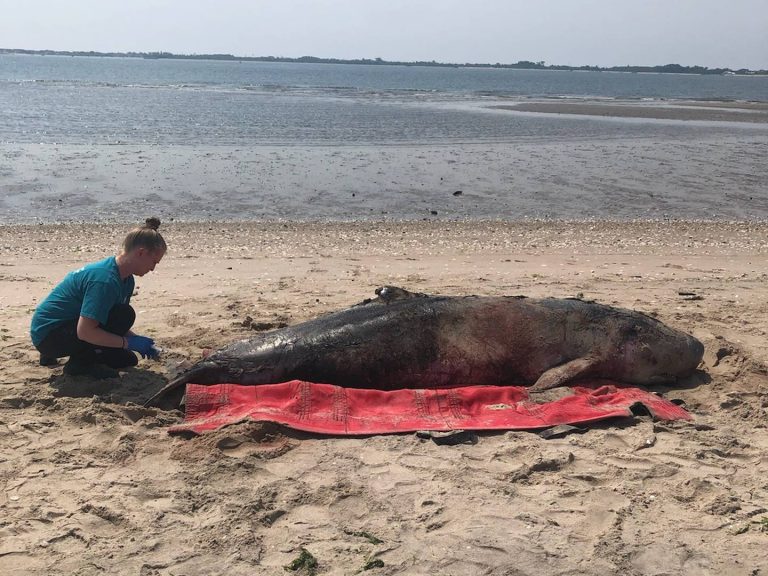
The dwarf sperm whale is one of only two cetaceans that can eject a cloud of dark fluid to escape a predator, squid style. It is also one of the least seen whales in the ocean, and almost everything we know about it comes from animals that washed ashore.
It is one of three surviving species in the sperm whale line, alongside the pygmy sperm whale and the sperm whale itself, and it is by far the smallest of them. Adults reach at most 2.7 metres (8.9 ft), which makes them shorter than several dolphins.
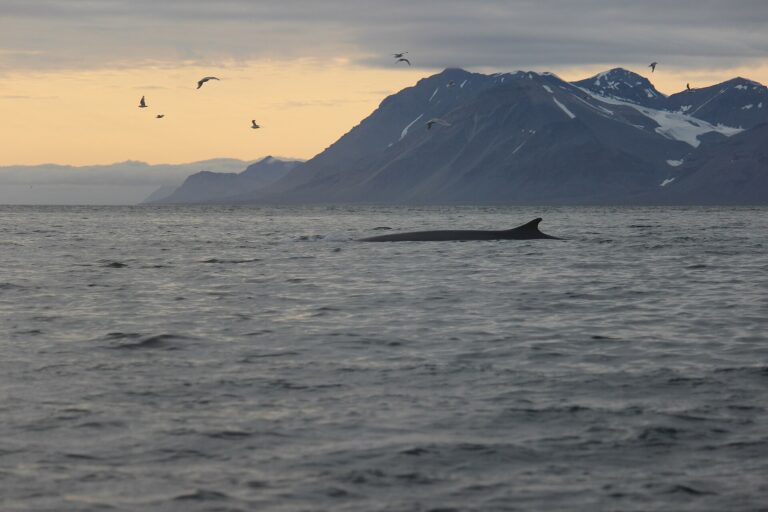
They favour calm water, where they spend long stretches lying motionless at the surface with the head slightly raised. In appearance and behaviour they are so close to the pygmy sperm whale that telling the two apart at any distance is close to impossible. The dwarf is the smaller of the pair and carries a taller, more prominent dorsal fin set near the middle of the back, which is enough to have it mistaken for a bottlenose dolphin at first glance.
The body is blue grey with a paler underside, and there is a light coloured crescent behind each eye, the false gill, which is part of why people sometimes take a stranded one for a small shark. The snout overhangs a small underslung jaw set with long, curved, sharp teeth. That dentition is why the species picked up the name rat porpoise in the Lesser Antilles. The flippers are short and broad. Like the rest of the family it carries a spermaceti organ in the forehead.
Mostly solitary, they are occasionally seen in small groups.
1) Scientific name
Kogia sima (Owen, 1866)
2) Scientific classification
- Kingdom: Animalia
- Phylum: Chordata
- Class: Mammalia
- Order: Artiodactyla
- Family: Kogiidae
- Genus: Kogia
- Species: Kogia sima
3) Life expectancy
Believed to be up to around 22 years.
4) Length
Adults run from about 2 metres to a maximum of 2.7 metres (8.9 ft).
5) Weight
Between about 136 and 272 kg (300 to 600 lbs).
6) Swimming speed
Slow and deliberate. They cruise at a few knots and spend a lot of time floating motionless at the surface, which is one of the few reliable ways to spot one.
7) Interaction with humans
Small numbers are still taken in artisanal harpoon fisheries in parts of Asia and the Caribbean, and the species was caught during the commercial whaling era, though it was never a major target.
It tends to stay over the continental shelf and slope rather than far offshore, which puts it closer to fishing gear, shipping, and coastal pollution than its deep water habits would suggest.
Dwarf sperm whales are very difficult to spot at sea. They rarely approach boats, though they will sometimes let a boat approach them.
8) Reproduction
Males mature at around 2 to 3 years and females at around 5, at a body length of roughly 2 to 2.2 metres. Gestation runs about 9.5 months and produces a single calf of about 1 metre and 14 kg. Females give birth roughly every other year.
9) Diet and hunting
Mainly squid, taken by suction feeding, along with some crustaceans and fish. In Hawaiian waters crustaceans make up a meaningful share of the diet.
Both Kogia species carry a sac in the lower intestine holding a red brown fluid. Released under stress, it can cloud more than 100 square metres of water, and the animal disappears behind it. No other cetacean has this.
10) Alternative names
- Rat porpoise
- Owen’s pygmy sperm whale
11) Population and conservation status
The IUCN reassessed the dwarf sperm whale in 2020 and lists it as Least Concern. That is a change from the older Data Deficient listing you will still find quoted in a lot of places, and it is worth reading carefully: it means assessors found no evidence of a decline steep enough to justify a threatened category, not that the species is well counted. There is still no global population estimate.
It is listed on CITES Appendix II and is covered by several regional cetacean conservation agreements, including the Pacific Cetaceans memorandum of understanding and the Western African Aquatic Mammals memorandum of understanding.
The pressures on it are the familiar ones:
- Entanglement in fishing gear and bycatch in commercial fisheries.
- Plastic ingestion. Stranded Kogia are found with plastic and other debris in the gut often enough that it is a recognised cause of death in the species.
- Disease, including degenerative heart disease and heavy parasite loads recorded in stranded animals.
- Underwater noise and sonar.
- Ship strikes.
12) Ancestry and history
The dwarf sperm whale sits in the family Kogiidae with the pygmy sperm whale, and the sperm whale is the next closest relative. The two Kogia were long treated as one species. Charles Handley’s 1966 revision established the dwarf sperm whale as distinct. A 1998 review changed the grammatical form of its scientific name from Kogia simus to Kogia sima.
13) Distribution and habitat
Found in tropical and temperate seas worldwide, with a preference for the continental shelf edge and slope rather than the open abyss. Records come from waters off Australia, New Zealand, Indonesia, Japan, Chile, southern Brazil, South Africa, Oman, the Persian Gulf, the Maldives, Hawaii, California, the Gulf of California, the Gulf of Mexico, the southeastern United States, and northwest Europe.
Updated 14 September 2026: corrected the taxonomic history of dwarf sperm whales.



A whale that squirts ink? Didn’t know that.
Amazing how little is known about these small whales.
Ferenc, agreed. Most of what we know comes from strandings.