
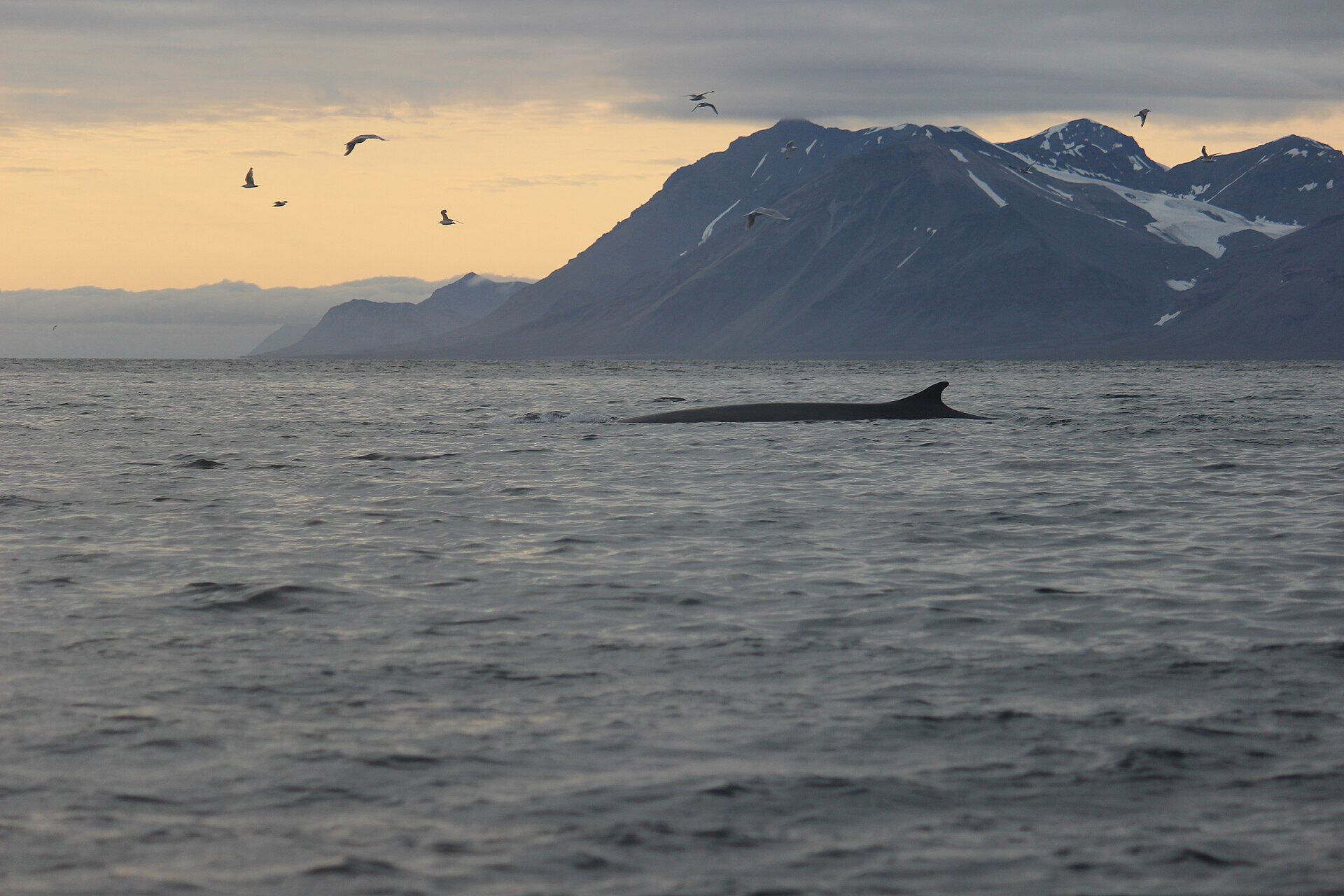
Species Profile: The Fin Whale
Last updated: October 14, 2026
9 min read
The fin whale (Balaenoptera physalus) is the second largest animal that has ever lived on Earth, beaten only by the blue whale. Nicknamed the greyhound of the sea, this sleek baleen giant can outpace a fast cruise ship, dive deep for krill, and produce calls so low that the human ear cannot register them. This profile pulls together what the science says about its size, range, behaviour, and conservation status, plus where you can realistically expect to see one in the wild.
Key facts at a glance
- Scientific name: Balaenoptera physalus
- Other names: finback whale, common rorqual, razorback
- Family: Balaenopteridae (rorquals)
- Max length: around 26 metres (85 feet), with a few Southern Hemisphere records past 27 metres; females are slightly larger than males
- Weight: commonly cited at up to about 80 tonnes, and the very largest animals heavier still
- Top speed: bursts of 37 to 41 km per hour (23 to 25 mph), with faster figures reported from whaling era chases
- Diet: krill, copepods, small schooling fish such as herring and capelin, occasionally squid
- Habitat: open ocean in all major oceans, mostly outside polar pack ice
- Lifespan: 75 to 90 years, possibly longer
- IUCN Red List status: Vulnerable (2018 assessment), with an estimated 100,000 to 140,000 mature animals worldwide
What a fin whale looks like
If you ever get the chance to watch a fin whale surface alongside a research boat, two things stand out. The first is the sheer length: the body looks like it is never going to end as the back rolls past you. The second is the colour pattern. Fin whales are unique among large whales in having asymmetric pigmentation. The right lower jaw is bright white, while the left lower jaw is dark grey. Inside the mouth, the right side of the baleen is also pale, and the left is dark. No one has settled the question of why, but the leading theory is that the whale tends to roll onto its right side when lunge feeding, so the pale side flashes through the bait ball and may help round up prey.
The body is long, slender, and built for speed, with a small dorsal fin set far back along the spine. There is a pale chevron pattern behind the head that helps researchers identify individuals from photographs. The blow is tall and column shaped, often 4 to 6 metres high, which is one of the easiest ways to spot a fin whale from a long way off.
How fast is the greyhound of the sea?
American naturalist Roy Chapman Andrews coined the greyhound of the sea nickname after watching fin whales pace his ship in the early 20th century. Modern telemetry has caught fin whales cruising at 30 to 35 km per hour and sprinting close to 41 km per hour over short distances. That is a remarkable speed for an animal the length of a basketball court. The combination of size and speed is part of why fin whales escaped early whaling fleets: until the steam catcher boat and the explosive harpoon arrived in the late 19th century, no whaling crew could catch up with one. Once the catchers could match their speed, fin whale populations collapsed in a few decades.
Where fin whales live
Fin whales are found in every major ocean. Three subspecies are currently recognised, one each for the North Atlantic, the North Pacific and the Southern Hemisphere. A population in the Mediterranean is genetically distinct from the North Atlantic animals outside the strait. Unlike humpbacks and grays, fin whales do not follow a tidy migration corridor from cold feeding grounds to warm calving lagoons. They shift seasonally between higher latitude feeding areas in summer and lower latitude waters in winter, but the routes are diffuse and the timing varies between individuals.
You can find fin whales close to shore in only a few hotspots, including the Sea of Cortez, the Bay of Biscay, the waters off Pico in the Azores, and around Iceland in summer. Across most of the range they live well offshore, which is why they show up so often in ship strike reports.
Diet and lunge feeding
Fin whales are baleen whales. Instead of teeth they have somewhere between 260 and 480 baleen plates of keratin on each side of the upper jaw, forming a giant strainer. To eat, they accelerate towards a dense patch of prey, then open the lower jaw wide and engulf an enormous mouthful of water and food. The throat pleats balloon outward to hold the volume, then the whale closes its mouth and uses its tongue to push water back out through the baleen, trapping prey on the inside. A single lunge can take in a volume of seawater greater than the whale’s own body volume.
The exact menu varies by region. In the Antarctic and in the North Pacific, fin whales feed mostly on krill. In the North Atlantic, they take more small schooling fish such as herring, capelin, and sand lance. Mediterranean fin whales specialise on the northern krill Meganyctiphanes norvegica. Adult animals eat on the order of 1 to 2 tonnes of food per day during the feeding season, then live off body fat through the leaner winter months.
Behaviour and social life
Fin whales are not as social as humpback or sperm whales. They are usually seen alone or in pairs, sometimes loosely associated with a handful of other animals around concentrated food. Large feeding aggregations gather where prey is abundant, for example off New England in summer or along the Iberian shelf in autumn. They are not known to form the long term social bonds that sperm whale matrilines do, but acoustic data suggests they may stay in contact with each other across hundreds of kilometres through their loud, very low frequency calls.
Foraging dives typically last 10 to 15 minutes and reach 100 to 300 metres, with recorded feeding dives past 300 metres. The blow sequence is distinctive: four to eight tall column blows over a few minutes, then a long terminal dive that sometimes shows the tail flukes but more often does not. Compared with humpbacks, fin whales rarely breach.
The 20 Hz pulse
Fin whales produce one of the loudest and lowest frequency sounds of any animal, a short tonal pulse centred on 20 Hz that can reach about 186 dB re 1 micropascal at 1 metre. That is at or below the lower limit of human hearing, which is why standing on a boat above a calling fin whale you hear nothing at all. Hydrophones, however, pick the calls up from hundreds of kilometres away. Researchers used to assume only mature males produced the pulse, in a song like sequence during the breeding season. More recent work suggests the function of the call may include long range social contact as well as mate attraction. The sound is so persistent that it appears as a clean, narrow band on long term ocean noise spectrograms across whole ocean basins.
Reproduction and lifespan
Fin whales reach sexual maturity at about 6 to 10 years old and around 17 to 19 metres in length. Mating happens in temperate waters during the winter. Gestation lasts about 11 to 12 months, and a single calf is born roughly every two to three years. Newborns are around 6 to 6.5 metres long and nurse on extremely fat rich milk for six to seven months. Hybrids with blue whales have been documented several times in the North Atlantic and the North Pacific, sometimes confirmed by DNA, which is striking for animals so different in size. Estimates of maximum lifespan run to 90 years and beyond, based on earplug lamination counts.
Conservation status and threats
The fin whale is listed as Vulnerable on the IUCN Red List, with roughly 100,000 to 140,000 mature animals worldwide at the 2018 assessment. That is a recovering number, not a healthy one. Twentieth century whaling took around 874,000 fin whales in total, of which about 726,000 came from the Southern Hemisphere between 1905 and 1976. The species was given protection from commercial whaling in the North Pacific and Southern Hemisphere in 1976 and in the North Atlantic in 1987. Some hunting continues today: Iceland has resumed commercial fin whaling under reservation in several recent seasons, and Greenland takes a small number under aboriginal subsistence quotas. For background on the broader debate see our explainer on whale hunting facts and motives.
Modern threats are dominated by ship strikes, entanglement in fishing gear, ocean noise, and prey shifts driven by climate change. The Mediterranean population is especially exposed to vessel traffic. Conservation responses include rerouting shipping lanes, speed restrictions in core habitat, and quieter propeller designs. For a wider overview of how fin whales sit alongside other species for risk, see conservation status of different whale species.
Fin whale vs blue whale vs sei whale
Fin whales are often confused with their close relatives. The blue whale is longer and bulkier, with a mottled blue grey body and a tiny dorsal fin set even further back. The sei whale is smaller, with a more upright dorsal fin and a single straight rostral ridge. The asymmetric jaw pigmentation is the giveaway: only the fin whale has it. Sperm whales, profiled separately in our sperm whale guide, look nothing like a fin whale once you see the blunt squared head.
Where to see a fin whale in the wild
The most reliable places to see fin whales from a boat are Pico and Faial in the Azores from April to June, the Bay of Biscay on cross channel ferries between Plymouth and Santander, Iceland from May to August, the Sea of Cortez from January to April, and Stellwagen Bank off Massachusetts in summer. Around Long Beach and the Channel Islands in California, fin whales appear year round in lower numbers. For a wider tour of options across species, see our roundup of the best whale watching spots worldwide by species.
Further reading
For the most current status assessment, the IUCN Red List entry for Balaenoptera physalus is the canonical reference. NOAA Fisheries publishes an accessible summary covering US waters management. The Wikipedia fin whale article is well sourced and links out to most of the primary literature.
Take whales home
Bring this species home with a curated collection of whale plush, books, jewelry, and apparel. Every order supports more long form whale writing on lovewhales.org.
whale plush toys
Read next
- Whale Species: A Complete Guide to the Cetaceans of the World
- Species Profile: The Antarctic Minke Whale
- Species Profile: The Long-Finned Pilot Whale
Frequently asked questions
How big does a fin whale get?
Adult fin whales reach about 20 to 26 metres in length, and Southern Hemisphere animals occasionally more. Females are slightly longer than males. That makes them the second largest animal on the planet, after the blue whale.
The fin whale takes second place on our rundown of the 5 biggest whales on Earth, beaten only by the blue whale.
How fast can a fin whale swim?
Cruising speed is around 10 km per hour, but fin whales can burst to 37 to 41 km per hour. That speed earned them the nickname greyhound of the sea, and it kept them safe from whalers until the arrival of the steam catcher boat.
What do fin whales eat?
Krill makes up most of their diet in polar waters. In temperate seas they take more small schooling fish such as herring, capelin, and sand lance. Adults eat roughly 1 to 2 tonnes a day during the feeding season and live off blubber reserves in winter.
Where do fin whales live?
They live in every major ocean, mostly in open water. Reliable nearshore sightings happen in the Sea of Cortez, the Bay of Biscay, the Azores, Iceland, and Stellwagen Bank off Massachusetts. A genetically distinct population also lives in the Mediterranean.
Are fin whales endangered?
The IUCN lists the fin whale as Vulnerable, with 100,000 to 140,000 mature animals estimated at the 2018 assessment. Industrial whaling removed roughly 726,000 fin whales from the Southern Hemisphere alone in the 20th century. Numbers are recovering in most regions, but ship strikes, entanglement, and noise remain real pressures.
How long do fin whales live?
Lifespan estimates based on counts of earplug laminae run to 75 or 90 years, with some individuals likely older. Sexual maturity is reached at 6 to 10 years and a body length around 17 to 19 metres.
How is a fin whale different from a blue whale?
Blue whales are longer, bulkier, mottled blue grey, and have an even smaller dorsal fin set further back. Fin whales are sleeker, dark grey on top, and have unique asymmetric jaw pigmentation: the right lower jaw is white and the left is dark.
Can humans hear fin whale calls?
Not really. The classic fin whale 20 Hz pulse sits at or below the lower limit of human hearing, which is about 20 Hz at best. Hydrophones pick the calls up from hundreds of kilometres away, and recordings can be sped up or pitch shifted to make them audible.
Updated 14 September 2026: added the reference units for fin whale calls.



Saw a fin whale from the Bay of Biscay ferry once. It kept pace with the ship without trying.
Would like to know more about the Mediterranean fin whales.