
Species Profile: The Humpback Whale
Last updated: October 26, 2026
9 min read
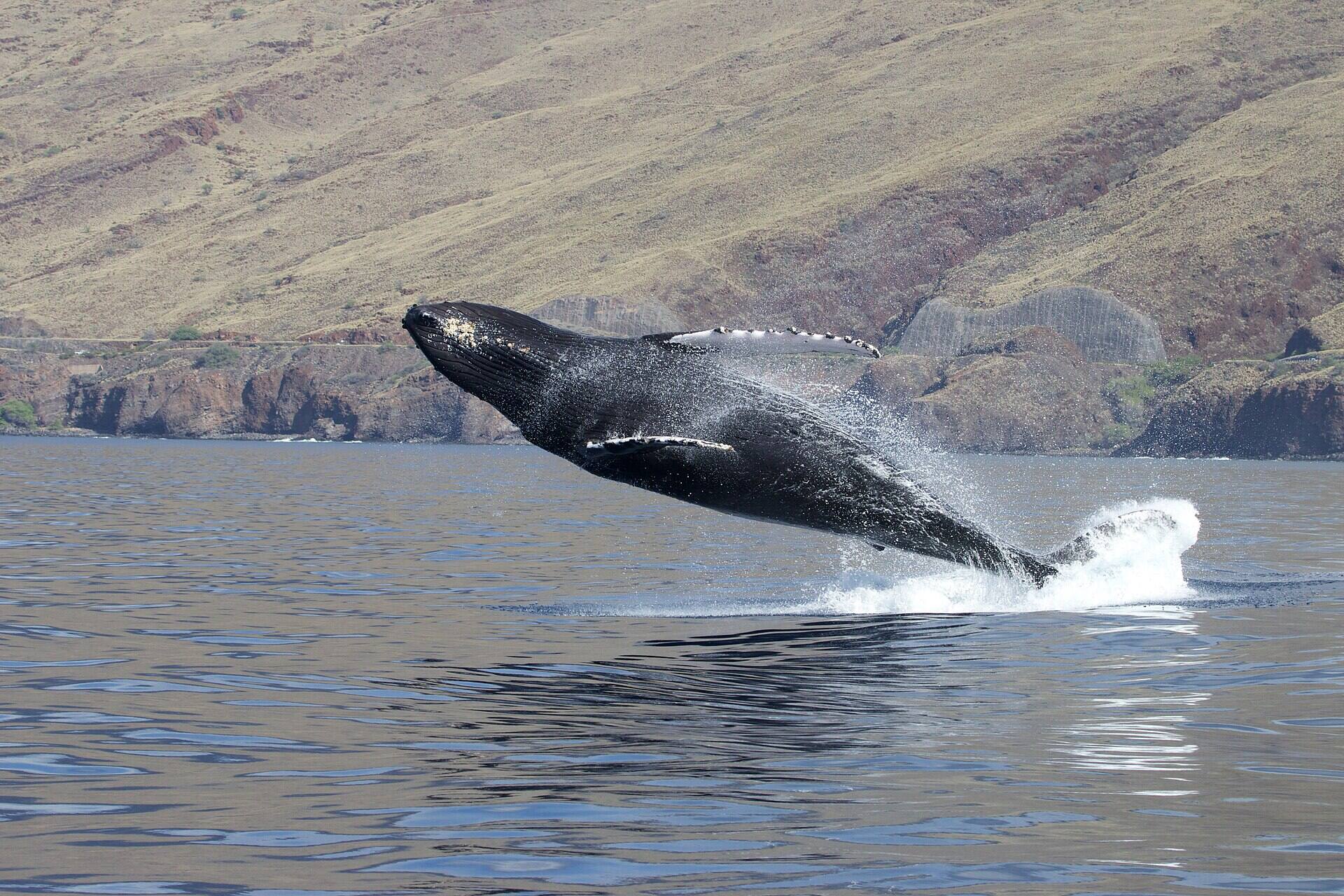
Photo: National Marine Sanctuaries, Public domain, Wikimedia Commons (source: Wikimedia Commons)
The humpback whale (Megaptera novaeangliae) is the large whale most people see first. It breaches clear of the water, slaps the surface with pectoral fins up to about five metres long, sings long and changing songs, and has recovered in most oceans since commercial whaling ended. Recovery is not the whole story: the North Pacific population shrank after a marine heatwave, as the research section below explains. This profile covers identification, behaviour, feeding, song, migration, and the current state of humpback populations worldwide.
Key facts at a glance
- Scientific name: Megaptera novaeangliae
- Common names: humpback whale, hunchbacked whale
- Max length: approx. 17 m (56 ft), females usually slightly larger than males
- Max weight: approx. 40,000 kg (40 tonnes)
- Diet: small schooling fish, krill, copepods (in cold feeding grounds)
- Habitat: all major oceans, polar to tropical, follows seasonal migration
- Lifespan: approx. 80 to 90 years
- IUCN status: Least Concern globally, some subpopulations still Endangered
- Estimated population: approx. 135,000 worldwide (IUCN, 2018 assessment)
Taxonomy and classification
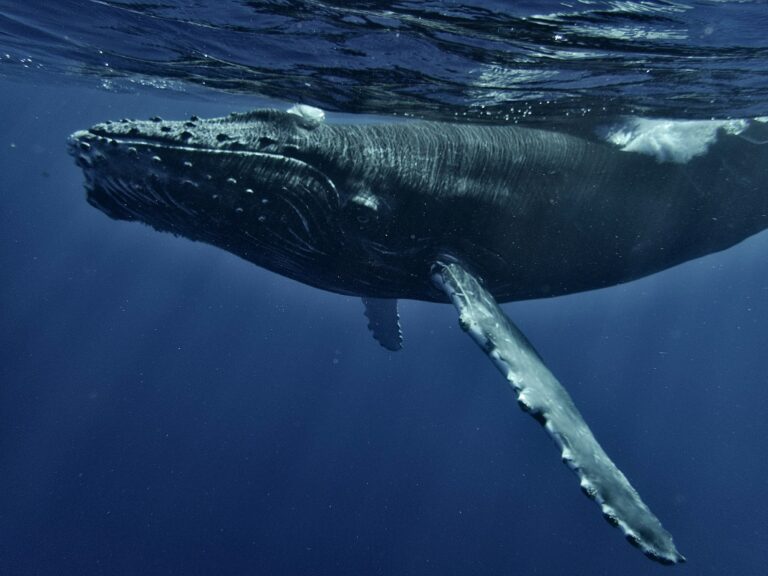
Humpback whales belong to the family Balaenopteridae, the rorquals, which also includes blue, fin, sei, Bryde’s, and minke whales. Despite that family resemblance, the humpback is the only species in its genus, Megaptera, which means big winged. That name refers to its enormous pectoral fins, which can reach a third of the animal’s body length.
- Kingdom: Animalia
- Phylum: Chordata
- Class: Mammalia
- Order: Artiodactyla
- Infraorder: Cetacea
- Parvorder: Mysticeti (baleen whales)
- Family: Balaenopteridae
- Genus: Megaptera
- Species: M. novaeangliae
Appearance and how to identify a humpback
Humpbacks are easy to identify even at a distance. The body is robust, the back is heavily humped (hence the name), and the pectoral fins are very long, mostly white on the underside, often two to five metres each. The tail fluke has a deep central notch and a trailing edge that is patterned uniquely in every individual: a black and white fingerprint that researchers use for photo identification.
The head is covered with tubercles, the small bumps that look like golf ball dimples. Each tubercle contains a single hair follicle and is thought to function as a sensor for water movement. The mouth contains 270 to 400 pairs of baleen plates, dark grey or black, hanging from the upper jaw. The throat has 14 to 35 ventral grooves that expand like an accordion during the explosive lunge feeding for which the species is famous.
Feeding strategies: lunges, bubbles, and cooperation
Humpbacks feed mainly in cold, productive waters. Rare feeding has also been documented during migration and on breeding grounds. They eat krill, copepods, and small schooling fish such as herring, capelin, sand lance, and anchovy. They put on enough blubber in a single summer to fuel the rest of the year, including a fasting migration and, for females, a lactation. The species has developed some of the most sophisticated feeding behaviour in the marine world.
Bubble net feeding is the most famous example. Working in teams of two to a dozen, humpbacks dive below a school of fish, then circle upward while exhaling a curtain of bubbles. The bubbles act as a net that traps the fish. The whales then lunge through the centre of the net with mouths agape. Researchers have documented stable feeding teams in southeast Alaska that work together year after year. Other populations use solo lunge feeding, trap feeding (waiting passively with the mouth open), or kick feeding (slapping the surface with the tail to stun prey).
The song
Male humpbacks produce the most elaborate song known in the animal kingdom. A song lasts 20 to 30 minutes and is then repeated, sometimes for hours on end. It is built from a hierarchical structure of units, phrases, themes, and song cycles. All males in a given ocean basin sing essentially the same song at any one time, but the song slowly evolves year after year, with new themes added and old ones dropped. In the South Pacific, song innovations from the Australian east coast have been shown to propagate eastward through the populations all the way to French Polynesia, in a kind of cultural wave.
The function of the song is still debated. Most researchers think it is a male display, either for attracting females or for negotiating with other males. The song is mostly produced on the breeding grounds in winter. For more on whale acoustics across species, see our roundup in 15 facts about whales.
Migration
Humpbacks make some of the longest migrations of any mammal. They feed at high latitudes in summer, then travel up to 8,000 kilometres to breed and calve in tropical and subtropical waters in winter. Specific populations are tightly tied to specific routes. Hawaiian humpbacks feed in Alaska. Hervey Bay and Tonga humpbacks feed off Antarctica. North Atlantic humpbacks split between Caribbean breeding grounds and feeding areas off Iceland, Norway, and the Gulf of Maine.
Individuals show strong site fidelity. The same mother will return to the same calving lagoon year after year and bring her calves to it. Researchers exploit this loyalty to study populations across decades. Photo identification catalogues such as Happywhale now hold tens of thousands of individually identified humpbacks, most of the images contributed by tour passengers and crew.
Reproduction and calves
Females give birth to a single calf every two to three years, after a gestation of about 11 months. The calf is 4 to 5 metres at birth and weighs about a tonne. It nurses on extremely fatty milk for around 11 months. Mothers and calves rest in shallow sheltered bays such as the Hawaiian Islands, the Silver Bank in the Dominican Republic, and the lagoons of Tonga and the Whitsundays. Males in those areas sing and compete for mating opportunities, sometimes forming aggressive competitive groups around a single receptive female.
Predators and threats
Adult humpbacks are large enough to deter most predators. Killer whales do attack calves, and rake mark scars on humpback flukes are a common sign of past encounters. Humpbacks are famously antagonistic toward orcas in return, often intervening to protect other species as well as their own calves, including gray whale calves, sea lions, and seals. The behaviour is so well documented that it is now considered a recurring pattern, possibly driven by a generalised response rather than altruism.
Human pressures are much more serious. Entanglement in fishing gear, ship strikes, underwater noise, and a changing climate that shifts prey distribution are the main modern threats. Current population status by ocean basin is tracked by NOAA Fisheries and assessed by the IUCN Red List.
Conservation recovery
Commercial whaling took more than 200,000 humpback whales in the Southern Hemisphere during the 20th century, plus roughly 28,000 in the North Pacific. By the time the moratorium took effect in 1986 the species was thought to be on the brink. The recovery in most ocean basins since then has been remarkable. The Australian east coast population has grown from a few hundred animals in the 1960s to tens of thousands, with recent estimates in the 30,000 to 40,000 range. The Hawaiian wintering population has rebounded similarly. The IUCN listed humpbacks as Least Concern globally in 2008. A 2026 Convention on Migratory Species report put the population above 80,000 mature individuals. Some groups are still in trouble. The Arabian Sea population is Endangered. Fewer than 100 whales are estimated in Oman waters, while no range-wide abundance estimate exists and genetic effective population size is likely below 250. Under the US Endangered Species Act the Central America and Arabian Sea distinct population segments are listed as Endangered and the Mexico segment as Threatened.
Research highlights from the last decade
Humpback whale research has produced a string of headline results in the last ten years. Two stand out. First, cultural transmission of song themes across an entire ocean basin, now well documented in the South Pacific. Second, the unusually high incidence of interactions with killer whales in which humpbacks appear to protect other species. Both results push the boundaries of what we think of as culture and altruism in non human animals.
Two studies from 2024 add a harder edge. A photo identification study led by Ted Cheeseman, published in Royal Society Open Science, estimated that the North Pacific humpback population fell by about 20 percent between 2012 and 2021, from roughly 33,000 to about 26,600 whales. The authors link the drop to the 2014 to 2016 marine heatwave, which cut the food supply. Later in 2024 another study in the same journal reported a male humpback photographed off Colombia and then near Zanzibar, at least 13,046 kilometres apart in a straight line, the longest distance yet recorded for the species (CBC). Two large collaborative surveys underpin much of this: YONAH in the North Atlantic in 1992 and 1993, and SPLASH in the North Pacific from 2004 to 2006. Their photographs feed catalogues that now span four decades.
Best places to see humpback whales
Humpbacks are the most accessible large whale to see in the wild. Top destinations include Maui in winter, Hervey Bay in Australia in spring, Husavik in Iceland in summer, Cape Cod and the Stellwagen Bank off Massachusetts, Monterey Bay in California, and the Inside Passage of British Columbia and Alaska. Tonga and the Silver Bank in the Dominican Republic also run regulated in water encounters under permit. For the full picture see our guide to the 10 best whale watching spots.
Acrobatics: what each behaviour might mean
Humpback whales are physically expressive in ways few other large mammals match. A complete trip can sometimes deliver every behaviour in a single afternoon. Each is more than a spectacle: each tells researchers something different about the animal.
- Breaching: full body leap clear of the water. Possibly communication, possibly play, possibly parasite removal.
- Pec slapping: striking the surface with a 5 metre flipper. Often seen in groups of mothers and calves.
- Tail slapping or lobtailing: repeated forceful smacks with the fluke. Thought to signal across long distances or warn rivals.
- Spy hopping: vertical head raise above the surface. Probably visual orientation.
- Trumpeting: a loud forceful exhalation. Often associated with feeding excitement or social tension.
- Logging: motionless rest at the surface, sometimes for half an hour at a time.
Photo identification of individuals over decades has shown that some humpbacks are consistently more acrobatic than others. A few signature whales, like Salt in the Gulf of Maine, have been tracked across more than 40 years. Researchers know her offspring, her grand offspring, and her preferred feeding behaviour.
Humpback whales and other species
Humpbacks share their range with many other large whales. Off Massachusetts they feed alongside fin and minke whales. In the Gulf of California they overlap with blue whales. Off Alaska and Norway they share herring schools with orcas. They also have a long running interspecific conflict with killer whales. Humpbacks have been filmed deliberately intervening when orcas are attacking gray whale calves, harbour seals, sunfish, and even the occasional sea lion. The behaviour is so widespread that some researchers now consider it a stable life history strategy of generalised orca harassment.
How to tell a humpback from other large whales
Look for three things: the long white pectoral fins (no other large whale comes close), the heavily humped back when arching for a dive, and the fluke up dive that exposes the underside of the tail. The dorsal fin is small and variable in shape but usually sits on a fleshy hump. The spout is bushy and 3 to 4 metres tall. Compare this with the much taller spout and smooth back of a fin whale or the squared head of a sperm whale.
Take whales home
Bring this species home with a curated collection of whale plush, books, jewelry, and apparel. Purchases through the store may earn us a commission.
Browse whale plush toys in our store.
Frequently asked questions
How big is a humpback whale?
Adults reach 14 to 17 metres in length and weigh up to about 40 tonnes. Females are usually slightly larger than males. Calves are 4 to 5 metres at birth.
How long do humpback whales live?
NOAA Fisheries estimates a lifespan of 80 to 90 years. Long term photo identification shows individuals returning to the same areas for decades.
Are humpback whales endangered?
Not globally. The IUCN lists the species as Least Concern thanks to widespread recovery since the 1986 whaling moratorium. The IUCN still assesses the Arabian Sea subpopulation as Endangered. Under the US Endangered Species Act the Central America and Arabian Sea segments are Endangered and the Mexico segment is Threatened.
Why do humpback whales breach?
The honest answer is that we are not sure. Breaching may be a form of long range communication, a way to dislodge parasites, a display during male competition, or simple play. Calves seem to breach more often, and most adults breach more in rough seas.
What do humpback whales eat?
Krill, copepods, and small schooling fish such as herring, capelin, sand lance, and anchovy. Humpbacks feed almost exclusively in summer in cold productive waters, then fast for months on the tropical breeding grounds.
How far do humpback whales migrate?
Up to 8,000 kilometres each way, between cold feeding grounds and tropical breeding grounds. Individuals show strong fidelity to specific routes and locations.
Why do humpback whales sing?
Only males sing, mostly on the breeding grounds. The current best explanation is some combination of mate attraction and male to male signalling. The song is also a cultural trait that evolves year on year, sometimes spreading across an entire ocean basin.
Where is the best place to see humpback whales?
Hervey Bay in Australia, Maui in Hawaii, Stellwagen Bank off Massachusetts, the Silver Bank in the Dominican Republic, and the Inside Passage of Alaska and British Columbia are all reliable. Pick a destination based on season: feeding grounds in summer, breeding grounds in winter.
Updated 14 September 2026: corrected feeding, status, and Arabian Sea population claims.
Updated 26 October 2026: rewrote the introduction, added two 2024 studies on the North Pacific decline and a record migration, and removed an unsourced age record.



Megaptera meaning big winged makes so much sense. The pec fins are the part I remember from every humpback photo.
Is the Arabian Sea population still listed separately? I read somewhere it is in a much worse state than the rest.
Davide, yes. The Arabian Sea humpbacks are assessed on their own by the IUCN and are listed as Endangered.
Took my kids on a whale watch out of Boston last summer and they still talk about it.
I would love more on how isolated some of these populations are. Any good beginner reading?
Tomasz, the IUCN Red List page for the Arabian Sea subpopulation is a good free place to start.