
Moon the Humpback Whale Makes a 3,000 mile Journey
Last updated: September 14, 2026
4 min read
A humpback whale called Moon swam roughly 3,000 miles from British Columbia to Hawaii with a broken spine, propelling herself with her pectoral fins because her tail no longer worked. Researchers who had followed her for more than a decade believed it was her last journey, and that she would not survive long enough to make the return trip.
Moon’s story is one of the clearest examples of what a vessel strike does to a whale, and of why ship speed rules near cetaceans exist. It is not a happy story. But it is a story worth keeping, because it makes a threat visible that is otherwise invisible to most people.
How Moon’s injury was discovered
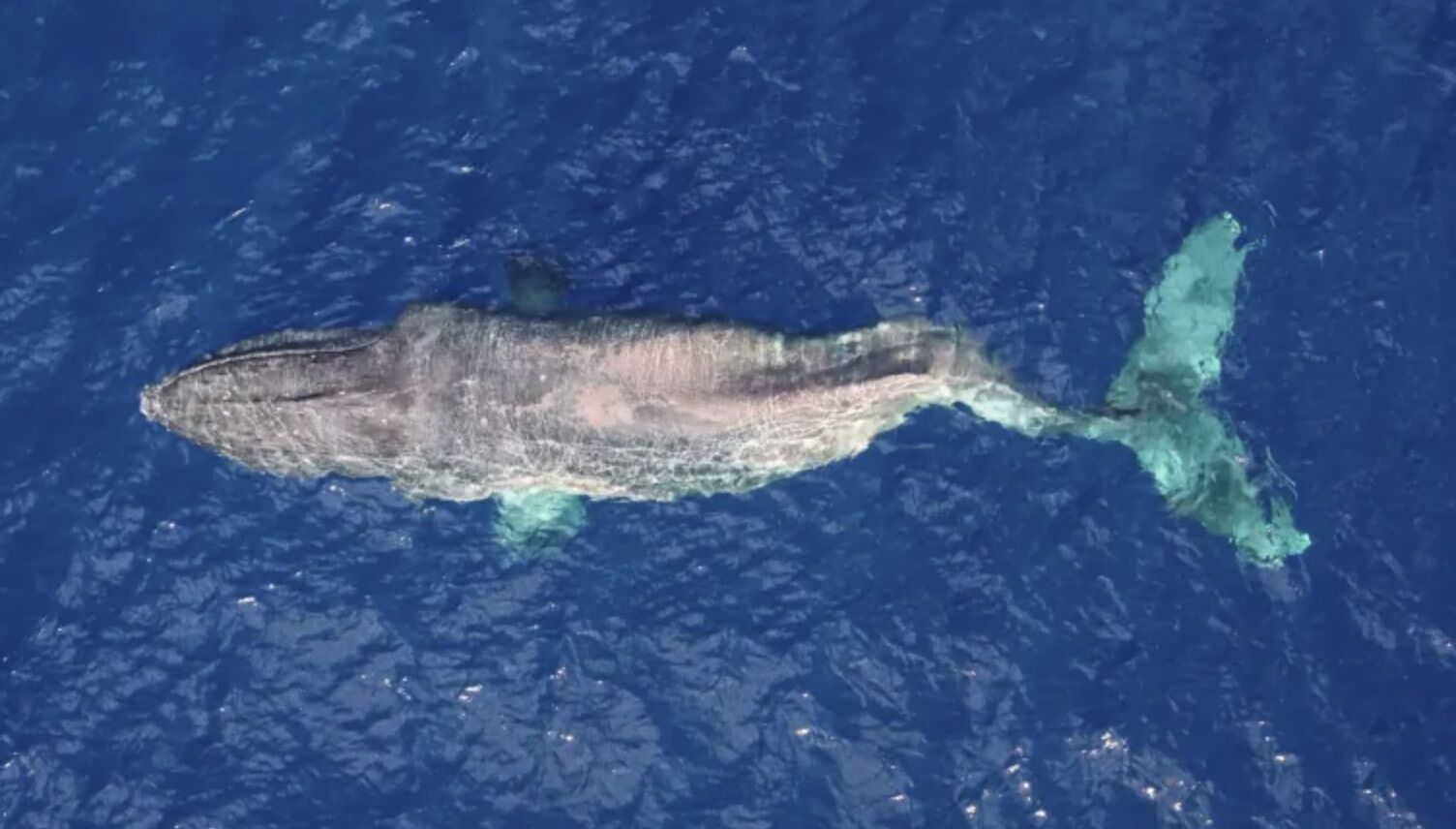
On 7 September 2022, a humpback swam past the Fin Island research station off the north coast of British Columbia, in Gitga’at First Nation territory. When the research team flew a drone over the animal, the aerial footage showed something badly wrong with its back. The spine, which should run in a straight line, was bent into a pronounced S shape running from the dorsal fin toward the tail. From the photographs the researchers identified the whale as Moon, an individual they had tracked for years and had seen with a healthy calf in 2020.
The injury was consistent with a vessel strike. A whale’s spine can be broken either by a small, fast boat or by a large ship moving slowly. Either way, the damage to Moon was catastrophic and permanent. With a broken back she could not move her tail, the organ that normally drives a humpback through the water.
A 3,000 mile swim without a tail
What Moon did next astonished the scientists watching her. A humpback’s fluke provides almost all of its forward power. Moon’s was locked in the S curve and useless. So she made the entire migration from Canada to Hawaii on her pectoral fins alone, the long side flippers humpbacks normally use for steering and balance. Janie Wray, CEO and lead researcher at BC Whales and co-founder of the North Coast Cetacean Society, put it plainly: without the use of her tail, Moon was doing the breaststroke to make that migration.
She was sighted off Maui on 1 December 2022. By then she was emaciated and covered in whale lice, small crustaceans that attach to whales and build up heavily on sick or slow moving individuals. The journey had taken everything she had. Wray said Moon would not make the spring migration back to British Columbia and would likely die before then. Moon was last documented on 10 December 2022 in waters off Kona on the Big Island. She has not been sighted since, and researchers believe she is dead.
Why would an injured whale make that journey?
It seems to make no sense. There is little food for humpbacks in Hawaii. They feed in the cold, productive waters of the north and travel south only to breed and give birth. Why would a dying whale swim 3,000 miles toward a place with nothing to eat?
The most likely answer is the migration itself, part hardwired and part learned. Wray suggested Moon had probably made the same trip every year with her own mother, and was very likely born in Hawaiian waters. The drive to reach the breeding grounds is deeply ingrained. There is also a possibility that Moon was pregnant and heading instinctively for the warm, sheltered water where humpbacks calve. Whatever the reason, she followed the route her body knew, even as that body was failing.
The hidden threat of vessel strikes
Moon’s case is a window into one of the two biggest human caused dangers to whales, alongside entanglement in fishing gear. Vessel strikes are easy to overlook because most happen out of sight and many go unreported.
- A strike does not have to be fast to be fatal. A large ship moving slowly carries enormous mass, and that alone can break a whale’s spine.
- Humpbacks feed and rest near the surface, which puts them directly in the path of hulls and propellers.
- Most struck whales are never identified. Moon was documented only because a research team flew a drone over her and recognised her.
Why drones changed whale research
It is worth pausing on the tool that uncovered the injury. For most of the history of whale science, researchers saw whales only from the side, at the surface, from a boat. A drone changes the angle completely. Looking straight down, it reveals the full shape of a whale’s body, its condition, the curve of its spine, whether a female is pregnant or a calf is present. That overhead view is exactly how the Fin Island team saw the S curve in Moon’s back, which would have been almost impossible to spot from a vessel. Drones also gather that information without approaching closely or disturbing the animal. Without a routine drone flight, Moon’s injury and the journey that followed might never have been recorded at all.
What this story asks of us
Moon’s story has no rescue and no happy ending. What it offers instead is a clear lesson. In Hawaiian and Alaskan waters, federal rules prohibit approaching a humpback whale within 100 yards by any means, boat, paddleboard, swimmer or drone, and NOAA’s general viewing guidance is to give any large whale at least the same distance. Reporting a whale you see in distress, or a collision you witness, genuinely matters: it is how research teams track injured animals, work out what happened, and build the case for stronger protections.
Researchers judged that Moon’s spinal injury was probably caused by a vessel strike. A drone documented her final journey. If her story makes one more boat slow down near a whale, it was worth telling. To understand the animal behind the story, our humpback whale species profile covers how these whales migrate, feed, and live.
Updated 14 September 2026: qualified the suspected cause of Moon’s injury.




The team that knew her calf from years before really got to me.
3,000 miles with an injured spine. I keep rereading that.
Pregnant or not, it is amazing she swam that far.
Marco, we will probably never know why she made the trip.
I have a small boat and this made me take the distance rules seriously.
Halsey, glad to hear it. NOAA’s vessel guidance is short and worth keeping on board.
Has anyone heard if Moon was seen again?