
Species Profile: The Beluga Whale
Last updated: November 5, 2026
8 min read
The beluga whale is the only entirely white cetacean as an adult, the only large whale with a flexible neck, and one of the noisiest mammals in the ocean. Early Russian sailors called it the morskaya kanareyka, the sea canary, because of the constant trills, whistles, clicks, and squeals you could hear coming through the wooden hull of a moored ship. The beluga is a creature of the Arctic and subarctic, a close relative of the narwhal, and one of the most studied whales on the planet thanks to its habit of moving into shallow coastal estuaries every summer.
Key facts at a glance
- Scientific name: Delphinapterus leucas
- Family: Monodontidae (with the narwhal its only close relative)
- Length: up to 5.5 metres
- Weight: males 1,100 to 1,600 kilograms, occasionally up to 1,900
- Diet: fish (cod, herring, capelin, salmon), squid, octopus, shrimp
- Habitat: Arctic and subarctic waters; shallow coastal estuaries in summer
- IUCN status: Least Concern overall; several subpopulations are Critically Endangered
Taxonomy and family
The beluga is the sole species in the genus Delphinapterus, and one of just two species in the family Monodontidae. Its only close relative is the narwhal, with which it occasionally hybridises in the West Greenland fjords. The Greek root of Delphinapterus translates as “dolphin without a wing”, a reference to the fact that the beluga has no dorsal fin. In its place is a low ridge along the back, which is useful for an animal that often swims under ice and needs a back it can press against the underside of a floe. See our narwhal species profile for its closest cousin.
Calves are born dark grey and lighten as they grow. Fisheries and Oceans Canada says they reach the white adult stage at about 15 years, and colour change should not be used as a fixed sexual maturity age. The slow colour change is unusual among cetaceans and is partly responsible for the species’ old common names ranging from “white whale” to “sea canary” to belukha (Russian for “white one”).
Size and appearance
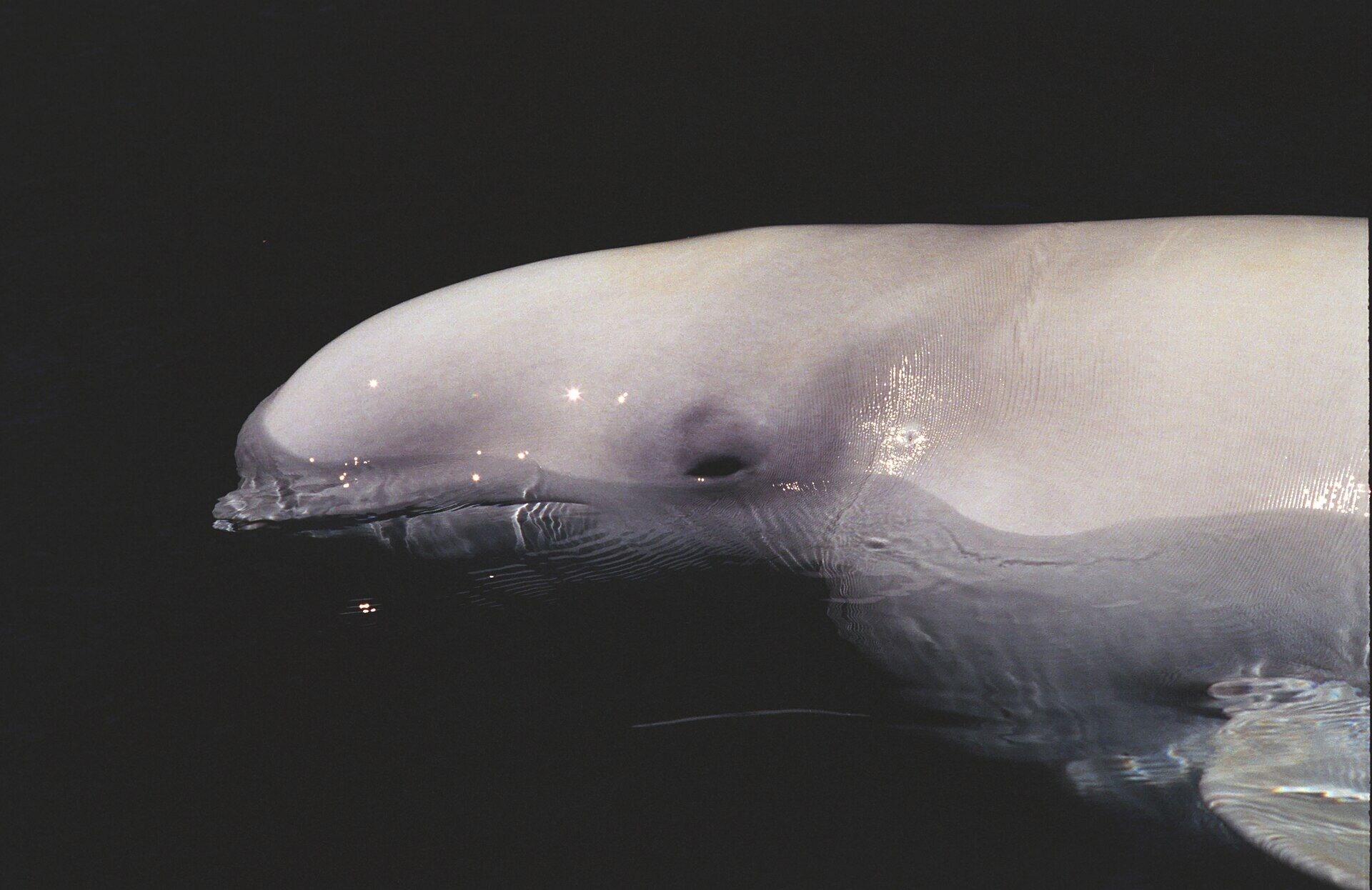
Adult belugas reach 3 to 5.5 metres in length, with males larger than females. Males weigh between 1,100 and 1,600 kilograms, and occasionally up to 1,900. Newborn calves are around 1.5 metres long at birth. The body is robust and torpedo shaped, with a small rounded head capped by the prominent melon, no beak to speak of, short broad flippers, and a flexible neck unusual among whales. Belugas can turn their heads to look around, a feature that gives them an oddly thoughtful appearance up close.
The skin is thick and tough, and under it the blubber layer can be up to 15 centimetres deep. The outer skin sheds in great patches once a year. Belugas are well known for using shallow gravel beds in their summer estuaries as natural exfoliators: the animals haul themselves into a few centimetres of water and rub their bodies across the bottom to slough off the yellowed outer layer. After the moult they are brilliant white again.
The melon and the songs
The most striking feature of the beluga’s head is the melon, the bulbous fatty organ on the forehead that focuses echolocation clicks. In a beluga the melon is flexible and visibly moves when the animal vocalises, almost like a balloon being squeezed. This is part of the reason belugas sound and look so unusual: you can watch the head deform as it makes a particular call.
Belugas are among the most vocal whales on Earth. Their repertoire includes clicks for echolocation, a wide range of whistles and pulsed calls for social signalling, and the chirps, moos, squeaks, and gurgles that early sailors compared to a flock of canaries. Captive belugas have shown the ability to mimic human speech well enough to be picked up on hydrophones; a beluga named NOC at the National Marine Mammal Foundation was studied extensively after researchers realised the strange sound coming from his pool was an attempt to imitate the cadence of human conversation. NOAA Fisheries hosts recordings of wild beluga vocalisations.
Diet and feeding
Belugas are opportunistic generalists. They eat fish (Arctic cod, polar cod, capelin, herring, salmon, smelt), squid, octopus, shrimp, crabs, and bottom dwelling invertebrates. They are bottom feeders as often as midwater feeders, and they regularly blow plumes of sand and mud to expose buried prey. The shape of the head, the flexible neck, and the soft mobile lips make them well adapted to picking individual prey items off the seafloor, in contrast to the lunge feeding strategy of the great baleen whales.
Belugas dive routinely to 300 to 600 metres, with occasional dives to over 1,000 metres in pursuit of deepwater fish. Most feeding dives are in much shallower water, especially in the summer estuaries where shoals of capelin and Arctic cod aggregate to spawn.
Habitat and migration
Belugas live in Arctic and subarctic waters across the circumpolar north: the Bering, Chukchi, and Beaufort Seas, Hudson Bay, the Canadian Arctic Archipelago, West Greenland, Svalbard, and the Russian Arctic. Twenty-two stocks are currently recognised. They are migratory: every summer they leave the offshore pack ice and move into shallow coastal estuaries to moult, give birth, feed on schooling fish, and socialise. Some of these summer aggregations are spectacular, with thousands of animals crowding a single bay or river mouth in July and August.
Belugas are also famous for the surprise visitors who occasionally wander far south of their normal range. Individual whales have been documented in the Thames in England, the Seine in France (see our coverage of the Seine beluga rescue), and the Loire. These wanderers may already be in poor health. Warm or fresh water alone does not explain their condition because some beluga populations use shallow, warm estuaries each summer.
Social behaviour
Belugas are intensely social. Pods range from 10 to several hundred individuals, and summer aggregations can be thousands strong. Group composition is fluid, with belugas forming temporary subgroups based on age and sex within a larger gathering. Mothers and calves form especially tight associations and may travel together for years.
Communication within pods is constant. Belugas produce around 50 different recognisable call types, and individual whales have personal signature whistles that pod mates respond to. Play behaviour is common, especially among juveniles, with belugas pushing pieces of driftwood or dead fish around, blowing bubbles, mimicking other animals, and chasing each other through shallow water.
Reproduction and life history
Beluga life cycles are slow, like those of most large whales. Females reach sexual maturity at around 8 to 9 years and males a year or two later. Mating occurs in late winter and early spring in the offshore pack ice, when pods are concentrated near polynyas (open water gaps in the ice). After a gestation of about 12 to 14.5 months, a single dark grey calf is born in summer, usually in the warm shallows of a coastal estuary. The mother nurses for around two years, sometimes longer, on milk that averages about 28 percent fat. Twin births are extremely rare.
A female produces a calf roughly every three years through her reproductive life. Beluga lifespans were badly underestimated for decades. Ages were read from growth layers in the teeth on the assumption that two layers formed each year, which capped published lifespans at around 30 years. Once researchers checked that assumption using aspartic acid racemisation in the eye lens and found that one layer forms per year, the numbers roughly doubled: belugas are now thought to live 70 to 80 years, and the oldest documented individual was 79. That correction matters, because management quotas set on the old short-lifespan figures were almost certainly too generous.
Predators and threats
The beluga’s main natural predator is the killer whale. Polar bears occasionally take belugas trapped in shrinking breathing holes in winter ice, a phenomenon called sassat. As the Arctic warms and the ice retreats earlier, orcas are spending more time in beluga range, and there is some evidence that beluga populations are shifting their migration timing in response.
Human threats are more varied. Subsistence hunting by indigenous communities continues in Alaska, Russia, and Greenland under regulated quotas. Pollution is a serious concern in the St. Lawrence estuary, where the resident beluga population carries body loads of PCBs, mercury, and other contaminants so high that beached carcasses have at times been classified as toxic waste. Other pressures include shipping noise, oil and gas exploration, and entrapment in fishing gear.
Conservation
The IUCN currently lists Delphinapterus leucas as Least Concern at the global species level, but conservation managers tend to treat each beluga subpopulation as effectively a separate stock. The total global population is thought to number around 200,000 individuals across all recognised stocks. That headline number hides serious local trouble. The Cook Inlet beluga in Alaska is down to roughly 300 animals and is listed as Critically Endangered. The Ungava Bay and Eastern Hudson Bay subpopulations are also Critically Endangered. The St. Lawrence beluga in Quebec was estimated at 889 animals and is heavily contaminated. Several of these subpopulations are not expected to recover without aggressive intervention.
Captive belugas remain a controversial topic. Several public aquariums in Asia, North America, and Europe still hold belugas, though several of the most visible facilities have moved towards open-water retirement. Nothing on that front has been simple. The Whale Sanctuary Project’s proposed coastal refuge in Nova Scotia broke ground in June 2026 after a decade of planning, but as of late 2025 it had raised only a fraction of its construction budget and had not yet taken in a whale. If you want to test what you have just learned about the sea canary, try our beluga trivia game, or compare the beluga with the other true Arctic giant in our detailed bowhead whale species profile.
Take whales home
Bring this species home with a curated collection of whale plush, books, jewelry, and apparel. Every order supports more long form whale writing on lovewhales.org.
whale plush toys
Read next
- Whale Species: A Complete Guide to the Cetaceans of the World
- Species Profile: The Antarctic Minke Whale
- Species Profile: The Long-Finned Pilot Whale
Frequently asked questions
Why are belugas called the canaries of the sea?
Early Russian and Norse sailors heard the constant whistles, trills, and chirps coming through the hulls of their moored ships and likened the sound to a flock of canaries. Belugas have one of the broadest vocal repertoires of any cetacean, with around 50 distinct call types.
How big does a beluga whale get?
Adult belugas reach 3 to 5.5 metres in length. Males weigh 1,100 to 1,600 kilograms and occasionally up to 1,900. Males are larger than females. Calves are around 1.5 metres at birth.
Where do beluga whales live?
In Arctic and subarctic waters across the circumpolar north, including the Bering, Chukchi, and Beaufort Seas, Hudson Bay, the Canadian Arctic, West Greenland, Svalbard, and the Russian Arctic. They winter in the pack ice and summer in shallow coastal estuaries.
What do belugas eat?
They are opportunistic generalists. Their diet includes Arctic and polar cod, capelin, herring, salmon, squid, octopus, shrimp, crabs, and bottom dwelling invertebrates. They feed in midwater and on the seafloor.
Are beluga whales endangered?
The species overall is listed as Least Concern by the IUCN, with a global population of around 200,000. But several subpopulations are in serious trouble. Cook Inlet, Ungava Bay, and Eastern Hudson Bay are all Critically Endangered, and the St. Lawrence estuary population is heavily contaminated and declining.
How long do beluga whales live?
Around 70 to 80 years. The oldest documented beluga was 79. Older published figures of 25 to 30 years came from counting tooth growth layers at the wrong rate and have been superseded.
Why are belugas white?
Adult belugas are white as camouflage against drifting ice from the perspective of both predators (killer whales below) and prey. Calves are born dark grey and lighten over many years. Fisheries and Oceans Canada says they reach the white adult stage at about 15 years.
Can beluga whales talk?
They can mimic. A captive beluga named NOC was famously recorded producing sounds with the rhythm and pitch of human speech, well enough to confuse divers in his pool. Wild belugas show no evidence of structured language, but their natural call repertoire is unusually broad.
What is the difference between a beluga and a narwhal?
They are close relatives in the same family. Belugas are pure white as adults, have no tusk, range further south, and are highly vocal in fluid social groups. Narwhals are mottled, the males carry a long spiral tusk, and they live almost entirely in deep Arctic waters.
Updated 14 September 2026: corrected beluga colour development and freshwater habitat claims.


Sea canary is such a good name. My grandad used to call them that.
Didn’t know belugas could turn their heads.
The Cook Inlet belugas are such a sad case.
Sandeep, agreed. They are still listed as Endangered in the US.
Seeing belugas in the St Lawrence is top of my list.