

Species Profile: The North Atlantic Right Whale
Last updated: November 18, 2026
9 min read
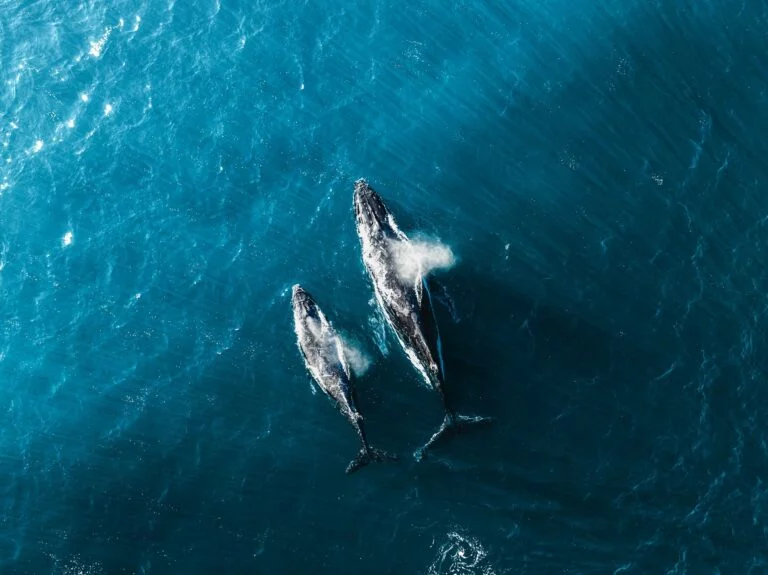
Photo: NOAA Photo Library, public domain, via Wikimedia Commons.
The North Atlantic right whale (Eubalaena glacialis) is one of the most endangered great whales on Earth. The North Atlantic Right Whale Consortium estimated 382 animals for 2025 in November 2026, down from a revised 389 for 2024, and only around 70 of those are reproductively active females (IFAW). Every birth, every death, every entanglement is now tracked, modelled, and counted because there is no statistical buffer left. The species sits on a knife edge between slow recovery and functional extinction.
This profile covers what makes a right whale a right whale, where this species lives, what it eats, how its calving cycle works, and the modern threats keeping it in the Critically Endangered category on the IUCN Red List. For the broader context, see our overview of the conservation status of different whale species.
Key facts at a glance
- Scientific name: Eubalaena glacialis
- Family: Balaenidae (right whales and bowhead)
- Length: typically 13 to 16 metres, with the largest recorded animals reaching about 18.5 metres (61 ft)
- Weight: commonly 40 to 70 tonnes, with the heaviest recorded animals over 100 tonnes
- Diet: copepods, especially Calanus finmarchicus, plus other zooplankton
- Habitat: western North Atlantic, from the Bay of Fundy and Gulf of St Lawrence south to Florida
- Lifespan: 70 years or more in optimal conditions, but current median is much shorter
- IUCN status: Critically Endangered
Where the name comes from
The grim origin of the name tells you most of the story. Early whalers called this species the right whale because it was the right whale to hunt. The North Atlantic right whale was slow, swam close to shore, floated when killed, and carried a thick layer of oil rich blubber. Those traits, brilliant for whalers in the 17th to 19th centuries, are exactly the traits that make the species so vulnerable to ship strikes and entanglement today.
There are three right whale species worldwide: the North Atlantic, the North Pacific (Eubalaena japonica), and the Southern right whale (Eubalaena australis). All three are members of the family Balaenidae alongside the bowhead whale. North Atlantic right whales were hunted close to extinction by the early 1900s and have never fully recovered.
How to recognise a North Atlantic right whale
Right whales are some of the most distinctive of all baleen whales. Several features make a confident identification straightforward at sea.
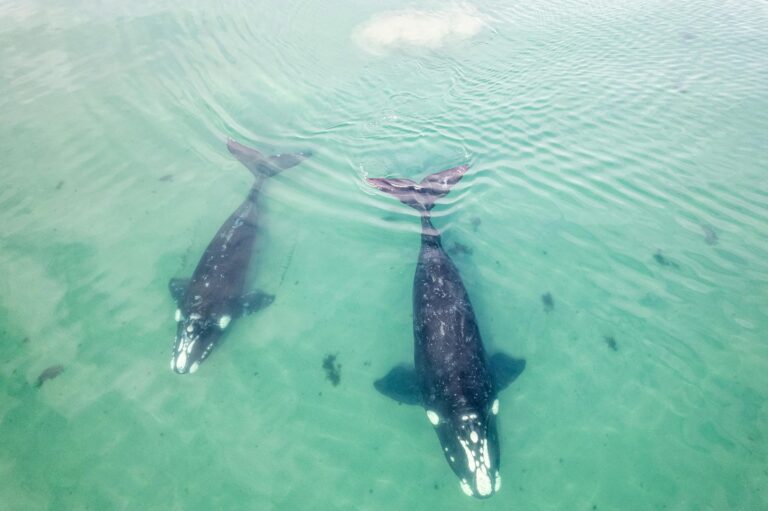
- Callosities: rough, lighter coloured patches of thickened skin on the head, jaws, and lower lip. These patterns are unique to each individual, like a fingerprint. Researchers use them to identify and track every animal in the population through the New England Aquarium catalog.
- No dorsal fin: like bowheads and the other right whales, the back is smooth and dark all the way to the tail.
- V shaped blow: two angled blowholes produce a distinctive V shape when the whale exhales, visible in calm conditions from a long way off.
- Broad black body: robust, dark, and often slightly mottled, with a huge arched mouthline that runs almost the full length of the head.
- Paddle shaped flippers: broad, almost rectangular pectoral fins.
Where do North Atlantic right whales live?
The species is almost entirely confined to the western North Atlantic. A small handful of historical sightings exist off Iceland, the Azores, and northwest Europe, but functionally, today, this is a Canada and United States animal.
The annual cycle is straightforward in outline. In spring and summer, the whales feed on dense patches of copepods in northern waters: Cape Cod Bay, the Great South Channel, the Bay of Fundy, the Gulf of St Lawrence, and waters off Nova Scotia. In autumn, pregnant females and some other animals head south, migrating along the eastern seaboard to a calving ground that stretches from Georgia to north east Florida. Calves are born there in December through March, and the cows return north with their newborns in spring. Mothers and calves are sometimes seen from Florida beaches; see where to see right whales in Florida.
That neat picture has been breaking down. Since around 2010, warming in the Gulf of Maine has shifted Calanus distributions, and right whales have increasingly moved into the Gulf of St Lawrence in summer. That area was not historically a major right whale ground and lacked the same speed restrictions and gear management as US waters when whales first arrived in numbers, with serious consequences for ship strike and entanglement deaths.
What do they eat?
North Atlantic right whales are dietary specialists. Their main food is a single genus of small copepods, Calanus, especially the lipid rich late stage juveniles of Calanus finmarchicus. A right whale needs to find and consume billions of these tiny animals each day to maintain its enormous body.
They feed by skimming, the same technique used by bowheads. The whale swims slowly forward with its mouth open. Water flows in at the front and out through the sides of the baleen, with the very long curved baleen plates (up to 2.5 metres) acting as a fine sieve. They feed at the surface, deep underwater, and everywhere in between, going where the prey is densest at any given time.
Specialist diets carry specialist risks. As Calanus populations shift north and east with warming temperatures, right whales are forced into new feeding habitats with different shipping and fishing pressures. Climate change is now firmly tied to the species recovery problem.
Behaviour, reproduction, and lifespan
Right whales are surface feeders and social animals. They form loose feeding aggregations where prey is dense, and males engage in vigorous courtship groups (sometimes called SAGs, surface active groups) in which several males compete for a single female. They are not deep divers by great whale standards, usually staying within the top 200 metres.
Females typically begin calving at around 10 years old, though that average has slipped in recent years. The calving interval was historically about three years. Today it is closer to seven, which is one of the clearest signals that the population is declining and reproductively stressed. Gestation lasts about a year. Calves are about 4 metres long at birth and nurse for around a year before weaning. A female with healthy body condition, low entanglement scarring, and good food supplies can in theory live more than 70 years and produce a dozen calves. Almost none of the current population is in that situation.
Conservation status and threats
The IUCN lists the North Atlantic right whale as Critically Endangered. The two biggest causes of unnatural death are clear, well measured, and persistent.
Vessel strikes. Right whales feed and migrate through some of the busiest shipping lanes in the western Atlantic. They spend significant time at the surface and have no instinct to dive away from approaching vessels. Lethal strikes are documented every year, with cargo ships, fishing vessels, and recreational craft all implicated. NOAA has implemented mandatory speed restrictions of 10 knots in seasonal management areas off the US east coast, and Canada has done the same in the Gulf of St Lawrence. The biological evidence for these zones is overwhelming.
Entanglement. Right whales feed where snow crab and lobster fisheries set vertical rope lines connecting traps on the seabed to surface buoys. Whales swim through these vertical lines and become wrapped in them, often around the mouth, flukes, or pectoral fins. Estimates suggest more than 80 percent of living right whales bear scars from at least one entanglement event. Many die from infection, exhaustion, or drowning. Our coverage of one such case is in the post on the North Atlantic right whale entangled in rope.
Since 2017, NOAA has formally declared an Unusual Mortality Event for the species. Deaths and serious injuries across the mortality event remain unsustainable, although annual documented deaths vary and were zero in some years. With a population this small, even a handful of unnatural deaths per year is enough to drive the species toward extinction.
Other pressures include noise from shipping and seismic surveys, which interferes with communication and stress physiology, and climate change, which both shifts prey distributions and warms the calving grounds.
For continuously updated information, see the NOAA Fisheries North Atlantic right whale page, the IUCN Red List entry for Eubalaena glacialis, and the Wikipedia overview at North Atlantic right whale.
A brief history of right whale exploitation
Right whales were one of the very first cetacean species hunted on an industrial scale. Basque whalers in the Bay of Biscay were taking them from at least the 11th century. By the 1500s the eastern North Atlantic population was already in collapse, and Basque crews shifted across the ocean to follow whales in Labrador and Newfoundland. American colonial whalers in New England took up the trade in the 1600s and 1700s, and by 1750 the western North Atlantic population was also heavily depleted. By the time international legal protection arrived in 1935, fewer than 100 animals were thought to remain. The full ban on commercial whaling under the International Whaling Commission moratorium has been in force since 1986.
That long, layered history matters because the demographic damage of three centuries of whaling is still visible today. Genetic diversity in the species is unusually low, calving intervals lag the biological optimum, and the population sits on a tiny number of founder lineages. Even a perfectly managed modern ocean would take decades to rebuild this species. Adding modern threats on top of that legacy is what makes the current situation so precarious.
Right whale science and how we know what we know
One of the unusual things about North Atlantic right whales is that we know almost every living individual by sight. The New England Aquarium maintains the North Atlantic Right Whale Catalog, a photo identification database that uses the unique callosity pattern on each whale head to track its life history. Researchers can read a single sighting and know where that animal was born, how many calves it has had, how often it has been entangled, and how its body condition has changed over time.
This level of individual tracking is extraordinary in marine mammal science and is the foundation for every conservation decision currently made about the species. It links mortality and serious injury to individual whales. Recovered or identifiable gear sometimes permits fishery attribution, but the responsible vessel or gear type often remains unknown.
How you can help
- Support and back ropeless (on demand) fishing gear in lobster and snow crab fisheries. The technology exists. Adoption is the bottleneck.
- Push for mandatory and enforced vessel speed restrictions in known right whale habitat, including the Gulf of St Lawrence and the seasonal management areas along the US east coast.
- Support the New England Aquarium right whale catalog and other photo identification programmes that track individual animals.
- If you live on the US east coast or in eastern Canada, support local NGO and political pressure to maintain and strengthen right whale rules. These rules have to survive successive political cycles to do their work.
- Stay informed. Our wider species profile library covers other whales and how each is faring.
Take whales home
Bring this species home with a curated collection of whale plush, books, jewelry, and apparel. Every order supports more long form whale writing on lovewhales.org.
Browse whale plush toys in our store.
Frequently asked questions
How many North Atlantic right whales are left?
The 2024 estimate, published in October 2025, is about 380 animals. Around 70 of those are reproductively active females. The species is Critically Endangered. It declined steadily through the 2010s, and the three most recent estimates have shown small increases, which researchers describe as fragile rather than a recovery.
Why are North Atlantic right whales endangered?
Two human caused threats dominate: vessel strikes and entanglement in fixed fishing gear. Climate driven changes in copepod prey distribution and ocean noise add to the pressure. With so few animals left, any one of these can keep the population in decline.
Where do North Atlantic right whales live?
They are found in the western North Atlantic. Summer feeding grounds include the Bay of Fundy, the Gulf of St Lawrence, and waters off New England. Pregnant females calve from December to March off the south east US coast, from Georgia to north east Florida.
What do North Atlantic right whales eat?
They are skim feeders specialising in copepods, especially the lipid rich late stages of Calanus finmarchicus. They filter dense patches of these tiny crustaceans through long curved baleen plates that can reach 2.5 metres long.
How big do North Atlantic right whales get?
Most adults are 13 to 16 metres long and weigh 40 to 70 tonnes. The largest recorded animals reach about 18.5 metres and over 100 tonnes. They are broad, heavy-bodied whales, much heavier than a streamlined rorqual of the same length.
Why are they called right whales?
Early whalers considered them the “right” whale to hunt because they were slow, coastal, oil rich, and floated when killed. That made them the first targets of commercial whaling and the reason they were almost eradicated by the early 1900s.
Can North Atlantic right whales recover?
Yes, but only with sustained reductions in vessel strikes and entanglements. Other right whale species, especially the Southern right whale, have shown that recovery is biologically possible once direct mortality is brought below the reproductive rate.
What is the Unusual Mortality Event?
An Unusual Mortality Event (UME) is a formal NOAA designation that triggers extra investigation and resources. The right whale UME was declared in 2017 and remains active. It documents a sustained pattern of right whale deaths above the species safe replacement rate.
Updated 14 September 2026: updated the North Atlantic right whale population figure.
Updated 17 November 2026: updated the North Atlantic right whale population to the consortium’s 2025 estimate of 382, released on 16 November 2026.


Didn’t know they depended so much on one tiny copepod.
Sad that the reasons they were the right whale to hunt are the same reasons ships hit them.
We saw a mother and calf in the Bay of Fundy years ago. Feels lucky now.
Read this with my son. He wanted to know if whales sleep while they migrate.
Easy to read, which is rare.
Two friends sent me this in the same week.