

General Conservation Status Of Different Whale Species
Last updated: November 17, 2026
8 min read
Every large whale you have ever read about sits somewhere on a global conservation ladder maintained by the International Union for Conservation of Nature (IUCN). The Red List places each species into a category from Least Concern through to Extinct, and those categories shape what governments, fisheries, shipping companies, and conservation NGOs are expected to do about that species. If you have ever wondered why a blue whale ship strike attracts international news while minke whale hunts in Norway barely register, the answer usually comes back to conservation status.
This guide walks through the conservation status of the great whale species, what those IUCN labels actually mean, and the main pressures keeping each species where it is. It is built as a companion to our species profile library, so where a species has its own deep dive, the links go through.
Whale conservation status at a glance
- Critically Endangered: North Atlantic right whale, Rice’s whale, and the eastern subpopulation of the North Pacific right whale
- Endangered: blue whale, sei whale, North Pacific right whale as a species, and some bowhead subpopulations. Southern Resident killer whales are Endangered under the US Endangered Species Act
- Vulnerable: sperm whale, fin whale (downlisted in 2018 and still recovering)
- Near Threatened: Antarctic minke whale
- Least Concern: humpback whale, gray whale, common minke whale, bowhead whale overall, narwhal, Cuvier’s and Sowerby’s beaked whales, dwarf sperm whale
- Data Deficient: a shrinking group of rarely seen beaked whales, as assessments catch up
What does an IUCN conservation status actually mean?
The Red List uses nine categories. For whales, six of them carry most of the weight.
- Critically Endangered (CR): facing an extremely high risk of extinction in the wild. Populations are usually small, fragmented, and still declining.
- Endangered (EN): very high risk of extinction. Numbers may be larger than for CR species, but trends are concerning or recovery is fragile.
- Vulnerable (VU): high risk of extinction in the wild under the IUCN’s evidence-based criteria.
- Near Threatened (NT): not currently meeting the thresholds for a threatened category, but likely to qualify soon without action.
- Least Concern (LC): widespread and abundant, with no urgent extinction risk. Recovery from past whaling is a common reason a great whale lands here.
- Data Deficient (DD): not enough information to assess. For whales this has mostly applied to deep diving species almost nobody sees.
The IUCN status is global, but for whales it is common to see subpopulations carry different labels from the species. The bowhead whale is Least Concern overall thanks to the strong recovery of the Bering Chukchi Beaufort stock, while its small Sea of Okhotsk and Svalbard stocks are still Endangered. The North Pacific right whale is Endangered as a species while its eastern subpopulation is Critically Endangered. Killer whales show the same split, with some local communities in serious trouble and others stable.
Critically Endangered whales
The most famous case is the North Atlantic right whale (Eubalaena glacialis). The 2025 estimate, released in November 2026, put the population at about 382 animals, with a very small number of breeding females. Vessel strikes off the eastern seaboard of the United States and Canada, and entanglement in fixed fishing gear, especially snow crab and lobster pots, are the two biggest killers. Both are getting worse as climate change pushes prey north into new shipping and fishing grounds.
Rice’s whale (Balaenoptera ricei) is a Gulf of Mexico endemic only described as a distinct species in 2021. With somewhere around 50 animals left it is one of the rarest whales in the world.
The North Pacific right whale (Eubalaena japonica) is Endangered as a species, but that global label hides the real emergency. The western stock in the Sea of Okhotsk and around the Kuril Islands numbers a few hundred. The eastern stock in the Bering Sea, listed separately as Critically Endangered, is down to roughly 30 animals, the legacy of illegal Soviet whaling in the 1960s.
Endangered whales
The Endangered tier contains some of the most iconic whale species, partly because so many of them were nearly wiped out by twentieth century industrial whaling.
The blue whale (Balaenoptera musculus) is the headline, and as the largest animal that has ever lived it tops our ranking of the 5 biggest whales on Earth. There were at least 140,000 mature blue whales in 1926, before the worst of the Antarctic slaughter. Recent estimates put the total at 10,000 to 25,000 animals, of which 5,000 to 15,000 are mature, and the species remains Endangered. Antarctic blues, hit hardest, are at a tiny fraction of their pre whaling baseline.
The sei whale (Balaenoptera borealis) is also Endangered. Sei whaling peaked in the 1960s, once the bigger blues and fins had been depleted. Populations remain a fraction of their original size and recovery has been slow.
Several subpopulations of killer whale (Orcinus orca) also sit at Endangered. The Southern Resident community off Washington and British Columbia, dependent on declining Chinook salmon, is the textbook example. With around 75 animals left it is a small stock with a very specific food chain problem.
Vulnerable whales
Vulnerable status often signals a species that was once Endangered and is now in slow recovery. Two great whales sit here.
The fin whale (Balaenoptera physalus) was downlisted from Endangered to Vulnerable in 2018. Numbers have been climbing in both hemispheres, and survey work around Elephant Island in the Antarctic has documented large feeding aggregations of a kind not recorded since industrial whaling ended. The species is still vulnerable to ship strikes and noise, and Iceland still hunts a small number in some years.
The sperm whale (Physeter macrocephalus) is also Vulnerable. The deepest diver of all the great whales was heavily hunted from the eighteenth century onwards for spermaceti oil. Global numbers run to several hundred thousand, with strong recovery in some oceans but worrying noise and ship strike trends in busy seas like the Mediterranean.
Least Concern whales
The Least Concern category is where most of the conservation good news lives.
- The humpback whale has recovered to roughly 135,000 animals worldwide, of which about 84,000 are mature, and the global trend is still rising. A few subpopulations remain at risk.
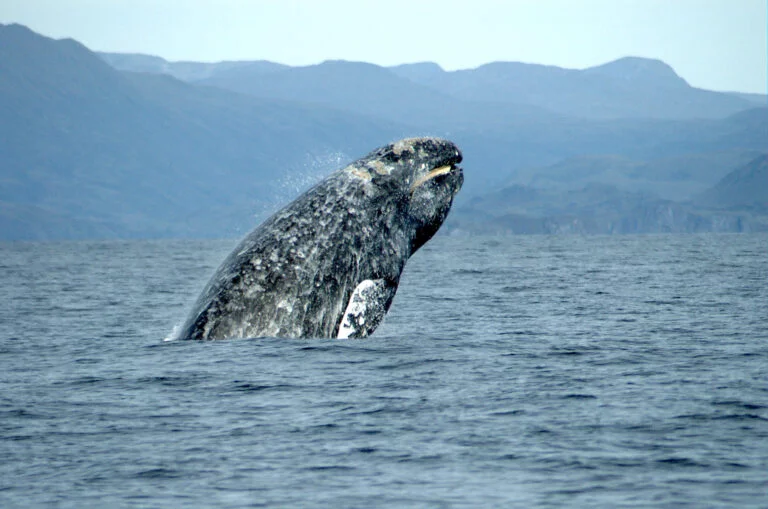
- The gray whale (Eschrichtius robustus) is Least Concern as a species, but the eastern North Pacific stock is having a bad decade: about 27,000 animals in 2016, then 11,700 to 14,200 in the 2024/25 survey. The 2025/26 estimate rose to 15,930 to 20,530, but NOAA says migration and survey effects may explain part of that rise. The Northwest Pacific subpopulation is Endangered.
- The common minke whale is Least Concern, with hundreds of thousands of animals worldwide.
- The bowhead whale, as a species, is Least Concern thanks to the rebuilding Bering Chukchi Beaufort stock.
- The narwhal (Monodon monoceros) is Least Concern, though it is highly exposed to climate change.
Least Concern does not mean safe. It means the global numbers are not currently triggering an extinction warning. The gray whale is the clearest illustration: a Least Concern species can still lose half its main population inside a decade.
The Data Deficient list is shrinking
For years the standard line was that most beaked whales were Data Deficient. That is less true than it used to be. The 2020 round of assessments moved several of them, including Cuvier’s beaked whale, Sowerby’s beaked whale, and the dwarf sperm whale, into Least Concern. That is not the same as saying they are well studied. It means assessors judged there was no evidence of a decline steep enough to justify a threatened category, on data that remain thin. A handful of the rarest beaked whales are still listed as Data Deficient, and for those species the priority is simply finding out how many there are.
What pushes whales up and down the list?
- Commercial whaling history: almost every Endangered or Vulnerable great whale today is climbing back from twentieth century industrial whaling. See our overview of why whales are hunted for context.
- Ship strikes: the biggest single threat to North Atlantic right whales, and a major factor for fins and blues in the Mediterranean, the Indian Ocean, and along the US west coast.
- Entanglement: a huge issue for right whales, humpbacks, and minkes in coastal fisheries.
- Climate change: shifting prey distributions, retreating sea ice, warming feeding grounds. Most acute for Arctic specialists like bowheads and narwhals, and for krill specialists like blues.
- Ocean noise: seismic surveys, military sonar, and shipping noise affect navigation, communication, and feeding. Sperm whales and beaked whales are particularly noise sensitive.
- Pollution: chemical contaminants build up in long lived top predators. Killer whales are some of the most contaminated animals on Earth.
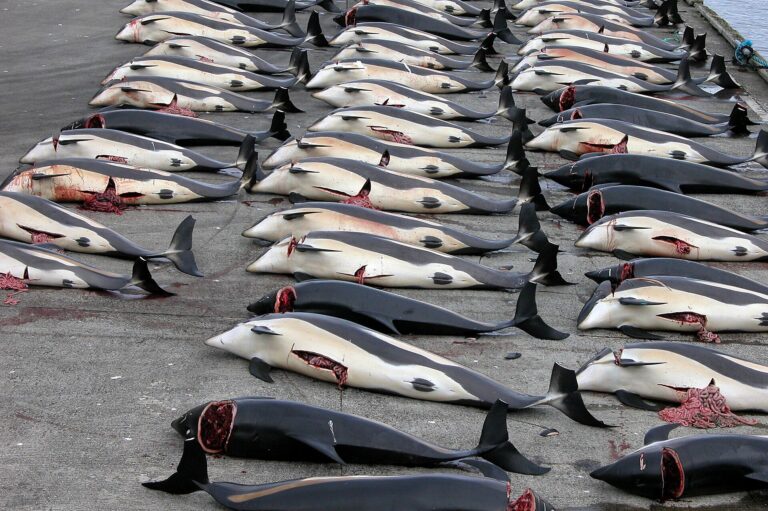
- Bycatch and ongoing hunting: direct take continues through aboriginal subsistence whaling and commercial catches by Norway, Iceland, and Japan. Japan ended its IWC scientific-permit programme when it left the convention in 2019.
For deeper reading, the IUCN Red List is the canonical reference for every species mentioned here. NOAA Fisheries keeps a clear page on threatened and endangered marine species in US waters, and WWF maintains an accessible overview of cetacean conservation.
How an IUCN status actually gets set
Each whale species has a dedicated assessment, usually led by a specialist group of cetacean scientists under the IUCN umbrella. Assessments combine population estimates, range data, trend analyses, and threat assessments against a fixed set of criteria: how fast a population is declining, how small it is, how restricted its range is, and how likely it is to slip further. Species are reassessed every few years, or sooner if new data warrant it.
Downgrades come out of multiple consecutive surveys showing recovery, which is what happened with the fin whale in 2018. Upgrades usually follow ship strike spikes, sudden mortality events, or new evidence of population fragmentation. Holding the North Atlantic right whale at Critically Endangered even in years when the count looks flat is an example of caution when reproductive output is the binding constraint.
What you can do
- Support shipping speed restrictions in known whale habitat, especially in right whale areas off the US east coast.
- Choose sustainable seafood. Lower bycatch is one of the most direct routes to reduced whale entanglement.
- Support climate action. Climate change is now embedded in nearly every great whale conservation problem.
- Stay informed and share what you learn. The more people who understand the difference between Least Concern and Critically Endangered, the easier it is for governments to act.
Take whales home
Want to go deeper on whales and their threats? Browse our curated whale book collection: science, history, and field guides for serious enthusiasts.
Frequently asked questions
Which whale is most endangered?
Among the great whales, the North Atlantic right whale is the most endangered large population, at about 382 animals in the 2025 estimate. Two smaller groups are rarer still: Rice’s whale in the Gulf of Mexico at around 50 animals, and the eastern North Pacific right whale stock at around 30.
Are blue whales still endangered?
Yes. The IUCN lists the blue whale as Endangered. Current estimates run to 10,000 to 25,000 animals against at least 140,000 mature whales in 1926, and Antarctic blue whales remain at a tiny fraction of their pre whaling numbers.
What is the difference between Endangered and Critically Endangered?
Both are extinction risk categories on the IUCN Red List. Critically Endangered species face the highest risk and usually have very small, declining populations. Endangered species are still at very high risk but typically have larger numbers or less acute trends.
Why is the humpback whale listed as Least Concern?
Most humpback populations have recovered strongly from whaling. The global total is now around 135,000 animals with about 84,000 mature, and the trend is increasing, although a few subpopulations remain at risk.
Are minke whales endangered?
Common minke whales are Least Concern. Antarctic minke whales are Near Threatened, and their abundance estimate comes from older surveys. They are still the most heavily hunted whale today, mostly by Norway, Iceland, and Japan.
How are whale conservation statuses decided?
The IUCN convenes cetacean specialist groups that combine population estimates, trend data, and threat analyses against fixed criteria. Species are reassessed every few years, and local subpopulations can carry different labels from the global species status.
What is the biggest threat to whales today?
Globally, the combined pressure of ship strikes, entanglement in fishing gear, and climate driven changes in prey distribution. For specific species like the North Atlantic right whale, vessel strikes and entanglement are catastrophic on their own.
Can whale species recover?
Yes. Humpback, fin, and bowhead whales all show that recovery is possible once direct killing stops and habitat threats are managed. It is slow, often measured in decades, and it can be reversed, as the recent gray whale decline shows.
Updated 14 September 2026: updated the North Atlantic right whale population figure.
Updated 17 November 2026: updated the North Atlantic right whale population to the consortium’s 2025 estimate of 382, released on 16 November 2026.



Good that you said fin whales are recovering unevenly rather than just recovered.
Didn’t know the Rice’s whale was its own species. How many are left?
Wendell, NOAA estimates about 50, based on surveys from 2017 and 2018. It was only named as a species in 2021.
Would like to see more on the Mediterranean fin whales. Lots of ships there.
Useful to have the IUCN categories explained in plain words.