
Whales Are Returning To South Atlantic Remote Islands
Last updated: October 14, 2026
4 min read
Whales and other wildlife are returning in large numbers to South Georgia and the South Sandwich Islands, a century after the industry that emptied these waters set up shop here.
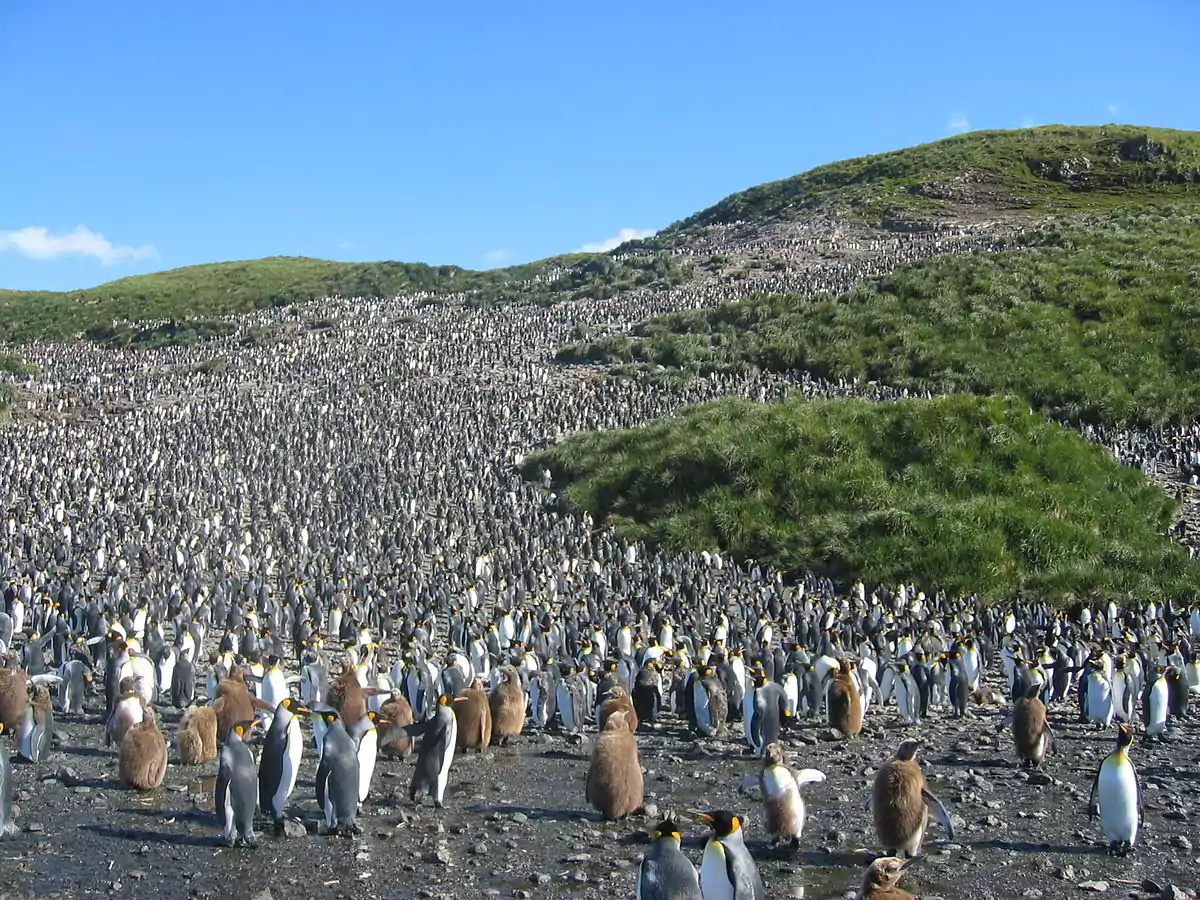
Colony of about 60,000 pairs of king penguins, Salisbury Plain, South Georgia (Photo: Pismire @ German language Wikipedia, CC BY-SA 3.0)
The place once credited as the greatest whaling station on Earth is making headlines again, for the opposite reason.
South Georgia and the South Sandwich Islands have no permanent population. A handful of government officers and scientists live at King Edward Point and on Bird Island, and that is it. Everything else out there is animal. The waters are thick with krill and fish, and wherever you look there is a seal, a penguin or a whale.
Visitors are often the centre of attention rather than the other way round. Tourists are kept at a distance from the wildlife, but young fur seals and penguins have no such rules and will come over for a closer look.
The history of this place is worth knowing too.
The Ghost Town Whaling Station
South Georgia is a British overseas territory, and its best known ruin is Grytviken, whose Norwegian name means pot bay, after the try-pots sealers had left behind on the shore. The South Sandwich Islands, a chain of volcanic islands further south, make up the rest of the territory.
Grytviken was founded in November 1904 by the Norwegian captain Carl Anton Larsen, working for the Compania Argentina de Pesca, the Argentine Fishing Company. It was the first shore whaling station in the Antarctic and the start of permanent human occupation of the island. The company took 195 whales in its first season, and where Grytviken led, others followed. By 1912 there were seven stations around the coast, including Leith Harbour, Stromness, Husvik and Prince Olav Harbour.
Across all of those stations, 175,250 whales were killed in the waters around South Georgia between 1904 and 1965. Grytviken itself shut in 1964, and land-based whaling on the island ended when Leith Harbour closed the following year. There were simply not enough whales left to make it pay. What remains is rusting machinery, oil tanks, and beaches still scattered with whale bones.
Sealing ran alongside whaling and outlasted it in one respect. Fur sealing had already finished by about 1912, the fur seals having been hunted almost out of existence, but a licensed elephant seal hunt ran from 1910 until 1964. After that the only activities on the islands were fishing, tourism and science.
Returning Of Whales, Seals, And Penguins
The abandoned whaling station at Grytviken, once one of the busiest in the world (Photo: Hannes Grobe, Alfred Wegener Institute, CC BY-SA 2.5)
The recovery is mostly a story about time. Commercial whaling in the Southern Ocean stopped, the animals were left alone for decades, and slowly the populations rebuilt. Protection has been layered on since: the government designated a marine protected area of 1.24 million square kilometres in 2012, strengthened it in 2013 and 2019, and in April 2025 expanded the no-take zones where fishing is banned outright to 470,000 square kilometres.
The whale numbers are the striking part. Whalers killed 42,698 blue whales at South Georgia between 1904 and 1971, and the species all but vanished from the island: dedicated surveys between 1998 and 2018 produced one blue whale sighting in twenty years. A British Antarctic Survey team logged 58 blue whale sightings on a single survey in 2020. Humpbacks are back in numbers too, with more than 600 counted during the same 2020 survey, and South Georgia is once again a summer feeding ground for southern right whales.
The rest of the wildlife is on the same scale. South Georgia holds some of the largest king penguin colonies anywhere, including St Andrews Bay and Salisbury Plain. Four species of penguin breed here: king, macaroni, gentoo and chinstrap. Adelie penguins, often lumped in with them, breed on the Antarctic continent rather than on South Georgia.
Antarctic fur seals were reduced to a remnant population by nineteenth-century sealers. South Georgia held about 1.98 million Antarctic fur seals in 2022. The species was listed as Endangered in April 2026 after a major decline. That number comes with a caveat: the closely monitored population on Bird Island peaked and has been declining since 2009, which researchers link to changes in krill availability.
The territory government counts about five million seals of four species and 65 million breeding birds of 30 species, among them prions, petrels and albatrosses. The South Georgia pintail lives here and nowhere else. It is a duck that has been filmed feeding on seal carcasses, which is odd behaviour for an animal with a flat bill and no talons, though it eats plenty of algae and invertebrates too.
New Threats To The Emerging Wildlife
A warming ocean
The glaciers on South Georgia are retreating and the surrounding sea is warming. Krill sit at the base of everything here, feeding the whales, the seals and the penguins, and krill are sensitive to temperature and to the extent of winter sea ice. The Bird Island fur seal decline is the clearest signal so far that changes further down the food chain reach the animals at the top.
Rats, and keeping them out
Rats and mice arrived with the sealers and whalers and spent two centuries eating the eggs and chicks of ground-nesting birds. The South Georgia Heritage Trust raised about 10 million pounds for a decade-long baiting programme covering more than 1,000 square kilometres, the largest rodent eradication ever attempted, and in May 2018 the island was declared rodent-free. Sniffer dogs confirmed it. The job now is biosecurity: a few rats stowing away on one ship would undo all of it.
Oceanic trash
Almost nobody lives here, and rubbish still washes up. Plastic bags, polystyrene and cans arrive on the current from thousands of miles away and collect on the beaches, along with lost fishing gear. It is a persistent problem for one of the least inhabited coastlines on the planet.
South Georgia is the rare case where the numbers are moving the right way. The whaling stopped, the rats went, the fishing is regulated, and the whales came back on their own.
Updated 14 September 2026: updated the Antarctic fur seal estimate and status.



Seeing the old whaling station at Grytviken would be sobering.
Good to read some recovery news for once.
Pavlina, agreed. South Georgia is one of the better stories.
The rat eradication there helped the seabirds too.