

Differences Between Sharks And Whales: Which Is A Mammal Or A Fish?
Last updated: October 14, 2026
4 min read
Drawing a clear line between sharks and whales can get confusing. Here is which is a mammal and which is a fish, and how to tell them apart.
A Whale Shark: despite being called a whale shark and sharing several traits with whales, this creature is a fish, not a mammal.
If you are anything like most people, you would have at some point thought sharks and whales, especially the very large species, are similar or even related.
Take the example of the largest sharks and whales. The whale shark and the basking shark strain their food from the water, and so do the blue whale and the gray whale. They are all massive, relatively gentle, and harmless to people. None of them chews: the sharks filter with gill rakers and the whales strain through baleen plates. (The two giant sharks do still have teeth, thousands of tiny ones, they just do not use them to feed.)
Well, strangely enough for those hearing it for the first time, sharks and whales are not related.
Whales are mammals and sharks are fish. Whales are descended from four-legged land mammals that went back to the water around 50 million years ago. Sharks were already ancient by then.
In fact, these two groups of marine creatures are remarkably distinct once you take a closer look. So let’s do that right away. Even a savvy animal lover could be confused, especially when they hear names like “whale shark” in reference to a fish.
Differentiating Between Sharks And Whales
Why Are Whales Mammals And Sharks Fish?
There are several clear distinguishing characteristics between these sea creatures. The major ones are:
1) Breathing System
Gills or lungs: sharks and other fish can stay underwater indefinitely because they take oxygen straight out of the water using their gills.
Fish gills sit in slits on either side of the head. They look like fringes or tendrils and are thin sheets of blood-red tissue.
Whales cannot do that. They must come up for air at intervals, which makes them like humans, dogs and bears in that one respect.
They use lungs, like we do, and they take air in through their blowholes. The blowhole is the opening on top of the head (dolphins have them too).
2) Skeletal Structure
Bone or cartilage: a whale skeleton is made of bone, just like ours. That is why whale bones are still recovered many years after the animal dies, and why you will find whale skeletons hanging in museums.
Sharks are different. Their skeleton is made of a firm but flexible substance called cartilage, which is lighter than bone. Cartilage decays quickly and rarely fossilises, so most of what we have of extinct sharks is their teeth.
Interestingly, cartilage is an important component in the human body too. It gives structure to our rib cage, outer ear, nose, and the ends of our long bones.
To swim, sharks move their tails from side to side while whales move theirs up and down.
3) Body Temperature Regulation
Cold-blooded or warm-blooded: one major difference between sharks and whales is the way they handle body temperature.
Most sharks are ectothermic, or “cold blooded,” meaning their body temperature tracks the water around them. Snakes, lizards and turtles are the same, relying on external heat sources.
There is a real exception. The mackerel sharks, which include the great white, the shortfin and longfin mako, the porbeagle and the salmon shark, are regionally endothermic. Using counter-current heat exchangers in their blood vessels, they keep their swimming muscles, eyes and brain warmer than the surrounding water. That is not the same as being warm-blooded, and it costs them a lot of energy.
Not every cold-water shark works that way. The Greenland shark lives under Arctic ice at temperatures close to freezing and simply runs cold, moving very slowly and living a very long time.
Whales, like us, are endothermic or “warm-blooded.” They generate and hold their own body heat, so they can live in cold or warm seas.
4) Care Of The Young
Lots of care or no care: sharks reproduce in various ways, and this is another source of confusion in the mammals versus fish question.
Some species lay eggs and some give birth to live young. Either way, shark mothers provide no care after the pups arrive. No shark species has been observed looking after its young once they are born.
The sand tiger shark takes it further in the other direction. Its embryos eat their siblings before birth. A female has two uteruses, and the largest embryo in each one consumes the rest, so a litter that started as many pups arrives as two.
Whale calves get the opposite deal. They nurse on their mother’s milk for months, and in some species far longer: a humpback calf feeds for close to a year, a sperm whale calf for two years or more, and young whales stay with or near their mothers well beyond weaning.
5) Skin Type
Hair or scales: whales have a little hair on otherwise smooth skin. You will often find it around the head. On a humpback, the bumps along the jaw and snout each hold a single hair.
Sharks are covered in placoid scales, also called dermal denticles. They are built like tiny teeth, with an enamel-like surface, which is why shark skin feels like sandpaper one way and smooth the other.
So, to summarise: whales, like other mammals, have some hair, a bony skeleton, lungs, warm blood, and milk for their young.
Sharks have denticles, a cartilage skeleton, and gills. Most have body temperatures near the surrounding sea, although some mackerel sharks keep parts of the body warmer. Reproductive care varies by species.
Updated 14 September 2026: qualified shark temperature and reproductive care claims.




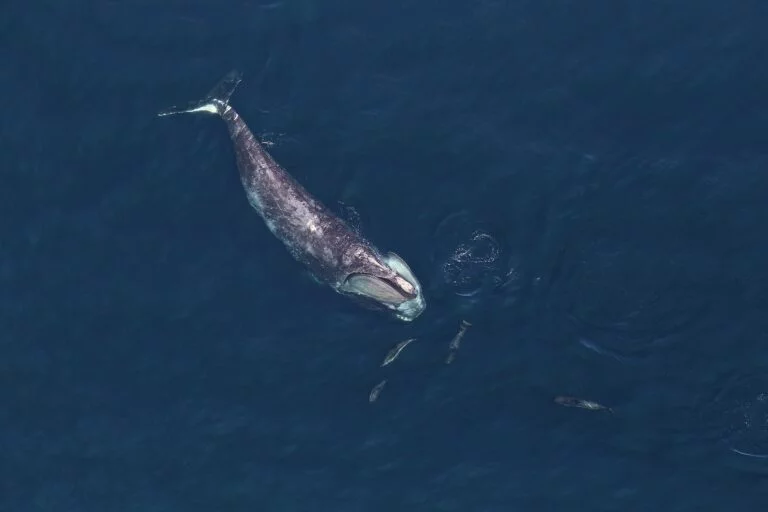

The whale shark name causes so much confusion.
Breathing air and live birth are the two tests I use with my kids.
The tail is the easiest giveaway. Side to side for sharks, up and down for whales.