Where to See Right Whales in Florida: Beaches, Season, Rules
Last updated: November 26, 2026
6 min read
On Florida’s northeast coast you can stand on a public beach in winter and, with patience and some luck, watch a North Atlantic right whale mother travel with her calf just beyond the surf. There are no boat trips to see them here, and the rules would not allow a close approach anyway. Many sightings come from people on the beach, residents looking out from oceanfront condos, and a volunteer network that watches the coast every winter.
This guide covers where right whales have actually been seen from the Florida shore, when to look, how to tell a right whale from the humpbacks that pass the same beaches, and who to call when you see one. Every place in the table below comes from a sighting record or a published lookout list, with the source beside it.
Why the whales come to Florida
Each autumn some right whales swim more than 1,000 miles from their feeding grounds off New England and Canada to the shallow coastal waters between North Carolina and Florida. NOAA Fisheries describes the southeastern United States as the only known area where right whales regularly give birth and nurse their young, and it has designated the coast from Cape Fear, North Carolina, to below Cape Canaveral as critical habitat.
The numbers explain why every calf matters. The North Atlantic Right Whale Consortium estimated 382 right whales for 2025, released on 16 November 2026, down from a revised 389 for 2024. The 2025 to 2026 calving season produced 24 documented births, the highest since 2009, and those calves are not yet counted in the estimate. My right whale recovery update keeps the year by year figures in one table.
The new season has already started. On 10 November 2026 members of the public reported a mother and calf to the NOAA hotline, and scientists identified the mother as Curlew (#4190), 16 years old and with her first calf, about 11 nautical miles east of St. Augustine Inlet. That is far beyond what you can see from a beach, but most of the pairs in the table below were found much closer in.
Where right whales have been seen from the Florida shore
The Marineland Right Whale Project surveys about 70 nautical miles of coastline, from Ponte Vedra Beach to Ponce Inlet, with mobile teams at set lookout points and stationary teams in oceanfront condos. Its sightings log for the 2025 to 2026 season is the best record I found of where whales were seen from land. The places below are listed north to south.
| Place | What was seen, and when | Source |
|---|---|---|
| Ponte Vedra Beach | 12 February 2026: a resident reported an adult whale heading south; the volunteer team confirmed a mother and calf, later identified as Magic (#1243). | Marineland Right Whale Project |
| St. Augustine Pier | Named as a whale lookout. The county closed the pier for piling repairs from 13 May 2026, with work due to finish by the end of November 2026, so check before you go. No 2026 sighting from the pier itself was found. | Florida Rambler, St. Johns County |
| Crescent Beach and Butler Beach | 14 March 2026: Mirror (#4617) and her first calf, seen just beyond the surf at Crescent Beach and spotted again from Butler Beach. | NOAA Fisheries, MRWP |
| Summerhouse and Matanzas Inlet, St. Augustine | 2 March 2026: two adult females just north of Matanzas Inlet near the Summerhouse condos. 5 March: Juno (#1612) and calf first seen from the Summerhouse Beach and Racquet Club. | Marineland Right Whale Project |
| Marineland | 5 March 2026: Juno and her calf were seen near Marineland in the afternoon. 14 March: Mirror and her calf passed Marineland at about 5 pm. | MRWP |
| Palm Coast (Varn Park, Jungle Hut Park) | 10 February 2026: Magic and calf near Varn Park. 14 February: Boomerang (#2503) and calf near Jungle Hut Park, tracked south past Hammock Dunes. | MRWP |
| Flagler Beach | 16 February 2026: a mother and calf off Flagler Beach, filmed from shore by a bystander. Six miles of beach are visible from State Road A1A. The town’s fishing pier has been closed since Hurricane Ian in 2022 and is being rebuilt. | MRWP, Florida Rambler, FOX 35 Orlando |
| Ormond-by-the-Sea | 4 February 2026: Boomerang, 31 years old, with her fifth known calf, travelling just offshore from Ormond-by-the-Sea to Flagler Beach. | MRWP |
| Daytona Beach | 10 February 2026: beachgoers saw Uca (#3390) and her calf moving slowly south and called the hotline. The Sunglow Pier in Daytona Beach Shores and the Main Street Pier are named as lookout points. | MRWP, Florida Rambler |
Two patterns stand out. First, the same pair can travel a long stretch of coast in a day: on 14 March 2026 Mirror and her calf were reported near Ocean Hammock Park, then followed south past Crescent Beach, Butler Beach and Marineland to Palm Coast by evening. Second, many sightings start with someone who was not looking for whales at all, a beach walker or a resident at home who called the hotline.
Further north, the Right Whale Festival is held each November at Main Beach Park in Fernandina Beach, on Amelia Island, to mark the whales’ return to the waters off northeast Florida and Georgia. The 2027 festival is set for 6 and 7 November.
When to look
NOAA puts the calving season between mid November and mid April. The Marineland project says mother and calf pairs are off Florida’s shores from December through March, and its volunteers survey from 4 January to 13 March 2027. Florida Rambler suggests February is the best month, which fits the dense run of February sightings in the project’s log.
Keep expectations honest. NOAA counted about 500 sightings of 129 right whales across the whole Southeast in the 2026 season, from planes, boats, volunteers and the public, over hundreds of miles of coast. On any one day at any one beach the most likely result is an empty sea. The Florida Rambler advice is practical: scan without binoculars from a high point, look where dolphins or sea birds gather, and pay attention when you see a group of people on the beach all pointing the same way.
How to tell a right whale from a humpback
Humpbacks also pass this coast in winter, so identification matters before you call anyone. The Marineland project’s field marks are the ones to learn:
- No dorsal fin, so the back looks broad, smooth and black.
- A V shaped blow, because the two blowholes point outwards.
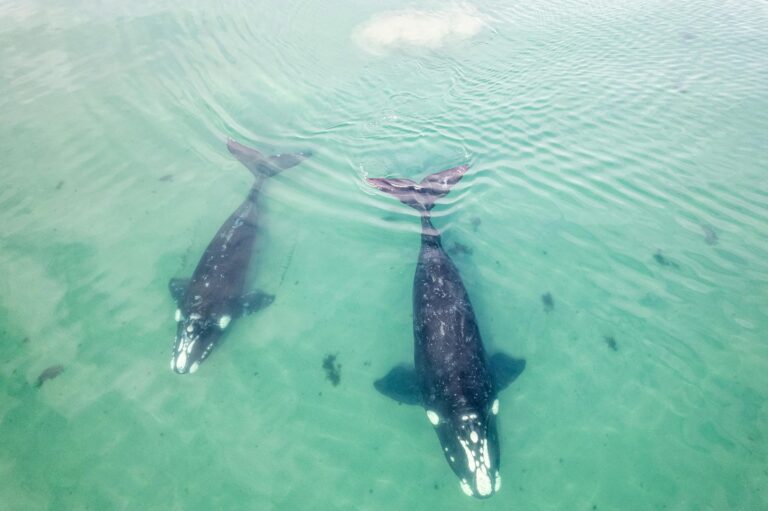
- White patches of rough skin on the head, called callosities, coloured by whale lice. Each whale’s pattern is unique.
- Short, wide, black flippers, where a humpback’s are long and white.
- An all black tail with a deep notch and a smooth edge.
Calves are about 14 feet long at birth, according to NOAA, and a mother with a calf spends most of her time at or near the surface, which is why pairs can be seen from shore and why they are so easy for boats to hit. If you want the full biology, my North Atlantic right whale profile covers it.
Rules: keep your distance, including with a drone
Federal rules prohibit approaching or remaining within 500 yards of a right whale. NOAA says this applies to boats, to aircraft including drones, and to people on surfboards, kayaks and jet skis. The drone pictures you see from the Marineland project are taken under a NOAA research permit; flying a hobby drone over a mother and calf, or paddling out for a closer look, breaks the federal rule.
Boats have their own rules. From 1 November most vessels 65 feet or longer must keep to 10 knots in seasonal management areas between Rhode Island and Florida, and NOAA urges smaller boats to do the same. NOAA names collisions with vessels and entanglement in fishing gear as the primary causes of the Unusual Mortality Event declared in 2017. I cover the first in ship strikes and large whales.
Who to call when you see one
A report is useful even if you are not sure. In Florida the Right Whale Hotline is 1-888-97-WHALE (1-888-979-4253), and the Marineland project’s log shows how a single call can bring out volunteer spotters, drone operators and a state survey plane to identify the whale. NOAA asks for sightings from North Carolina to Florida on 877-WHALE-HELP (877-942-5343). Note the time, the nearest street or beach access, the direction of travel and whether there is a calf. Never approach an injured or entangled whale yourself.
And Georgia?
The calving grounds reach into Georgia, where the right whale is the official state marine mammal. NOAA lists the Georgia Department of Natural Resources among the teams that survey the calving grounds and take biopsy samples from calves. I could not find a Georgia source that lists shore sightings or lookout points the way the Florida volunteer network does, so I have left Georgia beaches out of the table rather than guess. If you know of one, tell me.
For other ways to watch whales from land, see my guide to whale watching from shore, and where to see whales for the rest of the world.
Sources
- NOAA Fisheries: North Atlantic right whale calving season 2027
- NOAA Fisheries: By the numbers, 2026 North Atlantic right whale calving season
- NOAA Fisheries: North Atlantic right whale species page
- IFAW: North Atlantic right whale population dips slightly (16 November 2026)
- Marineland Right Whale Project: home page and hotline
- Marineland Right Whale Project: sightings, 2025 to 2026 season
- Marineland Right Whale Project: volunteer sighting network
- Marineland Right Whale Project: right whale characteristics
- Florida Rambler: Endangered right whales return to Florida coast in winter
- The Current GA: Surprise calf adds to 2026 right whale calving season total
- Right Whale Festival, Fernandina Beach
- FOX 35 Orlando: Flagler Beach Pier construction begins (21 July 2025)
- St. Johns County: beaches announcements, pier closure
Seen a right whale from a Florida beach this season? Tell me where and when in the comments.
Photo: NOAA Fisheries, Public domain, via commons.wikimedia.org.