
Why Whales Sing: The Science of Cetacean Song
Last updated: September 14, 2026
6 min read
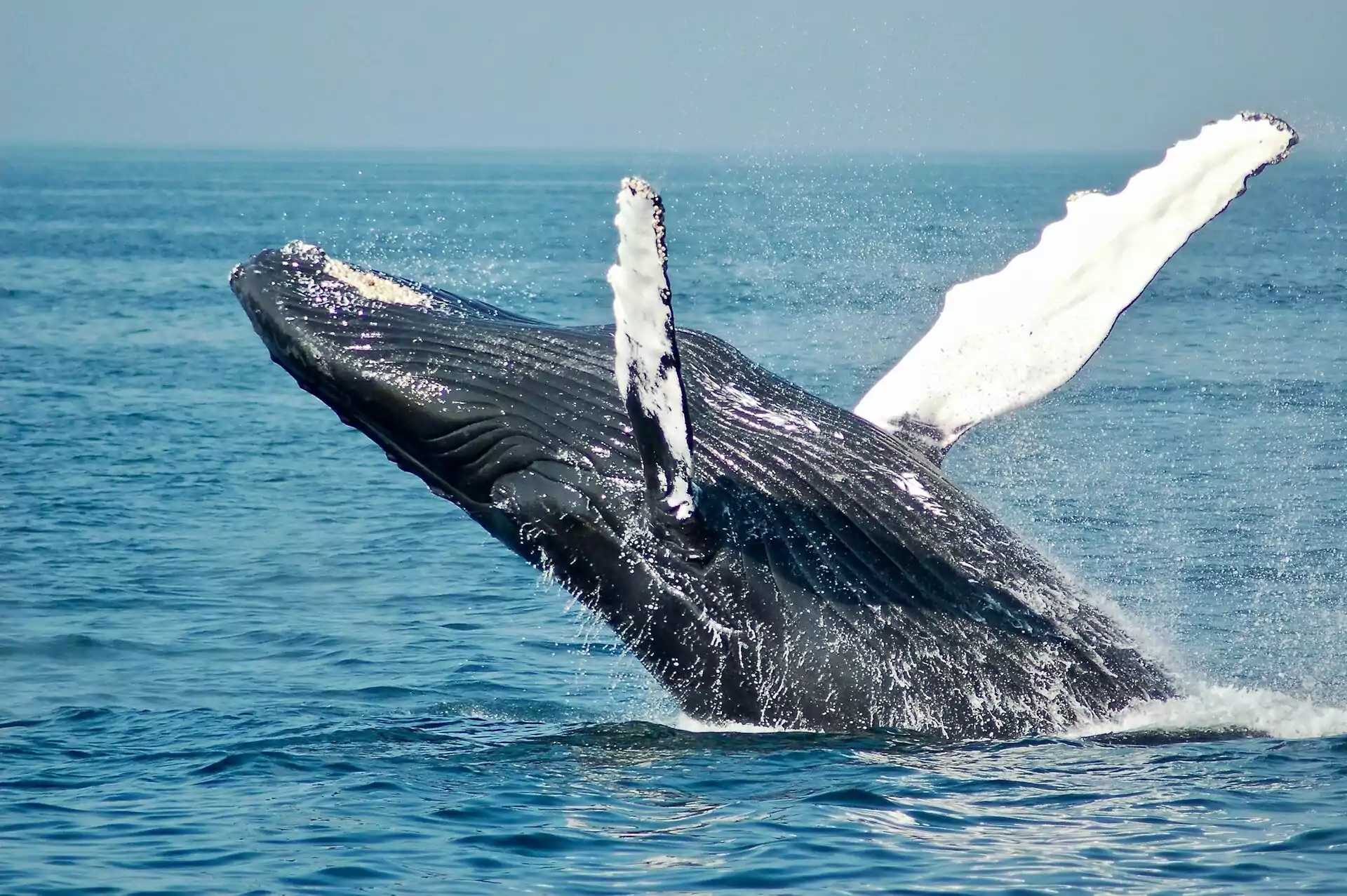
Photo: Todd Cravens via Unsplash
Whale song is one of the few animal vocalisations long and complex enough that scientists have spent half a century arguing about what it actually is. Humpback songs run for twenty to thirty minutes and repeat for hours. Bowheads improvise jazz-style. Blue whales pulse at frequencies so low they travel across entire ocean basins. None of this happens by accident, and yet the question of what whales are saying when they sing is still partly open.
This guide pulls together what marine biologists know in 2026 about cetacean song: which species sing, how they make sound without vocal cords, what songs are likely communicating, and why the answers matter for NOAA Fisheries and other conservation agencies trying to reduce noise pollution in the ocean.
Key facts at a glance
- Singers: Mainly male humpbacks, blue whales, fin whales, bowheads, minke and right whales
- Sound mechanism: toothed whales use nasal structures; baleen whales use specialised laryngeal structures and recycle air through a laryngeal sac
- Range: Blue whale calls travel hundreds of kilometres in deep sound channels
- Song length: Humpback song: 20 to 30 minutes per cycle, repeated for hours
- Cultural change: Humpback songs evolve year over year and spread between populations
Which whales actually sing
Not every whale sings. Toothed whales (odontocetes) such as orcas, dolphins, and sperm whales mostly produce clicks, buzzes, and whistles tied to echolocation and short-range social calls. Baleen whales (mysticetes) are the songsters. The humpback whale is the most famous, but blue whales, fin whales, bowheads, sei whales and common minke whales all produce structured, repeated vocalisations that fit a working definition of song: sequences of notes arranged into themes that repeat over time.
Sperm whales sit in their own category. Their codas (rhythmic click patterns) are not song in the musical sense, but they show cultural variation across clans the same way songs do across humpback populations. That has made researchers cautious about drawing too sharp a line between song and other complex vocalisations.
How whales sing without vocal cords
Whales do not have vocal cords. A 2024 study of excised baleen whale larynges showed how they do it instead: air is pushed past a U-shaped fold of tissue inside the larynx and recycled back into the lungs, so a whale can vocalise for long stretches without surfacing to breathe. Toothed whales use a structure called the phonic lips (sometimes called monkey lips) inside the nasal passage. Air pulses past these lips and vibrations are focused by the melon, the fatty organ in the forehead, into a directional click beam.
Two consequences follow. First, whales can produce sound while diving without losing air to the surface. Second, the frequencies they choose are tuned to the medium. Water carries low frequencies further than air does, which is why blue and fin whale calls sit between 10 and 40 Hz, below the range humans can hear without amplification.
What the songs probably mean
The leading hypothesis for humpback song is reproductive display. Almost all known humpback singers are male, and they sing more during the winter breeding season in tropical waters. Song may function in reproductive display and interactions between males. Researchers have not shown that females select males by song quality or that song reliably signals fitness.
But the picture is not that clean. Singers space themselves out in the water column, sometimes joining other singers and modifying their song to match. That looks more like territory negotiation or coalition-building than pure courtship. Smithsonian Ocean has profiled researchers who argue song serves multiple functions simultaneously: advertisement, navigation, social bonding, and possibly even passive sonar.
Cultural transmission and song revolutions
Humpback song is one of the clearest examples of culture outside primates. Within a population, all males sing the same song. Over a season, the song slowly mutates: a phrase gets dropped, a new theme appears. Other males copy these changes in near-real-time, so the song evolves as a single shared text. Every few years, a song revolution sweeps a population: a completely new song, often imported from a neighbouring population, replaces the existing one within months.
This kind of population-wide horizontal transmission of a complex behavioural pattern is rare in the animal kingdom. It is one of the reasons researchers think cetacean cognition deserves to be discussed alongside great apes and elephants on questions of culture, identity, and self-awareness.
Blue and fin whale song
Blue and fin whale calls are simpler in structure than humpback song but no less interesting. The classic blue whale call is a downward-sweeping moan around 16 to 18 Hz, repeated in long bouts. Different populations have distinctive call types: the North Pacific blue sounds different from the Antarctic blue, and the Sri Lankan blue is different again. Because the calls are loud and low, they propagate hundreds of kilometres in the SOFAR channel (the deep sound layer in the ocean) and probably function as a long-distance contact call between widely scattered individuals.
Fin whale pulses (the so-called 20 Hz signal) are also long-range and structured. Researchers use fin whale pulses to study distribution and movement. The evidence does not show that fin whales use echoes from these calls as an acoustic map.
The noise problem
Shipping, seismic surveys, and naval sonar have made the ocean dramatically louder over the past century. Low-frequency shipping noise sits exactly where blue and fin whales call. The International Whaling Commission and NOAA have both flagged anthropogenic noise as a major welfare and conservation issue, and there is growing evidence that whales change call frequency, amplitude, or timing in response.
This matters for population recovery. Shipping noise can mask humpback song and change behaviour, but researchers have not measured a direct reduction in mating success. If a blue whale cannot reach a distant mate across the SOFAR channel, the calculus of finding each other in a vast ocean gets harder. Mitigation work, including slower shipping lanes and quieter ship designs, is one of the practical conservation levers that comes out of cetacean song research. See also our deeper look at underwater sonar and whales.
Open questions
Even after fifty years of recordings, plenty is unresolved. Why do humpback songs revolutionise? What triggers the new song that sweeps through a population? Do females ever sing? Are there individual signatures inside the population-wide song that let listeners identify the singer? Are songs structured in a way that contains compositional meaning, the way human language combines small units into larger ones?
New tools are moving the field forward fast. Suction-cup tags record sound and movement on individual whales for days at a time. Machine learning sifts thousands of hours of hydrophone data for previously unnoticed call types. Project CETI is even attempting a partial decoding of sperm whale codas using large language model techniques. The science of whale song is one of the most active corners of marine biology in 2026.
What you can do
- Support quiet-ocean campaigns by donating to or following groups like NRDC, IFAW, and the Ocean Conservation Research center.
- When whale watching, pick operators that follow current distance, speed, and viewing-time rules. We cover this in our best whale watching spots guide.
- Reduce single-use plastic. Marine debris adds to the cumulative pressure on cetacean populations alongside noise.
- Listen. NOAA and many research groups stream live hydrophone feeds from the Pacific and Atlantic. A few minutes a week of attention is its own conservation act.
For more on what makes whales different from other ocean mammals, see 15 surprising whale facts and the difference between whales, dolphins, and porpoises.
Take whales home
If this piece pulled you in, our curated whale book collection is the next step: deep dives on biology, behavior, and the history of human relationships with cetaceans.
Browse whale books in our store.
Frequently asked questions
Do all whales sing?
No. Mainly male baleen whales (humpback, blue, fin, bowhead, minke, right) produce what researchers call song. Toothed whales like dolphins and orcas make clicks and whistles, which are communicative but structured differently.
Why are male humpbacks the main singers?
The dominant hypothesis is reproductive display: a costly, energy-expensive song signals fitness to females and competitors during the breeding season. Some researchers think it also negotiates social position among males.
How loud is a blue whale call?
Up to about 188 decibels at source, one of the loudest sustained animal sounds known. Because most of the energy is below 40 Hz, it travels much further in water than higher-pitched calls.
Can humans hear whale song?
Humpback song sits mostly in the human audible range and can be appreciated unprocessed. Blue and fin whale calls need speeding up or pitch-shifting to be perceived clearly by human ears.
Does ship noise really change whale behaviour?
Yes. Studies have documented whales calling louder, calling at different frequencies, shortening songs, or simply stopping in the presence of shipping or seismic survey noise.
Is whale song the same as language?
Not in the human sense. Whale song is structured and culturally transmitted, but there is no strong evidence yet of compositional meaning where units combine into novel statements. That is one of the central open questions of cetacean cognition.
Updated 14 September 2026: corrected sound anatomy and qualified song hypotheses.




Do sperm whales use the same clicks to talk and to hunt?
Imogen, the codas used to communicate are made the same way as hunting clicks, just in different patterns.
A whole population changing its song in a season is amazing.
Elin, songs do seem to spread between humpback populations, often in one direction.
Would love to read more about the project trying to decode sperm whale codas.
Whales using a deep sound channel that humans only found later is amazing.
Listened to a live hydrophone feed for an hour after reading this. Very calming.
Do female humpbacks sing at all?