

Why Do Whales Breach? Answers From Science
Last updated: October 14, 2026
3 min read
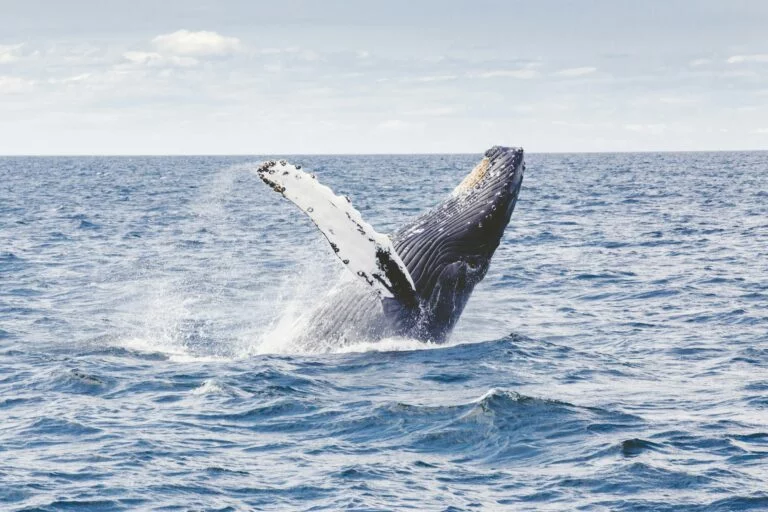
Photo: Thomas Kelley via Unsplash
If you always thought whales breach out of the water just for fun, you are not alone. Scientists now have a better answer than that.
All over the world’s oceans, whales throw themselves clear of the surface and crash back down. They also slap their tails and fins against the water. These are separate surface-active behaviours. Breaching means launching much of the body from the water, and humpback whales (Megaptera novaeangliae) are especially known for it.
People have argued about the reason for a long time. One idea was a dominance display between males, though that struggles to explain why females breach just as readily. Another was a way of stunning schools of prey. Others suggested a warning aimed at predators, whalers or passing boats, or simply that the animals enjoy it, the way we do when we splash about in a pool.
Why Whales Breach According To Science
Breaching burns a lot of energy, and whales still do it while fasting on their long migrations. That cost was the first clue that it was doing real work rather than passing the time.
A team led by Ailbhe Kavanagh at the University of Queensland spent September and October of 2010 and 2011 at Peregian Beach on the east coast of Australia, watching humpbacks heading south towards their Antarctic feeding grounds. They collected focal observations on 94 groups of whales alongside continuous acoustic monitoring, and published the results in the journal Marine Mammal Science in 2017.
What they found:
- Whales were much more likely to breach when the nearest other group was more than 4,000 metres (about 2.5 miles) away.
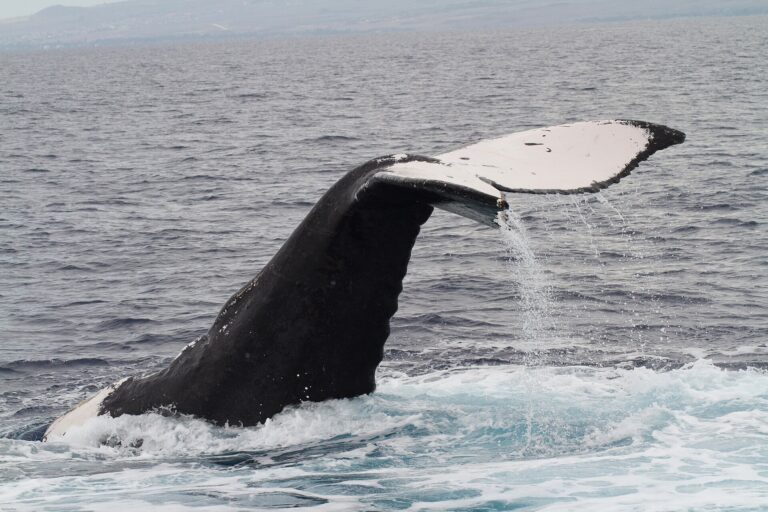
- Slapping with the pectoral fins, tail flukes and peduncle went with groups splitting up or joining together, so at close range.
- Surface activity of all kinds went up when it was windy.
- Taken together, the researchers read breaching as long-distance communication between groups, and slapping as short-range communication within one.
Why Hit The Water At All?
A body weighing tens of tonnes landing flat on the surface makes a loud, broad thud rather than a call. That matters because the ocean is a noisy place. Wind and waves, ships, motorboats and other animals all fill the same water a whale is trying to be heard in, and a voice can be swamped. A breach carries through the racket, which fits neatly with the finding that whales were most surface active on windy days.
This makes absolute perfect sense. Even though these whales can produce calls that travel great distances, if there’s a lot of noise, it might be easy to drown out. Leaping up in the air and splashing down is equivalent to the really keen kid in a classroom jumping up and down waving his arms.
Chris Parsons, cetacean biologist at George Mason University in Virginia, speaking to Hakai Magazine. He was not part of the research team.
Will Humans Ever Understand Whale Communication?
Mostly, no, not yet. Researchers can describe the moans, grunts, cries and knocks in fine detail, and they know a great deal about the structure of humpback song, which is shared across a whole population and rewritten from one year to the next. What any of it means is a separate problem, and nobody can translate it.
The job is getting harder rather than easier. Better recording gear helps, but shipping, sonar, motorboats and underwater blasting keep adding noise to the frequencies these animals rely on.
Breaching almost certainly serves more than one purpose, and the circumstances decide which. For humpbacks on migration, the Peregian Beach study supports a long-range communication hypothesis. Breaching was less likely when the nearest group was within four kilometres, but the study did not measure a fixed hearing range or purpose.
Updated 14 September 2026: corrected surface behaviour terms and qualified a communication hypothesis.



The idea that breaching carries a message over distance makes sense to me.
Eddie, it is still being studied. Communication is the leading idea.
Do they breach more on migration or in the breeding grounds?
Seems like a lot of effort for a whale that is fasting. There must be a reason.
Calves breaching for play while adults do it for other reasons makes sense.
Painting a series of whale watercolours, so saving this for the colour notes.
Saw a breach off Cape Cod and just thought it was showing off.
Read like a book chapter. Meant as a compliment.
Read this by the harbour after a day out.