
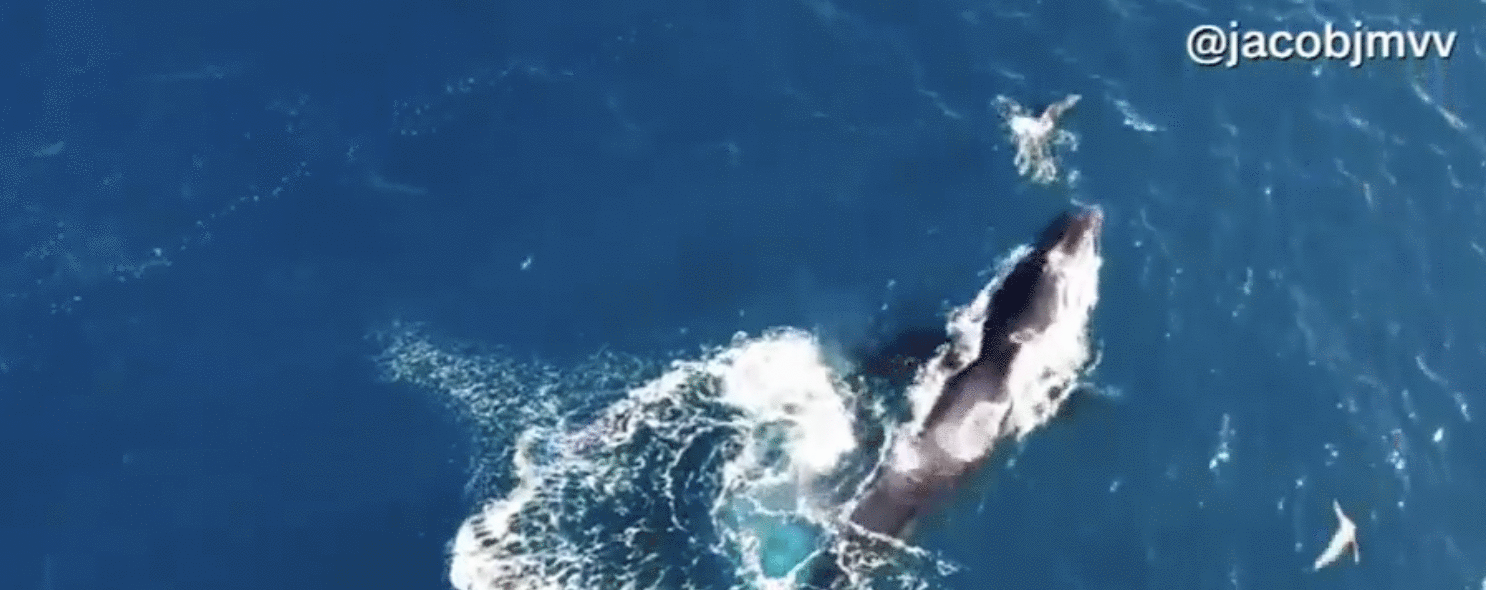
Humpback Whale and Dolphin Playing in Hawaii
Last updated: July 28, 2026
3 min read
A video shot off Oahu’s North Shore in February 2022 caught something most people never get to see: a humpback whale and a dolphin turning slowly through the water together, with the dolphin looping around the whale’s head. Hawaii photographer Jacob VanderVelde filmed it about 300 yards off Shark’s Cove at around 9:15 in the morning on 2 February.
“On a scale of one to 10, it would be a 12,” VanderVelde told Hawaii News Now. “It’s a magic moment, I will never forget what just happened yesterday.” He shoots waves and ocean photography for a living, and said this was probably the biggest moment of his career. Seeing whales off the North Shore in winter is routine. Seeing two species play together is not.
Why humpback whales are in Hawaii at all
The whale in the video is not a permanent Hawaiian resident. North Pacific humpbacks feed through the summer in the cold, productive water off Alaska, then migrate roughly 3,000 miles south to Hawaii for the winter. NOAA Fisheries notes that some individuals cover that distance in as few as 28 days. They make the trip to breed and to give birth in the islands’ sheltered, shallow channels, and thousands gather around Maui, Oahu and the rest of the main chain between about November and April.
Adult humpbacks are commonly 45 to 50 feet long and reach about 60 feet at the top end, weighing up to about 40 tons. They are easy to recognise by their pectoral fins, which run up to 18 feet, and by the knobbly bumps on the head, called tubercles. Much of the water where this encounter happened sits inside the Hawaiian Islands Humpback Whale National Marine Sanctuary.
The other animal: Hawaii’s dolphins
The dolphin circling the whale’s head is a fraction of its size. Common bottlenose dolphins, found around Oahu, run to roughly 8 to 12 feet and a few hundred kilograms, and the spinner dolphins that rest in Hawaiian bays are smaller still. Set that against tens of thousands of kilograms of humpback and the size gap is the whole reason the footage is striking: the dolphin is small enough to treat a 40-ton animal as a moving playground.
Is it really play?
The best documented case comes from Hawaiian water. In a 2010 paper in Aquatic Mammals, Mark Deakos and colleagues described two encounters in which a humpback lifted a bottlenose dolphin clear of the surface on its rostrum. The first was off northwest Kauai, where a dolphin lay balanced across the end of the whale’s snout and was raised until it slid off and swam back to its group. The second was off northwest Maui, where a mother humpback lifted a dolphin six times over eight and a half minutes, with lifts lasting from four to 45 seconds, and the dolphin never tried to get away. The authors concluded that object play by the whale and social play by the dolphin were the most plausible explanations.
Behaviour like that is hard to explain as feeding or defence. A few things make it worth noticing:
- Both animals are large-brained social mammals with long lifespans, the kind of species in which play tends to show up.
- Neither one gains anything obvious in survival terms, which is exactly what makes researchers interested.
- Dolphins routinely ride the pressure waves pushed by larger animals and by boats, so circling a slow-spinning whale may be an extension of a habit they already have.
Be careful with the word “friends” here. No one can confirm a lasting bond between two specific animals from a single clip. What the footage does show is two very different species choosing to interact in a way that is gentle, repeated, and not driven by hunger or threat.
Why Hawaii produces these moments
Hawaii is one of the easiest places on Earth to watch humpback behaviour close in. The water is clear, warm and relatively calm in winter, the whales come near shore to breed, and dolphins are in the same areas all year. Add a photographer who spends his mornings in the surf and encounters that would go unseen elsewhere end up on camera. Whale-watching season runs from roughly December through April, and federal law makes it illegal to approach a humpback in Hawaii within 100 yards by land or sea, or within 1,000 feet by air.
What the encounter does not tell us
A short video has limits. We cannot know whether these two animals had met before, how long the interaction ran before and after filming, or how much attention the whale was paying to the dolphin at all. Honest uncertainty is part of watching wild animals. The encounter is real, but the inner experience of both animals stays out of reach.
A small window into whale behaviour
It is easy to enjoy a clip like this and leave it there, but each recorded interaction adds to a slow accumulation of evidence about how these animals spend time when they are not feeding or migrating. Humpbacks are already known for complex song and for cooperative bubble-net feeding, and they turn up in other odd interspecies situations too: our post on humpback whales interfering with killer whale hunts covers 115 recorded cases of humpbacks breaking up orca attacks on other species.


Dolphins riding on humpbacks is one of the happiest things I’ve seen.
Drone footage has changed whale photography.