
Two Dead Sperm Whales in One Week
Last updated: October 14, 2026
4 min read
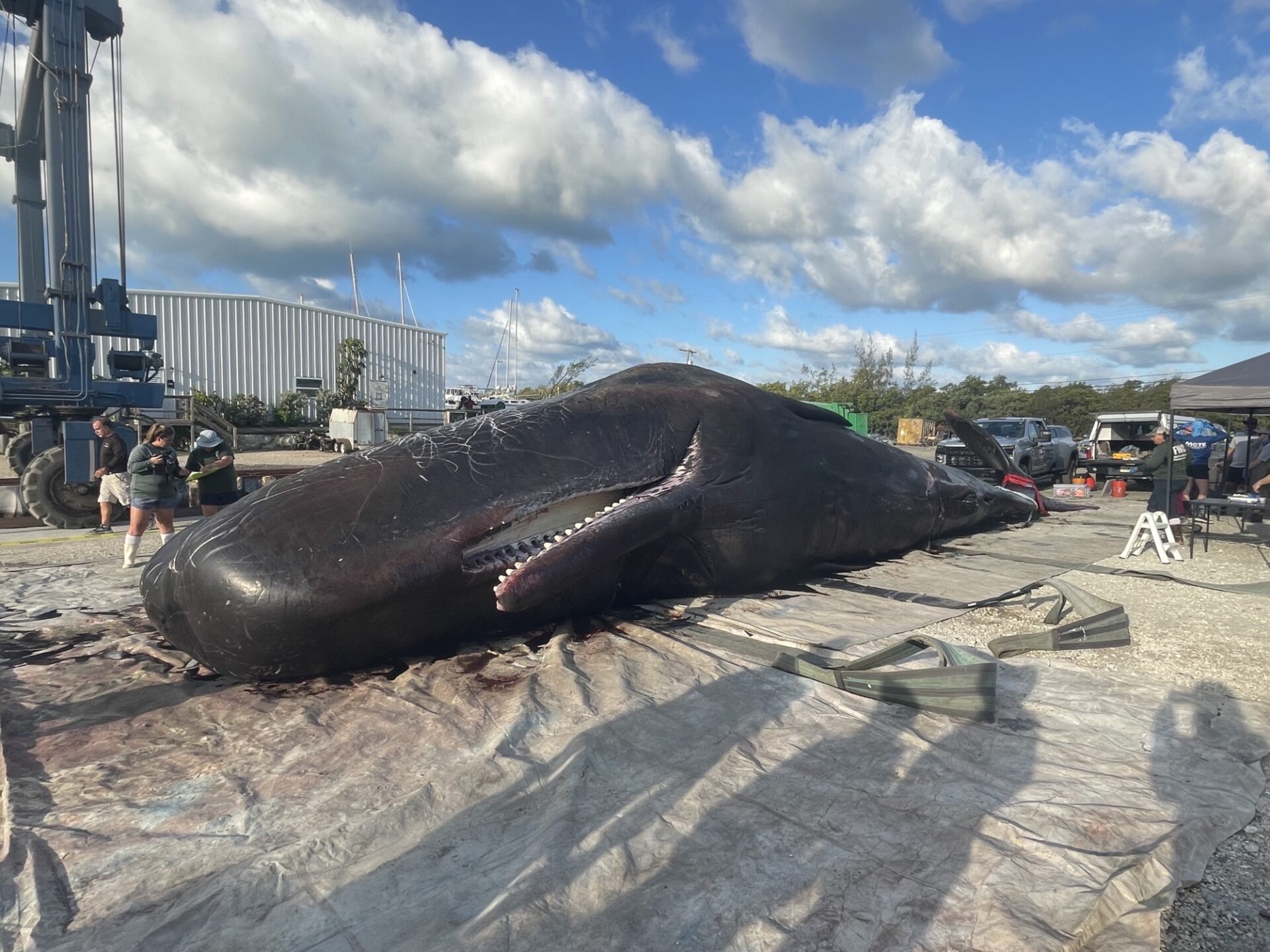
Two dead sperm whales in a single week off Florida is well outside the normal pattern, and the second death points straight back at us. In May 2022 the Florida Keys saw two sperm whale strandings: a newborn calf at Key Largo and, six days later, a 47 foot male in the shallows north of Key West whose stomach held a mass of fishing line, net and plastic. Officials normally record about two sperm whale strandings a year across the whole Gulf of Mexico, not two in a week.
The two strandings
The first was a female calf, nine and a half feet long, reported swimming near Key Largo on 4 May and found soon after on a small barrier island off John Pennekamp Coral Reef State Park. Her umbilical cord was still open, so she was days old at most. Blair Mase, NOAA’s marine mammal stranding coordinator for the southeast region, said the likely major factor was that she had been separated from her mother so soon after birth. A calf that young depends entirely on her mother’s milk and protection.
The second whale was still alive when a fisherman found it. On the morning of 10 May a 47 foot male was reported stranded in the shallows at Mud Keys, about 15 miles northeast of Key West. It died shortly after the NOAA stranding network reached it. Biologists towed the body to Robbie’s Marina at Stock Island and carried out the necropsy, the animal version of an autopsy, two days later. The whale was extremely thin, and inside the stomach was a mass of intertwined line, pieces of net and plastic bag material. The completed investigation found an obstructive mass of line, net and plastic weighing 1,335 grams. Investigators said the debris may have impaired feeding and contributed to emaciation. Tissue samples went off for further analysis to confirm the final cause.
Mase said the two deaths did not appear to be connected to each other. One was natural misfortune. The other was not.
Why plastic kills whales
A sperm whale starving with a full stomach sounds like a contradiction, but it is exactly how plastic ingestion works. A whale cannot tell a drifting plastic bag from a squid. Once swallowed, plastic does not digest. It collects, tangles and forms a solid mass that blocks the gut. The whale keeps feeling full, stops taking in real nutrition, and slowly wastes away. In some documented cases the blockage causes a fatal internal infection called peritonitis.
This Florida whale is not an isolated horror story. Cases recorded around the world include:
- A sperm whale that washed up in Murcia, southern Spain, in 2018 with 29 kilograms of plastic and debris in its digestive tract.
- A sperm whale on Luskentyre beach in Scotland’s Outer Hebrides in 2019, found with roughly 100 kilograms of rubbish inside it.
- A sperm whale stranded on a Kauai reef in Hawaii whose stomach held fishing nets, plastic bags and hagfish traps.
- A mass stranding on the North Sea coast in early 2016. Researchers examined the digestive tracts of 22 of the 30 whales and found marine debris in nine of them, up to 25 kilograms in a single animal, including netting, rope, packaging and a piece of a car.
The scale behind these individual deaths is hard to take in. The IUCN estimates that at least 14 million tonnes of plastic end up in the ocean every year, and that plastic makes up around 80 percent of all marine debris. A 2025 analysis in the Proceedings of the National Academy of Sciences pooled more than 10,000 marine animal necropsies and found that 12 percent of the marine mammals examined had swallowed macroplastic, and that it had killed roughly one in every 140 of them.
Sperm whales: a quick profile
The sperm whale (Physeter macrocephalus) is the largest of the toothed whales and a true deep-sea hunter. NOAA gives males up to 52 feet and 45 tons, females up to about 40 feet and 15 tons. The enormous boxy head holds a waxy substance called spermaceti, which gave the species its name and helps it focus sound for echolocation.
They are extraordinary divers. NOAA describes foraging dives that routinely reach 2,000 feet and last up to 45 minutes, and the deepest records run past 2,000 metres, hunting squid in complete darkness. A sperm whale eats 3 to 3.5 percent of its body weight a day. Globally the species is listed as Vulnerable by the IUCN, and it is protected as Endangered under the United States Endangered Species Act. The biggest direct threats now are ship strikes, entanglement in fishing gear, ocean noise and, as these Florida deaths show, marine debris.
Why sperm whales are so exposed to plastic
Sperm whales are squid specialists, and that diet is part of the problem. A single adult can take hundreds of squid in a day, hunting them in deep, dark water where vision is useless. The whale relies on echolocation and on a gulping feeding style, taking in prey quickly rather than inspecting it. A semi-transparent plastic bag drifting in the water column behaves, to a hunting sperm whale, much like a squid. There is no chance to check before swallowing.
Their digestive system makes things worse. Sperm whales cannot easily bring an indigestible object back up, and their long, complex gut is exactly the kind of plumbing that a wad of nets, line and bags can choke. Deep-diving species that feed on soft, slippery prey are therefore among the most vulnerable of all marine mammals to plastic ingestion, which is why sperm whales appear so often in the worst stranding reports.
What you can do, and what to report
Sperm whales live far offshore and dive deep, so seeing one near the shore is unusual and often a sign that something is wrong. If you find a stranded or distressed whale, do not push it back out or approach closely. Note its location and condition and call the NOAA marine wildlife hotline on 1-877-942-5343 so a trained stranding team can respond.
The harder work happens far from any beach. The male whale near Key West did not die because the ocean is dangerous. It died because we fill that ocean with waste it cannot tell apart from food. Cutting single-use plastic, securing rubbish near coastlines and supporting cleanups are not abstract gestures: they are the difference between a whale that feeds and a whale that starves. To understand more about the animal at the centre of this story, read our full sperm whale species profile.
Updated 14 September 2026: qualified the role of ingested debris in the whale’s death.




The plastic found in that whale’s stomach is awful.
Two sperm whales in shallow water in one week is so unusual.
Didn’t realise they travelled so far.
Saved this to read properly tonight.
Read this on the ferry. Fitted the mood.
Been looking for an article like this for months. Cheers.
Shared this with a whale group I’m in. Most agreed with it.