How Baleen Whales Feed: Gulps, Skims and Bubble Nets
4 min read
A blue whale hunts shrimp-like animals called krill. A humpback sometimes waits for a ring of its own bubbles to do the work. Neither animal has a single tooth, and both still take in a huge mouthful of water, then keep the food and send the water back out.
That trick belongs to the baleen whales, the group covered in our guide to baleen whales and toothed whales. Here is how it works, and how different species have turned it into very different feeding styles.
Baleen is a sieve made of keratin
Instead of teeth, a baleen whale has rows of plates hanging from its upper jaw. Baleen plates are triangular sheets of keratin, the same protein found in human fingernails and hair. Each plate is attached to the jaw at the top and ends in a fringe of hairs at the bottom. Those hairs tangle together and catch the food.
Wikipedia notes that people have compared the plates to sieves or Venetian blinds. NOAA Fisheries uses the sieve comparison for humpbacks and right whales too. The whale takes in water, pushes it out through the plates, and swallows whatever stays behind.
Gulp feeding: blue whales and humpbacks
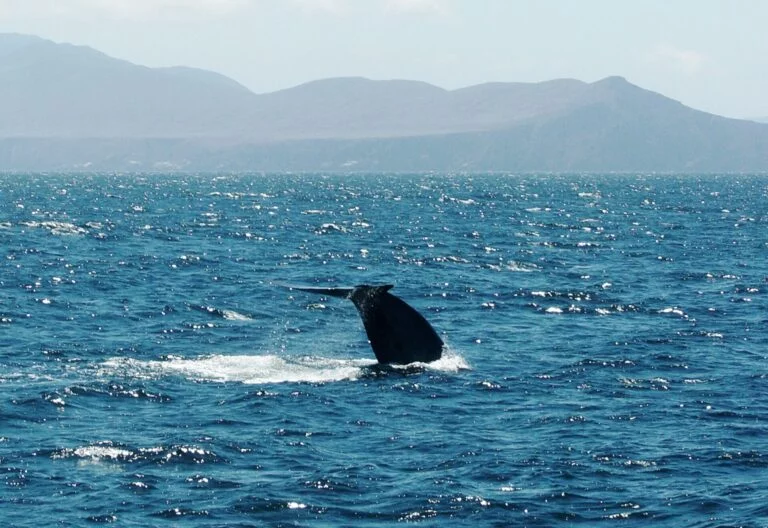
Blue whales feed almost exclusively on krill. According to NOAA Fisheries, a blue whale swims toward a dense school of krill with its mouth open, then closes its mouth around the krill while inflating its throat pleats. It pushes the trapped water out with its tongue, and the baleen plates keep the krill inside. NOAA adds that some of the biggest individuals may eat up to 6 tons of krill a day.
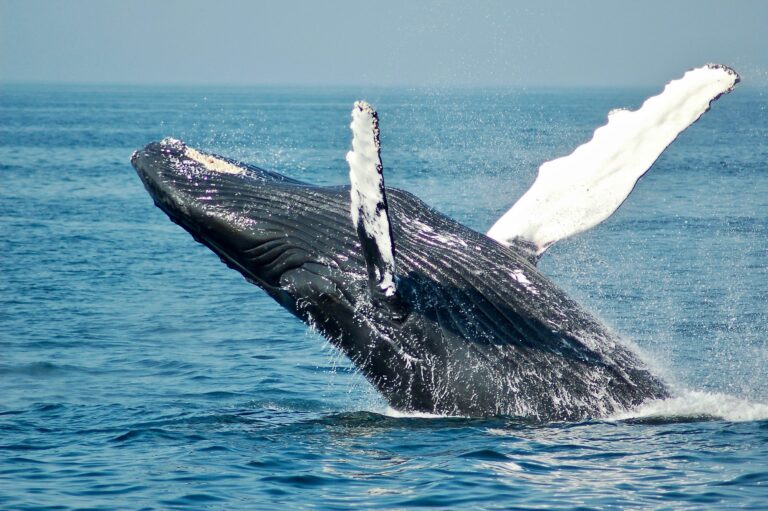
The pleats are the clever part. Humpbacks have them too. Wikipedia describes a humpback’s expandable throat pouch as having 14 to 35 grooved pleats running from the chin toward the navel, which lets the mouth stretch to hold huge volumes of water and prey. In our humpback whale profile you can see how big these animals are overall. NOAA gives them up to about 40 tons and up to about 60 feet.
Skim feeding: right whales
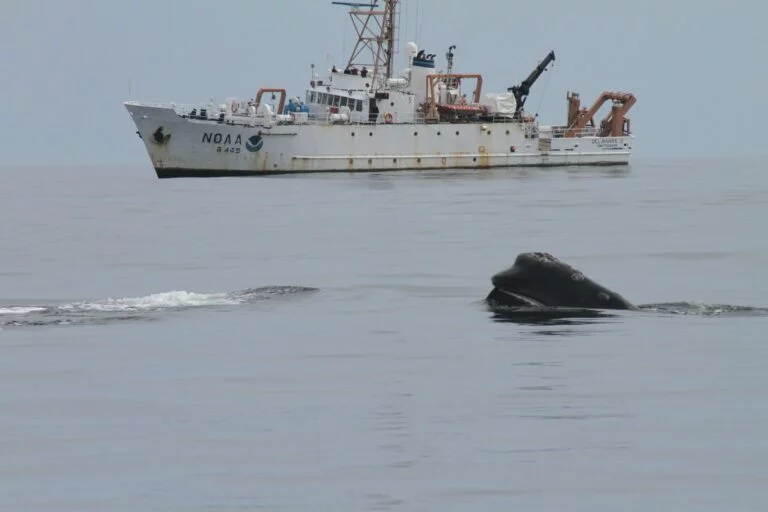
Right whales take a slower route. NOAA Fisheries says they feed by opening their mouths while swimming slowly through large patches of copepods and other zooplankton. The copepods get trapped in a tangle of hair-like material on the baleen. Observers sometimes see right whales swimming with the rostrum, the upper front part of the head, out of the water as they skim feed on dense patches of plankton.
NOAA also says right whales feed anywhere from the surface to the bottom of the water column. They simply find the patch and swim through it. Our profile of the North Atlantic right whale covers why that slow-swimming habit matters for their safety.
Bottom feeding: gray whales
The gray whale feeds on the seabed. NOAA describes them as primarily bottom feeders that eat invertebrates such as amphipods. A gray whale sucks sediment and food from the sea floor by rolling on its side and swimming slowly along. It filters the mix through 130 to 180 coarse baleen plates on each side of the upper jaw.
The feeding leaves marks. NOAA notes that gray whales often leave long trails of mud behind them and feeding pits on the seafloor. Read more in the gray whale species profile.
Bubble nets: a team method
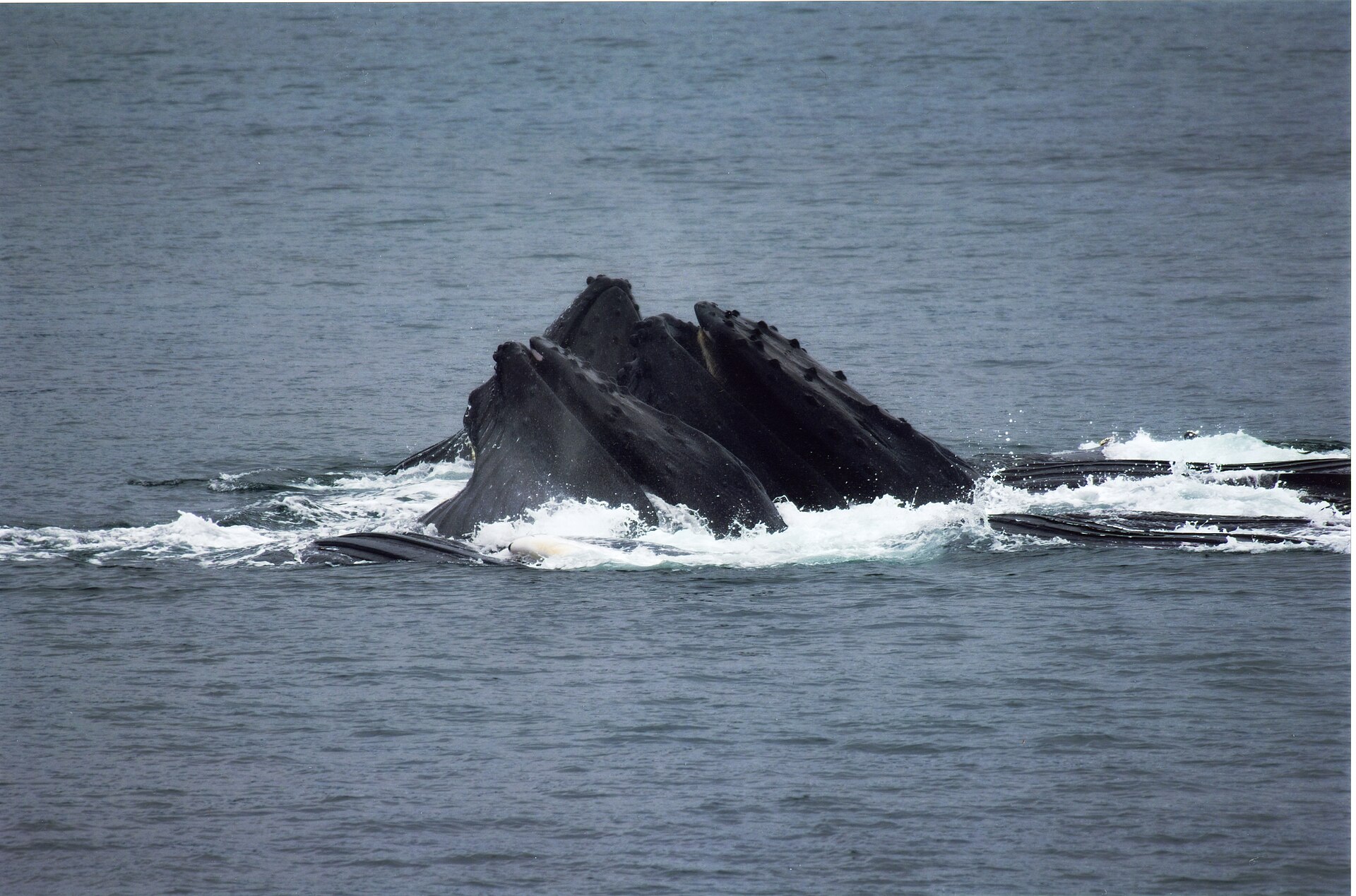
One of the most elaborate methods belongs to some humpback whales. NOAA says humpbacks use several techniques to herd, corral and disorient prey, including bubbles, sounds, the seafloor and even their pectoral fins. One of them is group coordinated bubble net feeding, where curtains of air bubbles condense the prey.
Wikipedia’s account of bubble-net feeding gives the sequence. One whale exhales beneath a school of fish and swims in an upward spiral, leaving a stream of bubbles. Other whales join, and the rising bubbles form a cylindrical net that ranges from three to thirty metres across. One whale sounds a distinct feeding call, and then the whales swim up together with their mouths open. NOAA adds that the fish are pushed toward the surface and engulfed as the whales lunge upward through the circular net.
Two details stand out.
- Wikipedia says groups of up to twenty whales may take part, and that the whales can hold up to 30 cubic metres of sea water in their mouths as they surface.
- It also describes the behaviour as learned, and says not all humpback populations do it. NOAA agrees there appears to be regional specialisation in bubble-feeding behaviours among populations.
Why feeding is so seasonal
Much of this eating happens in the warmer months. NOAA says humpbacks spend the warmer months feeding and building fat stores to sustain them through the winter, and National Geographic describes humpbacks migrating each year from summer feeding grounds near the poles to warmer winter breeding waters. The stored fat is the blubber that carries them through the lean months.
Every one of these methods solves the same problem. The ocean holds a lot of tiny food, spread thin, and a whale must collect it faster than it burns energy swimming. Baleen turns a huge mouth into a filter, and each species has found its own way to fill that filter.
Have you watched a feeding whale from a boat or from shore? Tell us what you saw in the comments.
Sources
- NOAA Fisheries, Humpback Whale
- NOAA Fisheries, Blue Whale
- NOAA Fisheries, North Atlantic Right Whale
- NOAA Fisheries, Gray Whale
- Wikipedia, Bubble-net feeding
- Wikipedia, Baleen
- National Geographic, Humpback whale
Photo: Evadb, Public domain, via commons.wikimedia.org.